Articles/Türkiye: A Journey Through the Crossroads of History and Modernity
Republic of TürkiyeAnatolian historyOttoman EmpireIstanbul economyTurkish culture
Türkiye: A Journey Through the Crossroads of History and Modernity
Exploring Türkiye: A Journey Through History, Culture, and Modernity Spanning two continents, the Republic of Türkiye serves as a unique bridge between the East and the West. From the anc...
Exploring Türkiye: A Journey Through History, Culture, and Modernity
Spanning two continents, the Republic of Türkiye serves as a unique bridge between the East and the West. From the ancient mysteries of Göbekli Tepe to the bustling, modern streets of Istanbul, the nation offers a rich tapestry of human history. Whether you are exploring its complex political landscape, its robust economy, or its diverse cultural heritage, Türkiye is a land of profound depth and continuous evolution.
Key Facts
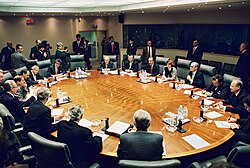
Tansu Çiller, Turkey's first female prime minister, attends a European Commission meeting in January 1994.
Capital: Ankara
Largest City: Istanbul
Official Language: Turkish
Government Type: Unitary presidential republic
Total Area: 783,562 km²
Population Estimate (Dec 2025): 86,092,168
Currency: Turkish lira (₺)
A Legacy Written in Stone: Ancient History
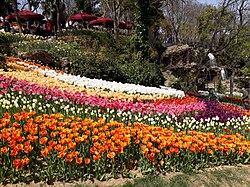
Tulip is a national flower of Turkey. Emirgan Park in Istanbul hosts Tulip Festival each year.
The history of the Anatolian peninsula is among the oldest in the world. Long before the rise of modern empires, prehistoric civilizations were establishing complex social structures. One of the most significant archaeological sites is Göbekli Tepe, which features henges erected as far back as 9600 BC, predating Stonehenge by more than seven millennia.
Some henges at Göbekli Tepe were erected as far back as 9600 BC, predating those of Stonehenge by over seven millennia.[48]: Some henges at Göbekli Tepe were erected as far back as 9600 BC, predating those of Stonehenge by over seven millennia.[48]
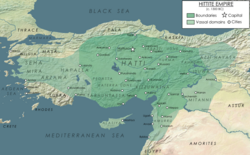
As time progressed, the region became a cradle for classical antiquity. The Hittite Empire once dominated the landscape, reaching its greatest extent around 1300 BC. Later, the Roman and Byzantine Empires left an indelible mark on the territory. The architectural grandeur of this era is still visible today in structures like the Library of Celsus in Ephesus, built by the Romans between 114 and 117 AD.
Map of the Hittite Empire at its greatest extent, with Hittite rule c. 1300 BC: Map of the Hittite Empire at its greatest extent, with Hittite rule c. 1300 BC
The Library of Celsus in Ephesus was built by the Romans in 114–117.[80]: The Library of Celsus in Ephesus was built by the Romans in 114–117.[80]
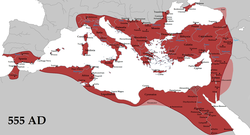
The Byzantine era, also known as the Eastern Roman Empire, reached its zenith under Justinian the Great in 555 AD. One of the most iconic symbols of this period is the Hagia Sophia in Constantinople, constructed between 532 and 537 AD.
The Eastern Roman (Byzantine) Empire in 555 under Justinian the Great, at its greatest extent: The Eastern Roman (Byzantine) Empire in 555 under Justinian the Great, at its greatest extent
The Hagia Sophia in Constantinople (now Istanbul) was built by the Eastern Roman emperor Justinian the Great in 532–537.[92]: The Hagia Sophia in Constantinople (now Istanbul) was built by the Eastern Roman emperor Justinian the Great in 532–537.[92]
From Empires to the Republic
ภาพประกอบจากบทความต้นฉบับ
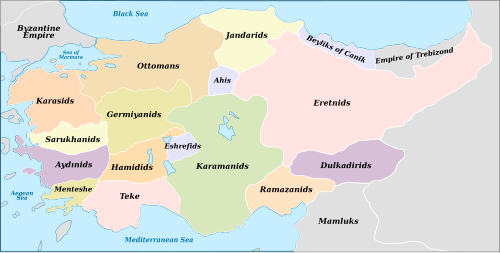
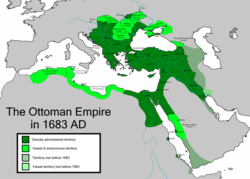
Following the era of the Seljuks and various Anatolian beyliks (small principalities), the Ottoman Empire rose to prominence. Established around 1299, the empire eventually became a global power, reaching its greatest European extent in 1683 during the Battle of Vienna. However, the 14th century saw a fragmented landscape of independent Turkish principalities before Ottoman unification.
A map of independent Turkish principalities in Anatolia during the 14th century: A map of independent Turkish principalities in Anatolia during the 14th century
The Ottoman Empire at its greatest European extent, in 1683, during the Battle of Vienna: The Ottoman Empire at its greatest European extent, in 1683, during the Battle of Vienna
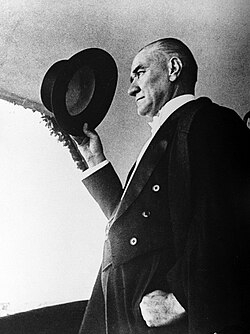
The modern era began with the War of Independence. Following the abolition of the Sultanate in 1922 and the signing of the Treaty of Lausanne in 1923, the Republic of Türkiye was officially declared on October 29, 1923. Mustafa Kemal Atatürk, the founder of the republic, led the nation into its new identity as the first President.
Mustafa Kemal Atatürk, the founder and the first President of the Turkish Republic: Mustafa Kemal Atatürk, the founder and the first President of the Turkish Republic
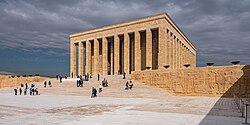
Anıtkabir in Ankara was completed in 1953 to become the mausoleum of Mustafa Kemal Atatürk.: Anıtkabir in Ankara was completed in 1953 to become the mausoleum of Mustafa Kemal Atatürk.
Geography and Natural Landscape
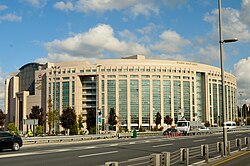
The Istanbul Justice Palace in Istanbul
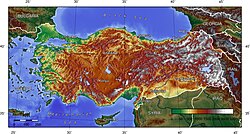
Türkiye's geography is diverse and complex. Approximately 97% of the country lies in Asia Minor (Anatolia), while 3% is located in Europe (Thrace). The landscape is defined by varied topography and significant tectonic activity.
Topographic map of Turkey: Topographic map of Turkey
Tectonic map of Turkey.[188] Straight lines and lines with triangles denote different types of faults, such as North Anatolian Fault and East Anatolian Fault.: Tectonic map of Turkey.[188] Straight lines and lines with triangles denote different types of faults, such as North Anatolian Fault and East Anatolian Fault.
For travelers, the natural beauty of the country is a major draw. The Lycian Way offers a stunning 760-kilometer hiking path through Southwestern Turkey, while the Bodrum peninsula serves as a high-end vacation spot within the Turkish Riviera.
The Lycian Way is a 760 kilometers (470 mi) long hiking path in Southwestern Turkey.[68]: The Lycian Way is a 760 kilometers (470 mi) long hiking path in Southwestern Turkey.[68]
Bodrum in Turkish Riviera. Bodrum peninsula is a high-end spot for vacationers.[323]: Bodrum in Turkish Riviera. Bodrum peninsula is a high-end spot for vacationers.[323]
Modern Society and Governance
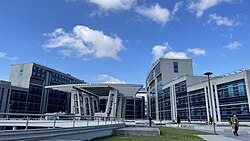
The Anadolu Justice Palace in Istanbul
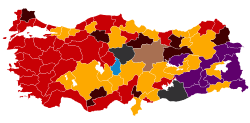
Today, Türkiye is a unitary presidential republic. The current administration is led by President Recep Tayyip Erdoğan, with Cevdet Yılmaz serving as Vice President. The nation's political landscape is characterized by a vibrant, though sometimes contested, democratic process, including various political parties and local elections.
Results of the 2024 Turkish local elections: Results of the 2024 Turkish local elections
Demographically, the population is predominantly Turkish (70–75%), with significant Kurdish (19%) and other minority groups. While Turkish is the official language, several other languages are commonly spoken, including Kurdish, Zaza, Arabic, and Greek.
Percentage of ethnic Kurds in Turkey by region (2010)[375]: Percentage of ethnic Kurds in Turkey by region (2010)[375]
Areas with speakers of Turkic languages: Areas with speakers of Turkic languages
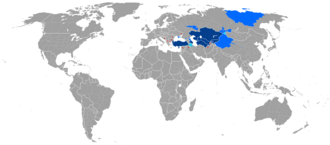
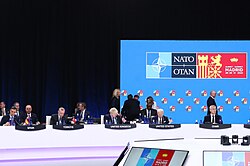
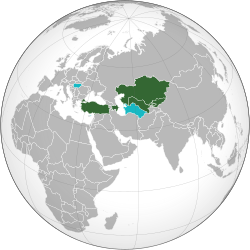
The nation also maintains a significant role in international relations. Türkiye has been a member of NATO since 1952, possesses the second-largest army in the alliance, and hosts the Allied Land Command headquarters. It is also a member of the Organization of Turkic States.
Turkey has been a member of NATO since 1952, has its second largest army and is the host of the Allied Land Command headquarters.: Turkey has been a member of NATO since 1952, has its second largest army and is the host of the Allied Land Command headquarters.
Members and observers of the Organization of Turkic States: Members and observers of the Organization of Turkic States
Economy, Science, and Technology
Women demonstrating and asking for non-interference with their clothing in Kadıköy, Istanbul[298]
Türkiye possesses a significant economy, with a projected 2026 nominal GDP of $1.640 trillion. The country's economic engine is heavily driven by its largest city, Istanbul, which serves as the nation's financial and economic center.
Turkey's nominal gross domestic product between 1960 and 2023 in 2015 constant US dollars[310][311]: Turkey's nominal gross domestic product between 1960 and 2023 in 2015 constant US dollars[310][311]
Istanbul is Turkey's largest city[371] and its economic and financial center.: Istanbul is Turkey's largest city[371] and its economic and financial center.
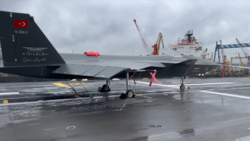
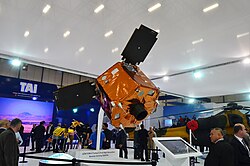
Technological advancement is evident in Türkiye's growing aerospace and defense sectors. The country produces advanced equipment, such as the TAI TF Kaan fighter jet and the Baykar Kızılelma UCAV. Furthermore, Türkiye maintains its own satellite capabilities through the Göktürk and Türksat series.
The TAI TF Kaan is currently being produced by Turkish Aerospace Industries for the Turkish Air Force.[274][275][276]: The TAI TF Kaan is currently being produced by Turkish Aerospace Industries for the Turkish Air Force.[274][275][276]
Baykar Kızılelma UCAV on TCG Anadolu: Baykar Kızılelma UCAV on TCG Anadolu
Göktürk-1, Göktürk-2 and Göktürk-3 are the Earth observation satellites of the Turkish Ministry of National Defense, while state-owned Türksat operates the Türksat series of communications satellites.: Göktürk-1, Göktürk-2 and Göktürk-3 are the Earth observation satellites of the Turkish Ministry of National Defense, while state-owned Türksat operates the Türksat series of communications satellites.
Economic and Demographic Overview
Summary of Key National Indicators
Indicator
Value / Detail
Total Area
783,562 km²
Population (2025 Est.)
86,092,168
GDP (Nominal 2026 Est.)
$1.640 Trillion
GDP (PPP 2026 Est.)
$4.025 Trillion
HDI (2023)
0.853 (Very High)
Culture and Lifestyle
Istanbul Pride was organized in 2003 for the first time. Since 2015, parades in Istanbul have been denied permission by the government.[302]
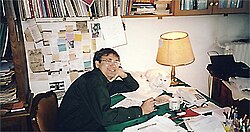
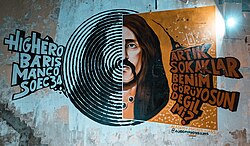
Turkish culture is a rich blend of traditions, expressed through cuisine, music, and the arts. Turkish coffee, often enjoyed with Turkish delight, is recognized as a UNESCO-listed intangible cultural heritage. The nation also boasts a vibrant arts scene, from the literary works of Nobel laureate Orhan Pamuk to the legendary Anatolian rock music pioneered by Barış Manço.
Nobel-laureate Turkish novelist Orhan Pamuk and his Turkish Angora cat at his personal writing space: Nobel-laureate Turkish novelist Orhan Pamuk and his Turkish Angora cat at his personal writing space
Barış Manço was a Turkish rock musician and one of the founders of the Anatolian rock genre.: Barış Manço was a Turkish rock musician and one of the founders of the Anatolian rock genre.
Turkish coffee with Turkish delight. Turkish coffee is a UNESCO-listed intangible cultural heritage of Turks.[490][491]: Turkish coffee with Turkish delight. Turkish coffee is a UNESCO-listed intangible cultural heritage of Turks.[490][491]
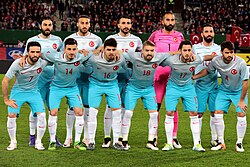
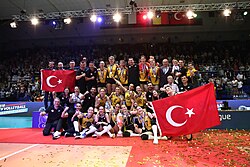
Sports also play a major role in social life, with high levels of engagement in football (soccer) and international success in women's volleyball, exemplified by teams like VakıfBank S.K.
Turkey at UEFA Euro 2016: Turkey at UEFA Euro 2016
VakıfBank S.K. is one of the best women's volleyball team in the world, having won the FIVB World Championship four times and the CEV Champions Cup six times.: VakıfBank S.K. is one of the best women's volleyball team in the world, having won the FIVB World Championship four times and the CEV Champions Cup six times.
Frequently Asked Questions
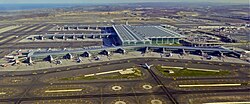
Installed electricity capacity in Turkey between 2000 and 2024 in terms of gigawatts[333]Istanbul Airport is one of the top 10 busiest airports in the world.Enrollment rates for primary, secondary and tertiary education in Turkey between 1971 and 2022. Completion rates for primary and lower secondary education.[431]Başakşehir Çam and Sakura City Hospital in Istanbul. It contains 2,068 seismic base isolation units to withstand earthquakes.[445]Süreyya Opera House is on the Asian side of Istanbul and Atatürk Cultural Center is the main opera house on the European side. Zorlu PSM is the city's largest performing arts theater and concert hall.
What is the capital of Türkiye?
The capital of Türkiye is Ankara.
Which city is the largest in Türkiye?
Istanbul is the largest city in Türkiye and serves as its economic and financial hub.
What are the main ethnic groups in Türkiye?
According to 2016 data, the population is approximately 70–75% Turkish and 19% Kurdish, with 6–11% comprising other minorities.
Is Türkiye a member of NATO?
Yes, Türkiye has been a member of NATO since 1952 and holds the second-largest army within the alliance.
What is the official language spoken in Türkiye?
The official language is Turkish, though several other languages such as Kurdish, Zaza, and Arabic are also commonly spoken.
![Some henges at Göbekli Tepe were erected as far back as 9600 BC, predating those of Stonehenge by over seven millennia.[48]](/images/a2/86/a2861ac93be5b67811ee6b45a8f14211d6de17af793c9e147566458aa589ed6e.jpg)
![The Library of Celsus in Ephesus was built by the Romans in 114–117.[80]](/images/2a/e2/2ae2d78c484aa7ab2e0bdb9eebf894e68076aeb3e89537a81037f57ff2f5bffa.jpg)
![The Hagia Sophia in Constantinople (now Istanbul) was built by the Eastern Roman emperor Justinian the Great in 532–537.[92]](/images/0d/7c/0d7c0b113fccb9e7a0dd9bd9780af2e96a197c905a4c2777d352018dea6e13a9.jpg)

![Tectonic map of Turkey.[188] Straight lines and lines with triangles denote different types of faults, such as North Anatolian Fault and East Anatolian Fault.](/images/18/8b/188b9593101db5675f2d944b19cce30f10e32ee0939ba0e3c648bc2ac3343c43.jpg)
![The Lycian Way is a 760 kilometers (470 mi) long hiking path in Southwestern Turkey.[68]](/images/f3/af/f3af52f7defee3f4ce4fde10d2b038887ae69a9ebfb49b2e81769a3c9b5d64d8.jpg)
![Bodrum in Turkish Riviera. Bodrum peninsula is a high-end spot for vacationers.[323]](/images/d4/4e/d44e7644114ab0de6f25613b71ca7047db5633a2000ae4931bb9f7bf1b9c2d73.jpg)
![Percentage of ethnic Kurds in Turkey by region (2010)[375]](/images/20/f3/20f3f2e4afb8a1b78b3843f93727a5e24b6168fde9fa410d2625b5c4575e876f.png)
![Women demonstrating and asking for non-interference with their clothing in Kadıköy, Istanbul[298]](/images/8d/a9/8da9822eb321ff1501daa7924cca5d8b66c33cc1413bd5e0c646b352b94663d3.jpg)
![Turkey's nominal gross domestic product between 1960 and 2023 in 2015 constant US dollars[310][311]](/images/48/5c/485c54d65fc8b6129b57486ecfee42dc668d35df269be6712b5a3b5c3e19455a.png)
![Istanbul is Turkey's largest city[371] and its economic and financial center.](/images/00/92/009282ef6a08af6cac8cb1e3764e5e17b9284091d54975e9baca3c9b16157200.jpg)
![The TAI TF Kaan is currently being produced by Turkish Aerospace Industries for the Turkish Air Force.[274][275][276]](/images/7e/aa/7eaa07de070505ed2940631306db4bd575c18bdecc91c91a3474eac8b7adefa9.jpg)
![Istanbul Pride was organized in 2003 for the first time. Since 2015, parades in Istanbul have been denied permission by the government.[302]](/images/96/36/96367f3dba75dbd122642a54077025ad750459f048a7de7383c024419b26bdc7.jpg)
![Turkish coffee with Turkish delight. Turkish coffee is a UNESCO-listed intangible cultural heritage of Turks.[490][491]](/images/bc/fe/bcfe333e0210c2c97e1e9578c5e3b545a15827484ffab896855be28520944c3d.jpg)
![Installed electricity capacity in Turkey between 2000 and 2024 in terms of gigawatts[333]](/images/4f/99/4f994d9e4130335a0c56d30dad295dddd64e5b1dc6e0d7cbda0b75af9f48c91b.png)
![Enrollment rates for primary, secondary and tertiary education in Turkey between 1971 and 2022. Completion rates for primary and lower secondary education.[431]](/images/d8/5e/d85e6f64eedc11e468dbd4b743133d7b03be0d2ab39cd1bf2d4f20ce4faeea9b.png)
![Başakşehir Çam and Sakura City Hospital in Istanbul. It contains 2,068 seismic base isolation units to withstand earthquakes.[445]](/images/13/0a/130a349a813072bdf9416882dc4d325d3488d038d6d274ac83a170919ce6d8d7.jpg)
