River Confluences: The Science and Geography of Merging Waterways
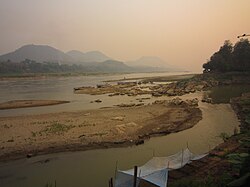
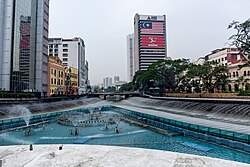
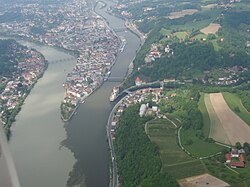
In geography, a confluence (or conflux) occurs when two or more watercourses join to form a single channel. These junctions are more than simple meeting points; they are dynamic environments that shape the landscape, influence local ecosystems, and often serve as pivotal hubs for human civilization.
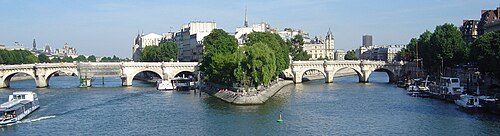
Confluences typically manifest in three primary configurations. The most common is where a tributary joins a larger main stem. In other cases, two streams meet to create the source of a river with an entirely new name. Finally, a confluence can occur when two separated channels of a single river, which had previously split to form a river island, rejoin downstream.
Key Facts
- Definition: The point where two or more flowing bodies of water merge into one.
- Scientific Importance: Studied in hydrology for flow patterns and in ecology for habitat shifts.
- Hydrodynamics: Divided into six distinct confluence flow zones (CFZ).
- Cultural Value: Often serve as sites for cities, spiritual pilgrimage, and international borders.
- Versatility: The term can also apply to non-riverine bodies like canals or the merging of glaciers.
The Science of Confluences
Hydrology and Ecology
Hydrology focuses on the characteristic flow patterns of confluences and how they create specific physical features such as erosion patterns, bars, and scour pools. Scientists often use mathematical models to predict these water flows and their environmental consequences.
From an ecological perspective, confluences are critical for the distribution of living organisms. As stream flow increases and slopes decrease downstream of a confluence, there is a corresponding shift in habitat characteristics, which dictates where various species can thrive.
Confluence Flow Zones (CFZ)
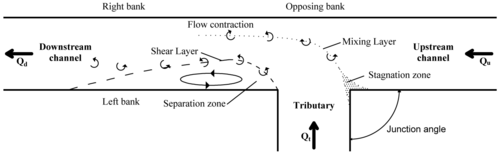
The hydrodynamic behavior of water at a confluence is complex and can be categorized into six identifiable distinct zones:
- Stagnation zone: Areas where water velocity drops significantly.
- Flow deflection zone: Where the main flow is pushed aside by the incoming tributary.
- Flow separation / recirculation zone: Areas where the flow detaches from the bank, often creating eddies.
- Maximum velocity zone: The region where the combined water reaches its highest speed.
- Flow recovery zone: Where the flow stabilizes after the initial turbulence of the merge.
- Shear layers: The boundaries between water masses moving at different velocities.
Notable Global Confluences

Asia and Africa
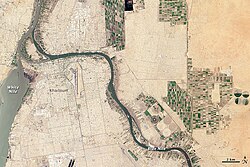
Many of the world's most significant rivers begin or are defined by confluences. In Africa, the capital of Sudan, Khartoum, sits at the meeting of the White Nile and the Blue Nile. In Nigeria, the Benue River flows into the Niger at Lokoja.
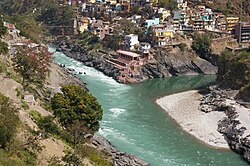
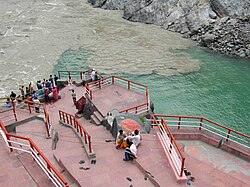
In Asia, the Ganges originates at the confluence of the Bhagirathi and Alaknanda rivers in Devprayag, India. Another site of immense spiritual importance is the Triveni Sangam near Allahabad, where the Yamuna joins the Ganges; Hindu belief holds this as a triple confluence, including the metaphysical Sarasvati river.
The Americas
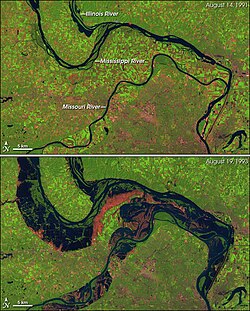
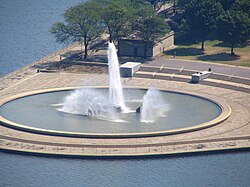
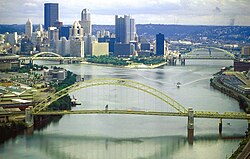
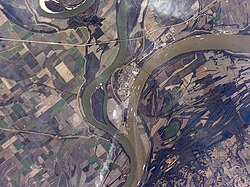
North America features massive river systems defined by confluences. In the Mississippi basin, the Missouri River joins the Mississippi just north of St. Louis, while the Ohio River merges with the Mississippi at Cairo, Illinois. The Ohio River itself is formed in Pittsburgh by the confluence of the Monongahela and Allegheny rivers.
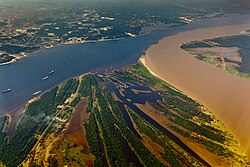
In South America, the city of Manaus, Brazil, is located near the "Meeting of Waters," where the dark Rio Negro and the turbid Amazon (Rio Solimões) merge.
Europe
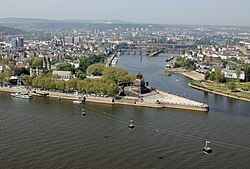
Europe's river networks are equally vital. The Rhine is a major artery of traffic, with key ports located at its confluences with the Ruhr and Neckar. In Germany, the Mosel flows into the Rhine at Koblenz—a city whose name is derived from the Latin Confluentes.
Summary of Major Confluences
| Rivers Involved | Location | Significance |
|---|---|---|
| White Nile & Blue Nile | Khartoum, Sudan | Formation of the Nile |
| Monongahela & Allegheny | Pittsburgh, USA | Formation of the Ohio River |
| Bhagirathi & Alaknanda | Devprayag, India | Origin of the Ganges |
| Missouri & Mississippi | St. Louis, USA | Major North American waterway merge |
| Rio Negro & Rio Solimões | Manaus, Brazil | Distinct water color contrast |
Frequently Asked Questions

What is the difference between a confluence and a river mouth?
A confluence is where two or more flowing watercourses join to form a single channel. A river mouth is the end of a river where it flows into a larger, typically stationary or tidal body of water, such as an ocean, sea, or lake.
Can confluences happen underground?
Yes. In karst topography—landscapes formed from soluble rocks—rivers can flow underground. An example is the Planina Cave in Slovenia, where the Pivka and Rak rivers merge to form the Unica.
Do confluences always involve rivers?
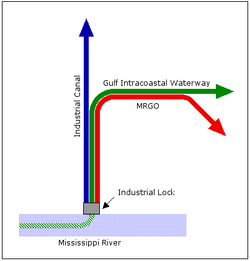
While most common with rivers, the term can describe the meeting of tidal bodies, canals (such as the Industrial Canal in New Orleans), or even the merging of two glaciers.
Why are confluences often sites for cities?
Confluences provide strategic advantages for transportation, trade, and water access, making them natural hubs for urban development and historical settlements.