Revolutions of 1848: The Springtime of the Peoples
Between January 1848 and October 1849, Europe was swept by a wave of political upheaval known as the Revolutions of 1848, or the "Springtime of the Peoples." This period represents the most widespread revolutionary wave in European history, characterized by a simultaneous eruption of protests, uprisings, and demands for systemic change across the continent.
These revolutions were not a single coordinated event but a series of interconnected explosions triggered by a volatile mix of social discontent, economic crisis, and a growing desire for national self-determination. While many of the immediate political gains were short-lived, the era left a permanent mark on the social and cultural fabric of Europe.
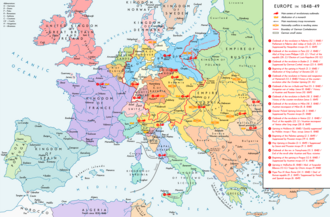
Key Facts
![Galician Massacre (Polish: Rzeź galicyjska) by Jan Lewicki depicts the fictional rewarding of Polish peasants by Austrian authorities for massacring their lords, who had attempted an uprising to reestablish an independent Polish state.[10]](/images/ed/8f/ed8f0d6801be27a2d1b4dbfd9f2b805a47f609a66e184c4bf6b6659f473de29c.png)
- Timeline: 12 January 1848 to 4 October 1849.
- Scope: The most extensive revolutionary wave in European history.
- Primary Goals: Political reform, national independence, and social justice.
- Key Outcomes: Significant social and cultural shifts, though many political regimes were eventually restored.
- Final Collapse: The movement ended with the surrender of Hungarian forces at Komárom in October 1849.
The Roots of Rebellion
Social and Economic Discontent
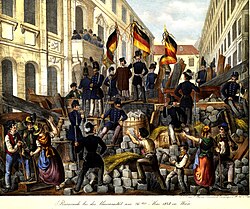
The revolutions were fueled by deep-seated grievances across different strata of society. In rural areas, peasants struggled against oppressive land systems. In the cities, urban workers faced precarious conditions and wage disputes. For example, silk weavers in Lyon revolted in 1831 and 1834 under the motto "Live working or die fighting!"
![Silk weavers in Lyon revolted in 1831 and 1834 in response to the refusal of their employers to pay agreed rates for their labour. Their motto was "Live working or die fighting!" (French: Vivre en travaillant, mourir en combattant).[20]](/images/15/e4/15e4b7e98188145e9daa9a3629b536cb7b1b6a9a66dbf2b57157aafdae132fcf.jpg)
The educated middle class, meanwhile, sought greater political participation and the end of autocratic rule. This anti-clerical and anti-aristocratic sentiment was widespread, as the nobility and clergy were seen as oppressors of the common people.
![An anti-clerical and anti-aristocratic print, published in Germany in 1845. The text reads: "Eyes Open!!!—Neither the nobility, nor the clergy will oppress us any longer; they have broken the backs of the people for too long."[39]](/images/9d/ef/9defe93ef2e4c3c22cf2b8e76c2e0c4560ae169d7e8f112f71563c962f3777e6.jpg)
Economic Crisis and Famine
Economic instability acted as a catalyst for the unrest. A critical factor was the spread of the potato blight in 1845, which caused widespread famine and desperation across Europe, particularly in Ireland and Central Europe.
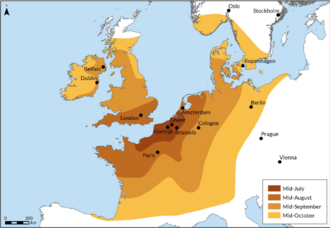
Chronology of the Uprisings
The Initial Wave (January–May 1848)
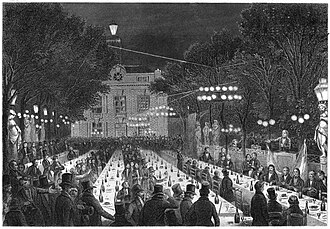
The spark ignited in France, where public festivities and political banquets—the campagne des banquets—became vehicles for political participation. The success of the French revolution provided the momentum for other nations.
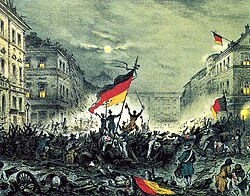
In the German states, popular demonstrations began in Baden on 27 February. This led to the "March demands" (Märzforderungen), which called for the creation of a national parliament. By mid-March, revolutions had successfully seized the capitals of Vienna and Berlin.
Counter-Revolution and the Second Wave (1849)
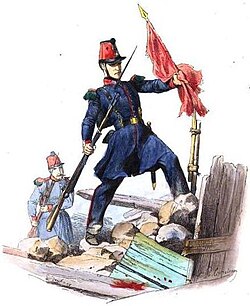
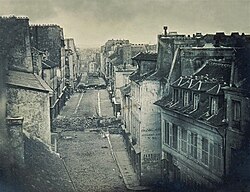
The initial successes were followed by a period of reaction. In France, the "June Days" uprising saw workers clash with the government, marked by the appearance of red flags—the symbol of the working class—on the barricades.
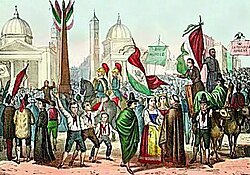
By 1849, the revolutionary tide began to recede. The Roman Republic was defeated in July following French intervention, and Venice surrendered in August after a prolonged siege.
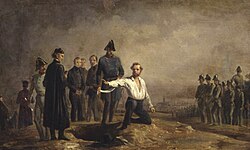
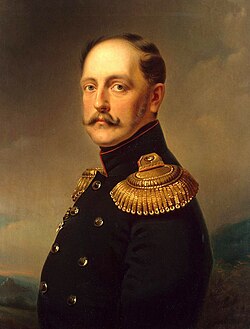
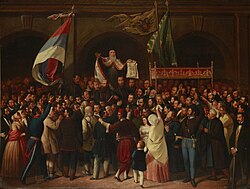
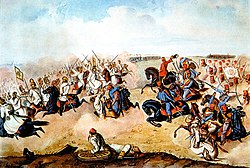
The final stand occurred in Hungary. Despite a fierce war of independence, the entry of Russian forces under Nicholas I—often called the "gendarme of Europe"—forced the Hungarian revolutionaries to surrender at Világos on 13 August. The final holdouts at the fortress of Komárom surrendered by 5 October 1849.
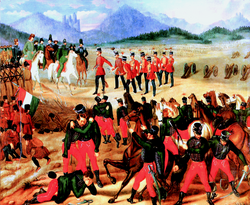
Regional Impacts and Events
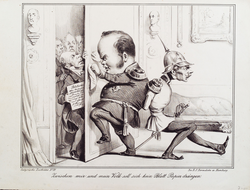
France and the German States
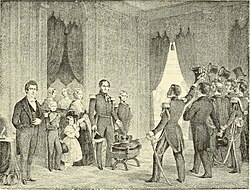
France saw the symbolic burning of Louis Philippe I's throne, proclaiming liberty, equality, and fraternity. In Germany, the Frankfurt National Assembly was convened as the first national parliament, though it struggled to reconcile the desires of the people with the stubbornness of monarchs like Frederick William IV of Prussia.
![The symbolic burning of the throne of Louis Philippe I on the Place de la Bastille. On the throne was inscribed: "The People of Paris to All Europe: Liberty, Equality, Fraternity. 24 February 1848"[136]](/images/82/99/8299246376fd533a04444b63a67c70ec348f83870c82d62fc48f97f05358b684.jpg)
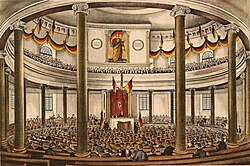
The Habsburg Monarchy and Beyond
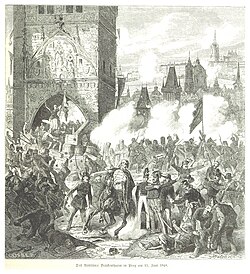
The Austrian Empire faced simultaneous uprisings in Hungary, the Czech lands, and Italy. In Milan, the "Five Days of Milan" saw intense street fighting, while in Prague, the June Uprising injected political energy into the Czech National Revival.
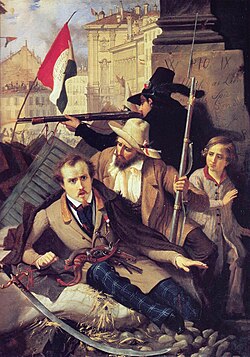
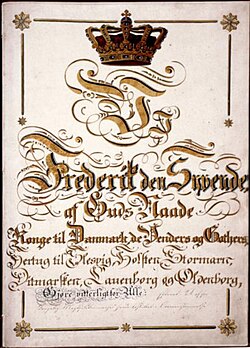
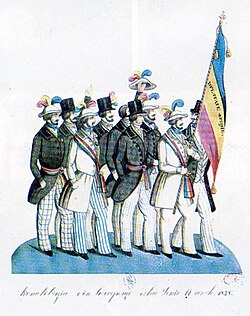
Beyond the mainland, the spirit of 1848 reached Denmark, where the first constitution was proclaimed in 1849, and the Romanian Principalities, where revolutionaries carried the tricolour in Bucharest.
| Region/Country | Key Event/Outcome | Primary Driver |
|---|---|---|
| France | Establishment of Second Republic | Political reform & workers' rights |
| German States | Frankfurt National Assembly | National unification & liberalism |
| Hungary | War of Independence | Autonomy from Habsburgs |
| Italian States | Roman Republic / Milan Uprisings | Unification & anti-Austrian sentiment |
| Denmark | 1849 Constitution | Constitutional reform |
Frequently Asked Questions
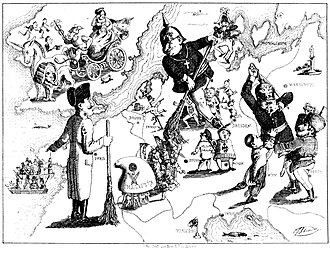
![Cariacature of Frederick William IV, satirizing his rejection of the imperial crown offered by the Frankfurt National Assembly; he privately likened the crown to "a dog collar, binding [him] to the revolution of '48'".[156]](/images/b3/62/b362eecf69f9184680eddcaf01da1d150d776efe667d54863562612fac39cdd9.jpg)
What was the "Springtime of the Peoples"?
It was a series of political revolutions that swept across Europe between 1848 and 1849, driven by demands for democracy, national independence, and social reform.
Why did the revolutions of 1848 ultimately fail?
While they achieved early successes, the movements were often divided internally between moderate liberals and radical socialists. This fragmentation allowed conservative monarchies, supported by military force (such as the Russian intervention in Hungary), to regain control.
What role did the potato blight play?
The potato blight caused a massive agricultural crisis and famine starting in 1845, which increased rural poverty and urban migration, creating a desperate population more prone to revolutionary action.
What was the significance of the Frankfurt National Assembly?
It was the first attempt to create a unified, democratic German national parliament. Although it failed to establish a lasting state because King Frederick William IV rejected the imperial crown, it set the stage for future German unification.
Which country was the last to see its revolutionary regime fall?
Hungary was the last revolutionary state to fall, with the final military holdouts at the fortress of Komárom surrendering in early October 1849.