Rape of Belgium: War Crimes and Civilian Suffering in WWI
During the opening stages of World War I, the German Empire's invasion of Belgium led to a period of systemic violence and devastation known as the Rape of Belgium. Spanning from August 1914 to November 1918, this era was marked by severe war crimes, the displacement of millions, and a campaign of terror against the Belgian population.
The conflict was not merely a clash of armies but a brutal encounter between military forces and a civilian population caught in the crossfire. The resulting atrocities became a focal point for international condemnation and a powerful tool for wartime propaganda.
Key Facts
- Duration: August 1914 – November 1918.
- Direct Deaths: Approximately 23,700 Belgian civilians.
- Indirect Deaths: Approximately 90,000.
- Displacement: 1.5 million Belgians were forced to flee their homes.
- Forced Labour: 120,000 individuals were coerced into forced work.
- Perpetrator: The German Empire.
War Crimes and Civilian Victimization
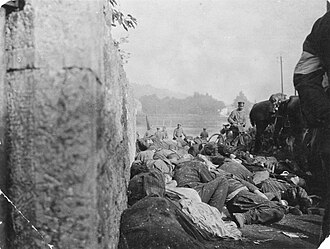
The German occupation was characterized by a variety of attack types, including mass murder, summary executions, and forced migration. Civilians were frequently targeted in an effort to suppress resistance and instill fear. These acts ranged from the execution of local notables to the widespread internment of the population.
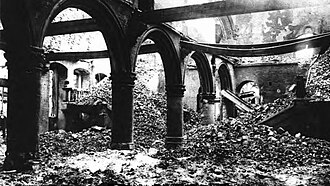
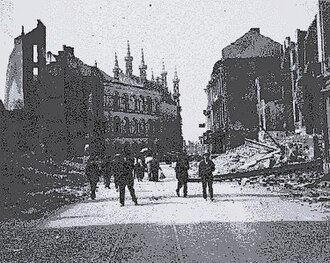
One of the most notorious episodes was the Sack of Leuven, where the city suffered immense destruction. The German army burned the library of the Catholic University of Leuven, destroying irreplaceable cultural heritage.
Industrial Dismantlement
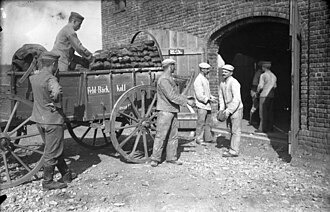
Beyond physical violence, the occupation involved the systematic stripping of Belgian resources. This industrial dismantlement served the German war effort, including the establishment of industrial bakeries near the Ypres Salient to feed the German Army.
Wartime Propaganda and Public Perception
Reports of German atrocities were widely publicized by Allied powers to galvanize support and paint the German military as "Huns"—a term used to imply barbarism. This was achieved through newspaper serializations, such as Hugh Simons Gibson's The Rape of Belgium, and provocative illustrations.
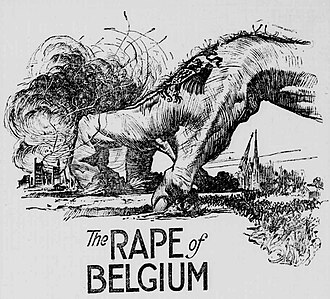
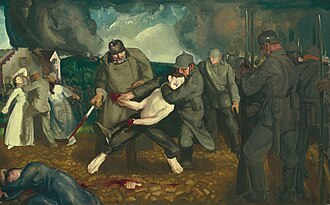
Artistic depictions of the era often highlighted the vulnerability of women and children. Cartoons and oil paintings, such as those by George Bellows and Alanson Burton Walker, depicted severed limbs and impaled civilians to evoke horror and moral outrage in the global public.
![In the foreground, a silhouette of a Hun on the move wearing a Pickelhaube (German Army's spiked leather helmet). In his left hand, a Gewehr 98-like rifle and with his right, he is pulling the left hand of a distressed young civilian woman – in the background, the carnage of a city in flames in a haze of smoke.Illustrated by Ellsworth Young (1866–1952).[31]](/images/58/30/5830c9aee1afed22221ddb612c0f458f713fc0ef18bc93274eb866e1db1e32df.jpg)
![Cartoon by Alanson Burton Walker (1878–1947), published in Life (July 29, 1915), depicting a German soldier carrying the impaled bodies of Belgian civilians on his bayonet – man, woman holding a newborn, and two children – as a commentary on reports of German atrocities during World War I.[32]](/images/37/96/3796cbdab41b8f827cca6639282849f3e172f73bcbd5ba3d6232a7ef3a526dc9.png)
![The Valour of German Culture 1914 (aka Kultur Panel),[b] 1915, terracotta bas-relief by William Baxter (1855–1927), 128 Pitt Street, Bonnington, Edinburgh – depicting eighteen figures: German soldiers ("Huns") committing acts of violence against Belgian civilians, including women and children. One soldier is wearing an Iron Cross.](/images/9b/2f/9b2fe1849fcd5f6c54e2198b1d20b8876125e3c2e1f54fe3c820ac50c7443abe.jpg)
Analysis of the Atrocities
Modern historical studies by scholars such as Larry Zuckerman, Jeff Lipkes, and Ulrich Keller have sought to identify the contributory factors that led to such widespread violence. Rather than a single directive, the atrocities are often attributed to a combination of systemic and situational failures.
Contributing Factors
- Lack of Discipline: Inexperience among soldiers and widespread drunkenness.
- Panic and Confusion: "Friendly fire" incidents and collisions with Belgian and French rearguards.
- Military Rage: Frustration over the stubborn Belgian defense during the Battle of Liège.
- Ideological Bias: Animosity toward Roman Catholicism and a refusal to view Belgians as a people entitled to defend themselves.
- Logistical Failure: A breakdown in German logistics that led to uncontrolled looting.
Summary of Impact
The following table summarizes the human and material cost of the German occupation of Belgium.
| Category | Estimated Figure | Nature of Impact |
|---|---|---|
| Direct Deaths | 23,700 | Mass murder and summary executions |
| Indirect Deaths | 90,000 | Disease, starvation, and hardship |
| Displaced Persons | 1.5 Million | Forced migration/refugees |
| Forced Labourers | 120,000 | Coerced industrial/military work |
Frequently Asked Questions
What was the "Rape of Belgium"?
It refers to the series of war crimes, mass murders, and systemic violence committed by the German Empire against the Belgian civilian population during World War I between 1914 and 1918.
Why did the German army target civilians?
Factors included rage over the defense of Liège, a lack of military discipline, inadequate field service regulations regarding civilians, and a perception that Belgians were not entitled to defend their territory.
What happened in the city of Leuven?
Leuven experienced a brutal "sack," which included the burning of the city and the destruction of the Catholic University of Leuven's library.
How was this event used in propaganda?
Allied forces used reports and graphic illustrations of the atrocities to depict German soldiers as barbarians, helping to mobilize public opinion and support for the war effort in countries like the United States and Great Britain.
What were the long-term human costs?
Beyond the approximately 113,700 total deaths (direct and indirect), the occupation resulted in the displacement of 1.5 million people and the forced labor of 120,000 Belgians.