Ram Manohar Lohia and the Indian Nationalist Movement (1930–1947)
Ram Manohar Lohia was a pivotal figure in India's struggle for independence, known for his strategic brilliance, socialist convictions, and unwavering commitment to freedom. From his early days as a student in Europe to his leadership during the Quit India Movement, Lohia played a critical role in challenging both British colonial rule and the Portuguese administration in Goa.
Early Activism and the League of Nations
Lohia's political awakening began while studying economics at Berlin University in the Weimar Republic. It was here that he formed a lasting friendship with Julião Menezes, a Goan medical student. Together, they became active members of the Indian Students' Union in Berlin.
In 1930, the duo took a bold stand during a session of the League of Nations—an international organization established to maintain world peace. From the visitors' gallery, Lohia and Menezes distributed leaflets denouncing Ganga Singh, the Maharaja of Bikaner. Ganga Singh had been sent by the British Crown as an Indian representative to the League, and the leaflets served as a public protest against this colonial appointment.
The Rise of the Congress Socialist Party
Returning to India, Lohia focused on integrating socialist ideals into the nationalist struggle. In 1934, he helped found the Congress Socialist Party (CSP) and served as the editor of its official publication, the Congress Socialist.
His organizational skills were recognized by Jawaharlal Nehru, who appointed Lohia as the secretary of the Foreign Department of the All India Congress Committee (AICC) in 1936. However, by 1938, Lohia resigned from this position to further develop his own political philosophy. During this period, he began critically analyzing the ideologies of the Congress leadership, which was heavily influenced by Mahatma Gandhi, as well as the Communists who had joined the CSP.
Anti-War Efforts and Political Friction
The onset of World War II created a strategic divide within the Indian independence movement. Lohia launched anti-war propaganda, arguing that the British government would never grant India its freedom if the Congress Party cooperated with them in the war effort.
This stance led to his arrest in June 1940, resulting in a two-year prison sentence for delivering anti-war speeches. While Lohia and Gandhi both opposed the Cripps Mission—a failed British attempt to secure Indian cooperation in the war—Lohia found himself at odds with Nehru. Although Nehru desired independence, he refused to adopt an anti-war position. This tension culminated in Lohia publicly criticizing Nehru during the May 1942 AICC session in Allahabad.
The Quit India Movement and Congress Radio
When the Quit India Movement began in 1942, the arrest of top leaders like Gandhi and Nehru left the movement without a central command. Lohia stepped into this vacuum, becoming a primary leader of the resistance.
To keep the movement alive, Lohia established Congress Radio, a series of clandestine (secret) radio stations in Bombay and Calcutta. He viewed these broadcasts as essential for disseminating information to the masses and sustaining a leaderless movement. His activities eventually led to his capture and imprisonment in Lahore Fort in 1944. He was finally released on April 11, 1946, alongside Jayaprakash Narayan, who had been organizing a guerilla force.
The Goa Revolution and Civil Disobedience
Shortly after his release, Lohia reunited with Julião Menezes in Bombay. In June 1946, Lohia traveled to Menezes' home in Goa to recuperate, but his arrival sparked a surge of nationalist fervor among local freedom fighters and the general public.
Lohia and Menezes organized a civil disobedience movement to challenge Portuguese colonial rule. On June 18, 1946, they defied a ban on public meetings and addressed a crowd of 600–700 people at a maidan in Margao. Despite a baton charge by the Portuguese police and Lohia's subsequent arrest, the event became a landmark in Goan history.
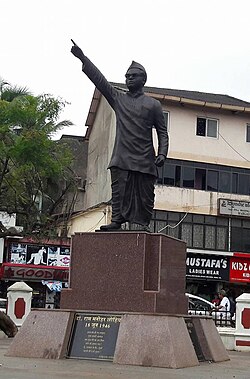
The site of this gathering is now known as Lohia Maidan, and June 18 is commemorated annually as Goa Revolution Day. Although Gandhi publicly supported these efforts, Lohia's return to Goa in September 1946 resulted in a ten-day imprisonment at Aguada Jail.
Peace Mission in Calcutta
As India approached its independence on August 14, 1947, the country was marred by sectarian violence. In Calcutta, Lohia worked alongside Mahatma Gandhi to maintain peace between Hindu and Muslim communities.
Following riots on August 31, Gandhi began an indefinite fast to stop the violence. Lohia complemented this by leading a peace mission, engaging directly with rioters and successfully gathering their weapons. This effort helped end the riots, allowing Gandhi to break his fast.
Key Facts
- League of Nations Protest: In 1930, Lohia and Julião Menezes protested the British-appointed representative Ganga Singh in Berlin.
- CSP Foundation: Lohia was a co-founder of the Congress Socialist Party in 1934.
- Clandestine Communication: He established "Congress Radio" in Bombay and Calcutta to sustain the Quit India Movement.
- Goa Revolution Day: June 18 is celebrated in Goa to mark Lohia's 1946 speech in Margao.
- Peacekeeping: Lohia helped disarm rioters in Calcutta in 1947, supporting Gandhi's peace fast.
| Year | Key Event/Role | Significance |
|---|---|---|
| 1930 | League of Nations Protest | Denounced the Maharaja of Bikaner in Berlin. |
| 1934 | Founded CSP | Introduced socialist ideology to the nationalist movement. |
| 1940 | Anti-War Speeches | Imprisoned for two years for opposing British war cooperation. |
| 1942-44 | Quit India Movement | Operated Congress Radio to coordinate a leaderless movement. |
| 1946 | Margao Speech | Sparked the Goa Revolution; led to the naming of Lohia Maidan. |
| 1947 | Calcutta Peace Mission | Collected weapons from rioters to end sectarian violence. |
Frequently Asked Questions
What was the purpose of Congress Radio?
Lohia established Congress Radio in Calcutta and Bombay during the Quit India Movement to disseminate vital information to the public, ensuring the movement could continue even after the primary leadership had been arrested.
Why did Lohia criticize Jawaharlal Nehru in 1942?
Lohia criticized Nehru because Nehru refused to take a definitive anti-war stand against the British during World War II, whereas Lohia believed that any cooperation with the British would hinder India's path to freedom.
What is the significance of June 18 in Goa?
June 18 is celebrated as Goa Revolution Day to commemorate the 1946 event where Ram Manohar Lohia and Julião Menezes defied Portuguese authorities to address a large crowd in Margao, sparking a movement for liberation.
How did Lohia contribute to the peace in Calcutta in 1947?
Lohia undertook a peace mission where he worked directly with rioters to gather their weapons, which successfully helped stop the violence and enabled Mahatma Gandhi to end his indefinite fast.
Who was Julião Menezes?
Julião Menezes was a Goan political leader and medical student who befriended Lohia in Berlin. He was a key collaborator in both the 1930 League of Nations protest and the 1946 civil disobedience movement in Goa.