Radionuclides: Properties, Production, and Practical Applications
A radionuclide (also known as a radioisotope or radioactive nuclide) is an unstable nuclide that undergoes radioactive decay, transforming into a different nuclide. This resulting nuclide may be stable or another radionuclide, potentially forming a decay chain. The energy released during this process is typically emitted as ionizing radiation, which possesses enough energy to liberate electrons from other atoms.
Radioactive decay is a stochastic, or random, process at the atomic level. While it is impossible to predict when a single specific atom will decay, the average decay rate for a large collection of atoms can be measured. This rate is expressed as a half-life (t1/2), the time required for half of the radioactive atoms in a sample to decay. Half-lives are incredibly diverse, spanning 55 orders of magnitude with no known upper limit.

Key Facts
- Universal Presence: All chemical elements have radionuclides, though some (helium, lithium, and boron) have none with a half-life exceeding one second.
- Inherent Instability: Elements heavier than lead (Z > 82), as well as technetium and promethium, exist only as radionuclides.
- Natural Variety: There are 35 primordial radionuclides that have persisted since Earth's formation.
- Synthetic Scale: Over 2,400 radionuclides have half-lives shorter than 60 minutes, most of which are produced artificially.
- Common Use: Americium-241 is a synthetic radionuclide widely used in household smoke detectors.
Origins and Classification
Radionuclides are categorized based on how they are formed and their presence in nature.
Natural Radionuclides
Naturally occurring radionuclides fall into three primary groups:
- Primordial Radionuclides: Created during stellar nucleosynthesis and supernova explosions. Because of their extremely long half-lives (>100 million years), isotopes like uranium and thorium still exist on Earth today. Some, such as bismuth-209, have half-lives so long that they were considered stable until decay was detected in 2003.
- Secondary Radionuclides: These are radiogenic isotopes produced by the decay of primordial parents. Examples include radium and polonium, which appear in the decay chains of thorium-232, uranium-238, and uranium-235.
- Cosmogenic Radionuclides: These are continuously formed in the atmosphere due to the impact of cosmic rays, with carbon-14 being a prominent example.
Synthetic Radionuclides
Synthetic radionuclides are created through human-led nuclear transmutation. Common production methods include:
- Nuclear Reactors: High neutron flux is used to activate targets; for example, iridium-192 is produced by activating iridium.
- Particle Accelerators: Cyclotrons accelerate particles (often protons) to bombard a target, producing positron-emitting nuclides like fluorine-18.
- Radionuclide Generators: These devices use a long-lived parent nuclide to produce a shorter-lived daughter nuclide, such as the molybdenum-99 generator used to produce technetium-99m.
Practical Applications
Radionuclides are utilized for their radiation alone or for a combination of their chemical properties and radioactivity.
Medicine and Science
In nuclear medicine, radioactive tracers are used for diagnosis, while radionuclide therapy is used for treatment. Pharmaceutical drugs incorporating these isotopes are known as radiopharmaceuticals. In geology and archaeology, radiometric dating uses natural radionuclides to determine the age of fossils and rocks.
Industry and Technology
- Food Preservation: Gamma emitters like cobalt-60 or caesium-137 are used to kill parasites, stop root crops from sprouting, and control fruit ripening.
- Industrial Testing: Radiation is used to detect leaks, examine welds, and study metal corrosion.
- Space Exploration: Radioisotope thermoelectric generators (RTGs) and radioisotope heater units (RHUs) provide heat and power for spacecraft.
- Environmental Study: Ecology uses radionuclides to trace pollutants and measure water runoff and stream flow rates.
Household Use: Smoke Detectors
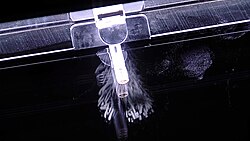
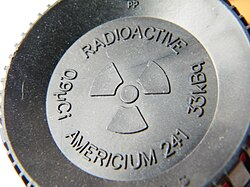
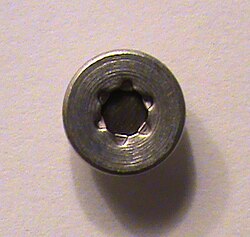
Many homes contain americium-241, a synthetic radionuclide produced by bombarding plutonium with neutrons. In a smoke detector, a tiny amount of americium dioxide (approx. 0.29 micrograms) emits alpha particles that ionize the air in a chamber, creating a small electric current. When smoke enters the chamber, it neutralizes some ions, decreasing the current and triggering the alarm.
Nuclide Stability Summary
The following table summarizes the classification of 986 nuclides with half-lives greater than one hour, alongside those with shorter durations.
| Stability Class | Number of Nuclides | Running Total | Notes |
|---|---|---|---|
| Theoretically stable (except proton decay) | 90 | 90 | Includes first 40 elements. |
| Stable to most decay, but not spontaneous fission | 56 | 146 | Possible for nuclides ≥ niobium-93. |
| Observationally stable | 105 | 251 | Energetically unstable, but no decay yet seen. |
| Radioactive primordial | 35 | 286 | Includes uranium, thorium, and potassium-40. |
| Radioactive nonprimordial (natural) | 62 | 348 | Cosmogenic (e.g., C-14) and daughter products. |
| Radioactive synthetic (≥ 1.0 hour) | 638 | 986 | Includes most medical radiotracers. |
| Radioactive synthetic (< 1.0 hour) | >2400 | >3300 | Short-lived artificial nuclides. |
Frequently Asked Questions
What is the difference between a primordial and a cosmogenic radionuclide?
Primordial radionuclides have existed since the formation of the Earth due to their extremely long half-lives. Cosmogenic radionuclides are continuously created in the Earth's atmosphere by the action of cosmic rays.
How is americium-241 used in smoke detectors?
Americium-241 emits alpha particles that ionize air in a chamber, creating an electric current. Smoke particles disrupt this ionization, reducing the current and triggering the alarm.
Can all elements have radioactive isotopes?
Yes, all chemical elements have radionuclides. However, some very light elements like helium, lithium, and boron do not have any radionuclides with a half-life longer than one second.
What is a radionuclide generator?
A radionuclide generator is a system containing a long-lived parent radionuclide that decays into a shorter-lived daughter radionuclide, which can then be extracted for use, such as in medical imaging.
Why are some nuclides called "observationally stable"?
Observationally stable nuclides are theoretically unstable and capable of decay, but their half-lives are so long that decay has not yet been observed or was only detected very recently (e.g., bismuth-209).