Nuclear Transmutation: From Ancient Alchemy to Modern Physics
Nuclear transmutation is the process of converting one chemical element or isotope into another. This occurs whenever the number of protons or neutrons within an atom's nucleus is altered. Whether happening in the heart of a star or within a particle accelerator, transmutation fundamentally changes the identity of an atom.
There are two primary ways this conversion occurs: through nuclear reactions, where an external particle interacts with a nucleus, or through radioactive decay, a spontaneous process that requires no outside trigger.
Key Facts
- Transmutation occurs when the proton or neutron count in a nucleus changes.
- Stellar nucleosynthesis creates most common elements like carbon, oxygen, and helium.
- The first artificial transmutation was achieved in 1925 by Patrick Blackett.
- Modern science can produce gold from elements like bismuth, lead, and mercury, though often at a net energy loss.
- Transmutation is a proposed strategy for reducing the longevity of hazardous nuclear waste.
Natural Transmutation in the Universe
Most of the heavier elements in the known universe were created through stellar nucleosynthesis. Stars primarily use fusion reactions involving hydrogen and helium to create heavier elements. While most stars stop at certain stages, massive stars can fuse elements up to iron late in their evolution.
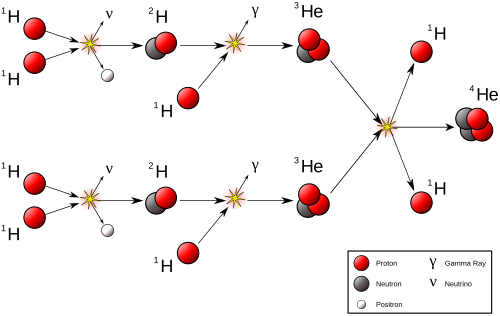
Beyond stars, natural transmutation occurs on Earth. Radioactive elements spontaneously decay via alpha or beta decay; for example, the decay of potassium-40 into argon-40 accounts for most of the argon in our atmosphere. Additionally, cosmic ray bombardment can trigger transmutation, such as the formation of carbon-14.
The Evolution of Transmutation: From Alchemy to Science
The Alchemical Dream
The concept of transmutation originated with alchemy. Practitioners sought the "philosopher's stone" to achieve chrysopoeia—the transformation of base metals into gold. While some viewed this metaphorically, others attempted it physically. By the 18th century, the work of Antoine Lavoisier and John Dalton replaced alchemical theories with the modern understanding of chemical elements and atoms, proving that the energy required to disintegrate an atom was far beyond the reach of alchemists.
The Dawn of Modern Physics
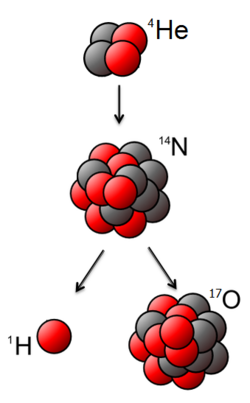
The transition to scientific transmutation began in the early 20th century. In 1925, Patrick Blackett provided the first experimental evidence of artificial transmutation by converting nitrogen into oxygen using alpha particles.
In 1932, John Cockcroft and Ernest Walton achieved a fully artificial nuclear reaction by using accelerated protons to split lithium-7 into two alpha particles. This event was famously termed "splitting the atom," though it differed from the nuclear fission discovered in 1938 by Otto Hahn, Lise Meitner, and Fritz Strassmann. By 1941, researchers Rubby Sherr, Kenneth Bainbridge, and Herbert Lawrence Anderson reported the transmutation of mercury into gold.
Creating Gold in the Modern Era
While alchemists failed to turn lead into gold, modern physics has succeeded, albeit with high costs. In 1980, Glenn Seaborg and his team produced minuscule amounts of gold from bismuth. More recently, CERN scientists have used the Super Proton Synchrotron and the Large Hadron Collider to create gold nuclei from lead through induced photon emissions and proton bombardment. By 2025, the ALICE experiment reported creating roughly 260 billion gold nuclei (approximately 90 picograms) over a decade.
Additionally, the startup Marathon Fusion has proposed a theoretical method to create gold from the mercury isotope Hg-196. By bombarding it with high-energy neutrons, they aim to create Hg-197, which decays into stable gold (Au-197) with a half-life of about 64 hours.
Artificial Transmutation of Nuclear Waste
One of the most practical applications of this science is the management of nuclear waste. By bombarding ceramic targets containing actinides (heavy radioactive elements) with neutrons, scientists can remove long-lived radioactive species.
Reactor Strategies and Challenges
Different reactor types offer different advantages for waste transmutation:
- Standard Reactors: Can transmute plutonium into mixed oxide (MOX) fuels, though limited by the accumulation of plutonium-240.
- Fast Reactors and Subcritical Reactors: Proposed by Carlo Rubbia, these "energy amplifiers" may be more effective for heavier elements.
- Plutonium-Thorium Fuels: Thorium-232 captures neutrons to eventually produce fissile uranium-233, reducing the production of second-generation plutonium.
Managing Long-Lived Fission Products
Not all waste is easily transmuted. Some elements, like caesium-137 and strontium-90, have low neutron absorption cross-sections (meaning they rarely capture neutrons), making them difficult to transmute. These are typically stored until they decay naturally.
However, elements like technetium-99 and iodine-129 are viable targets for transmutation. Technetium-99, in particular, can be transmuted into ruthenium, a precious metal, potentially providing an economic incentive for the process.
| Nuclide | Half-life (Millions of Years) | Yield (%) | Transmutation Viability |
|---|---|---|---|
| Technetium-99 | 0.211 | 6.1385 | High (Potential Ruthenium production) |
| Iodine-129 | 16.1 | 0.8410 | Moderate |
| Caesium-135 | 2.3 | 6.9110 | Low (Low mobility/cross-section) |
| Zirconium-93 | 1.61 | 5.4575 | Low |
Frequently Asked Questions
What is the difference between natural and artificial transmutation?
Natural transmutation occurs spontaneously through radioactive decay or stellar nucleosynthesis in stars. Artificial transmutation is induced by humans using particle accelerators or nuclear reactors to bombard nuclei with particles.
Can we actually turn lead into gold?
Yes, it is scientifically possible through nuclear transmutation, as demonstrated by experiments at CERN and other laboratories. However, the process is extremely expensive and produces only minuscule amounts of gold, making it commercially impractical.
How does transmutation help with nuclear waste?
Transmutation can convert long-lived radioactive isotopes into shorter-lived or stable isotopes. This reduces the time that nuclear waste remains hazardous to the environment, although some isotopes are too resistant to this process to be effectively treated.
What is the role of stars in transmutation?
Stars act as massive natural fusion reactors. They transmute hydrogen into helium and subsequently fuse heavier elements up to iron, creating the chemical building blocks of the universe.