Radiation: Types, Properties, and Effects of Energy Emission
In the realm of physics, radiation is defined as the emission or transmission of energy. This energy travels through space or a material medium in the form of waves or particles. While often associated with nuclear power or medical imaging, radiation is a fundamental part of the natural world, encompassing everything from the light we see to the sound we hear and the gravitational ripples of the cosmos.
Radiation is broadly categorized based on its nature and its ability to interact with matter. The primary forms include electromagnetic radiation (photons), particle radiation (subatomic particles), acoustic radiation (sound and seismic waves), and gravitational radiation (ripples in spacetime).
Key Facts
- Ionizing radiation has enough energy (typically above 10 to 33 eV) to remove electrons from atoms.
- Non-ionizing radiation lacks the energy to ionize atoms but can still cause biological damage through electronic excitation.
- Gamma rays are highly penetrating because they lack mass and electric charge.
- Neutrons are "indirectly ionizing" because they cause ionization by making other nuclei unstable.
- The Ozone Layer absorbs approximately 98% of dangerous non-ionizing UV-C and UV-B radiation.
Ionizing Radiation
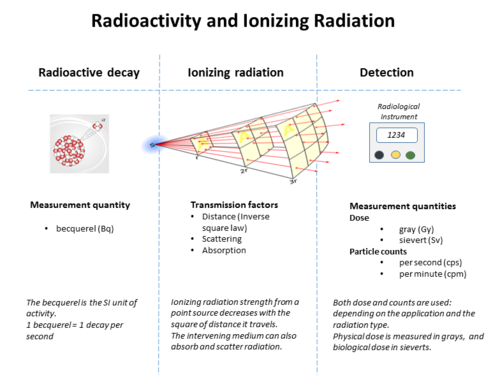
Ionizing radiation occurs when photons or particles carry sufficient energy—generally above 10 electron volts (eV), though some define the threshold at 33 eV (the ionization energy of water)—to knock electrons out of atoms. This process is common in nuclear fission, fusion, and cosmic rays.
Particle Radiation
Particle radiation consists of subatomic particles accelerated to relativistic speeds. Most of these particles carry an electrical charge, which limits their penetrating power as they interact readily with other matter. Key types include:
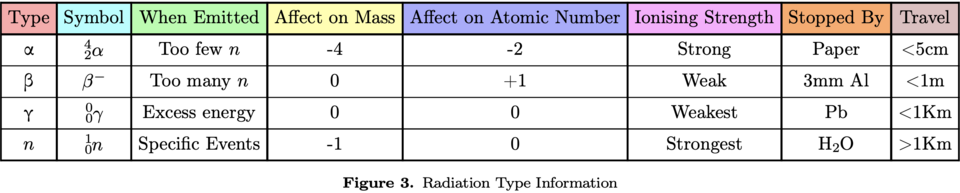
- Alpha particles (α): Positively charged particles with low penetration; they can be stopped by a simple sheet of paper.
- Beta particles (β): Negatively charged electrons that are more penetrating than alpha particles but can be stopped by 3mm of aluminum foil.
- Protons: Charged particles capable of ionizing materials.
- Neutrons: Uncharged particles that are highly penetrating.
![An illustration of the relative abilities of three different types of ionizing radiation to penetrate solid matter. Typical alpha particles (α) are stopped by a sheet of paper, while beta particles (β) are stopped by 3mm aluminum foil. Gamma radiation (γ) is dampened when it penetrates lead. Note caveats in the text about this simplified diagram.[clarification needed]](/images/58/6a/586a9dbc622cd0cf26821d4a8c37230990e10955b9e854164ba820943d370379.webp)
Neutron Radiation and Activation
Neutrons are unique because they do not ionize atoms through direct electrical excitation. Instead, they are indirectly ionizing; they are absorbed by nuclei, making those nuclei unstable and radioactive. This process is known as neutron activation and is used to create radioactive sources for industrial and medical use. While water is weakly capable of activation, materials like sodium in salt can become intense sources of beta decay (Na-24) after absorbing a single neutron.
Electromagnetic Ionizing Radiation
High-energy photons also cause ionization. X-rays have wavelengths shorter than 10 nm. They are absorbed differently by various materials; for example, calcium in bone absorbs X-rays more effectively than the smaller atoms in soft tissue, a property used in medical radiography.
Gamma (γ) radiation consists of photons with wavelengths shorter than 3 × 10-11 m. Emitted by unstable nuclei to shed excess energy, gamma rays have no mass or charge, allowing them to penetrate much deeper into matter than alpha or beta particles. They can be dampened by dense materials like lead or depleted uranium.

Non-Ionizing Radiation

Non-ionizing radiation consists of lower-energy waves that cannot remove electrons from atoms but can still influence biological systems.
Ultraviolet (UV) Radiation
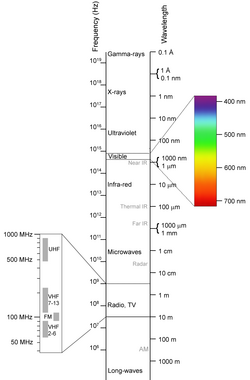
UV radiation ranges from 10 nm to 200 nm. While "vacuum ultraviolet" is absorbed by the atmosphere, other UV rays reach the surface. Although non-ionizing, UV radiation is biologically hazardous because it can cause electronic excitation in molecules, leading to the formation of pyrimidine dimers in DNA at wavelengths below 365 nm.
Visible Light and Infrared
Visible light is a narrow band (380–750 nm) detectable by the human eye. Infrared (IR) radiation (0.7 to 300 μm) is felt as heat. In sunlight at sea level, approximately 53% of the energy is infrared, 44% is visible light, and 3% is ultraviolet.
Microwaves and Radio Waves
Microwaves range from 1 mm to 1 m in wavelength. Radio waves extend even further, including Very Low Frequency (VLF) (30 Hz to 3 kHz) used for navigation, and Extremely Low Frequency (ELF) (3 to 30 Hz), which can penetrate deep water to reach submerged submarines.

Thermal and Black-Body Radiation

Black-body radiation is the emission of energy based on the temperature of a surface. This determines the color of stars: red stars are cooler (~2500 K), yellow stars are mid-range (~5800 K), and blue-white stars are the hottest (~15,000 K).
Summary of Radiation Types
| Type | Nature | Ionizing? | Penetrating Power | Common Shielding |
|---|---|---|---|---|
| Alpha (α) | Particle (Helium Nucleus) | Yes | Low | Paper |
| Beta (β) | Particle (Electron) | Yes | Moderate | Aluminum Foil |
| Gamma (γ) | Photon | Yes | High | Lead / Concrete |
| X-Ray | Photon | Yes | High | Lead |
| Ultraviolet | Photon | Partial/No | Low | Ozone / Glass |
| Radio/Microwave | Photon | No | Variable | Conductive Metals |
Frequently Asked Questions
What is the difference between ionizing and non-ionizing radiation?
Ionizing radiation carries enough energy to detach electrons from atoms, which can cause chemical changes and DNA damage. Non-ionizing radiation lacks this energy but can still cause effects like heating or electronic excitation in molecules.
Why are gamma rays more penetrating than alpha particles?
Alpha particles have mass and a positive electrical charge, causing them to interact and collide with other atoms quickly. Gamma rays are photons with no mass or charge, allowing them to pass through much more matter before being absorbed.
How does neutron activation work?
Neutron activation occurs when a nucleus absorbs a neutron, becoming unstable and radioactive. This is an indirect form of ionization because the neutron itself is uncharged and does not excite electrons directly.
Is non-ionizing radiation completely safe?
Not necessarily. While it cannot ionize atoms, certain types can cause burns or biological damage. For instance, the IARC has listed radio frequency electromagnetic fields as possibly carcinogenic to humans.
How is the temperature of a star determined by radiation?
Through black-body radiation, the peak wavelength of light emitted by a star corresponds to its surface temperature. Cooler stars peak in the infrared or red spectrum, while hotter stars peak in the blue-white spectrum.