Articles/Ultraviolet Radiation: Science, Subtypes, and Real-World Applications
ultraviolet radiationUVA UVB UVCelectromagnetic spectrumUV light applicationsUV damage DNA
Ultraviolet Radiation: Science, Subtypes, and Real-World Applications
Ultraviolet Radiation: Science, Subtypes, and Real-World Applications Ultraviolet (UV) radiation is a form of electromagnetic radiation with wavelengths ranging from 100 to 400 nanometers...
Ultraviolet Radiation: Science, Subtypes, and Real-World Applications
Ultraviolet (UV) radiation is a form of electromagnetic radiation with wavelengths ranging from 100 to 400 nanometers. Positioned in the spectrum between visible light and X-rays, UV radiation carries more energy than the light we see with our eyes. While it is a natural component of sunlight, it is also produced through various artificial means, including electric arcs, mercury-vapor lamps, and specialized black lights.
The energy of UV photons typically ranges from 3.1 to 12 electron volts. This energy level is significant because it sits near the minimum required to ionize atoms. While long-wavelength UV is generally considered non-ionizing, it can still induce chemical reactions and cause substances to fluoresce—a phenomenon where a substance absorbs light and re-emits it as a different color. Conversely, short-wave UV acts as ionizing radiation, capable of damaging biological structures like DNA and sterilizing surfaces.
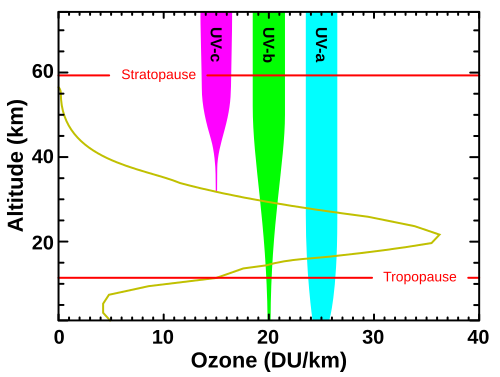
Levels of ozone at various altitudes (DU/km) and blocking of different bands of ultraviolet radiation: In essence, all UVC is blocked by diatomic oxygen (100–200 nm) or by ozone (triatomic oxygen) (200–280 nm) in the atmosphere. The ozone layer then blocks most UVB. Meanwhile, UVA is hardly affected by ozone, and most of it reaches the ground. UVA makes up almost all UV light that penetrates the Earth's atmosphere.: Levels of ozone at various altitudes (DU/km) and blocking of different bands of ultraviolet radiation: In essence, all UVC is blocked by diatomic oxygen (100–200 nm) or by ozone (triatomic oxygen) (200–280 nm) in the atmosphere. The ozone layer then blocks most UVB. Meanwhile, UVA is hardly affected by ozone, and most of it reaches the ground. UVA makes up almost all UV light that penetrates the Earth's atmosphere.
Key Facts
Wavelength Range: 100 to 400 nanometers.
Solar Composition: UV radiation accounts for approximately 10% of the Sun's total electromagnetic radiation output.
Subtypes: Divided into UVA, UVB, and UVC based on wavelength.
Biological Impact: Short-wave UV can damage DNA and is used for sterilization.
Fluorescence: UV light can cause many organic and inorganic materials to glow.
The UV Spectrum: UVA, UVB, and UVC
The scientific community categorizes ultraviolet radiation into specific bands based on wavelength and energy levels. This classification is essential for understanding how different types of light interact with the environment and human biology.
Subtype Breakdown
According to ISO standards, the spectrum is subdivided into several ranges:
Ultraviolet A (UVA): 315–400 nm. This is the longest wavelength and reaches the Earth's surface in high amounts.
Ultraviolet B (UVB): 280–315 nm. This band is partially absorbed by the atmosphere but plays a major role in skin effects.
Ultraviolet C (UVC): 100–280 nm. This is the highest energy band and is largely blocked by the atmosphere.
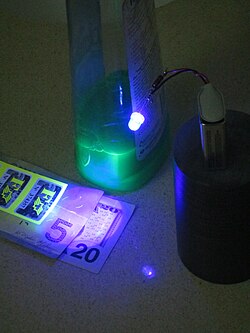
A 380 nanometer UV LED makes some common household items fluoresce.: A 380 nanometer UV LED makes some common household items fluoresce.
Comparison of Ultraviolet Radiation Subtypes
Name
Abbreviation
Wavelength (nm)
Photon Energy (eV)
Ultraviolet A
UVA
315–400
3.10–3.94
Ultraviolet B
UVB
280–315
3.94–4.43
Ultraviolet C
UVC
100–280
4.43–12.4
Biological and Environmental Effects
The interaction between UV radiation and living organisms is complex. Because UV photons can excite electrons to higher energy states, they can break chemical bonds within molecules.
DNA Damage and Skin Health
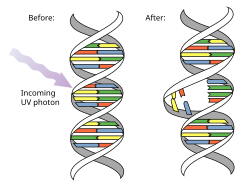
One of the most critical biological impacts of UV radiation is its effect on DNA. Short-wave UV can cause adjacent thymine bases in a DNA strand to bond with each other rather than across the "ladder." This creates a thymine dimer, a structural bulge that prevents the DNA molecule from functioning correctly.
Ultraviolet photons harm the DNA molecules of living organisms in different ways. In one common damage event, adjacent thymine bases bond with each other, instead of across the "ladder". This "thymine dimer" makes a bulge, and the distorted DNA molecule does not function properly.: Ultraviolet photons harm the DNA molecules of living organisms in different ways. In one common damage event, adjacent thymine bases bond with each other, instead of across the "ladder". This "thymine dimer" makes a bulge, and the distorted DNA molecule does not function properly.
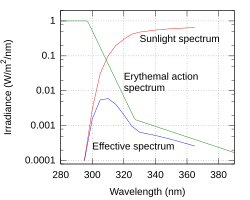
In humans, exposure to UVB can lead to sunburns. The severity of a sunburn is determined by the product of the sunlight spectrum and the erythemal action spectrum, which measures skin sensitivity to specific wavelengths.
Sunburn effect (as measured by the UV index) is the product of the sunlight spectrum (radiation intensity) and the erythemal action spectrum (skin sensitivity) across the range of UV wavelengths. Sunburn production per milliwatt of radiation intensity is increased by nearly a factor of 100 between the near UVB wavelengths of 315–295 nm.: Sunburn effect (as measured by the UV index) is the product of the sunlight spectrum (radiation intensity) and the erythemal action spectrum (skin sensitivity) across the range of UV wavelengths. Sunburn production per milliwatt of radiation intensity is increased by nearly a factor of 100 between the near UVB wavelengths of 315–295 nm.
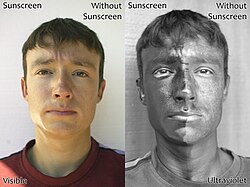
Sunscreen is a primary defense against these effects. By absorbing or reflecting UV light, it prevents the radiation from reaching the skin cells.
Demonstration of the effect of sunscreen. The left image is a regular photograph of his face; the right image is of reflected UV light. The man's face has sunscreen on his right side only. It appears darker because the sunscreen absorbs the UV light.: Demonstration of the effect of sunscreen. The left image is a regular photograph of his face; the right image is of reflected UV light. The man's face has sunscreen on his right side only. It appears darker because the sunscreen absorbs the UV light.
Eye Sensitivity
The human eye is particularly sensitive to the lower UVC band (265–275 nm). While this radiation is mostly filtered out by the atmosphere, artificial sources like arc welding can cause photokeratitis, commonly known as "welder's flash." UVB exposure can also lead to conditions like snow blindness and damage to the cornea, lens, and retina.
Signs are often used to warn of the hazard of strong UV sources.: Signs are often used to warn of the hazard of strong UV sources.
Practical and Industrial Applications
Despite the risks, UV radiation is an incredibly versatile tool used across numerous industries.
Sterilization and Forensics
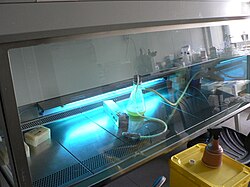
Because short-wave UV can destroy biological contaminants, it is widely used for sterilization. Mercury-vapor lamps are often used in medical or laboratory settings to disinfect surfaces.
A low-pressure mercury vapor discharge tube floods the inside of a hood with shortwave UV light when not in use, sterilizing microbiological contaminants from irradiated surfaces.: A low-pressure mercury vapor discharge tube floods the inside of a hood with shortwave UV light when not in use, sterilizing microbiological contaminants from irradiated surfaces.
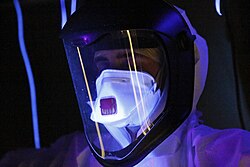
In forensics, UV light helps investigators detect invisible traces of fluids or biological matter, which is vital for maintaining sanitary compliance and solving crimes.
After a training exercise involving fake body fluids, a healthcare worker's personal protective equipment is checked with ultraviolet to find invisible drops of fluids. These fluids could contain deadly viruses or other contamination.: After a training exercise involving fake body fluids, a healthcare worker's personal protective equipment is checked with ultraviolet to find invisible drops of fluids. These fluids could contain deadly viruses or other contamination.
Material Science and Technology
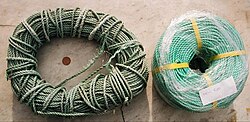
UV light is used to cure polymers and printer inks, and it is essential in the manufacturing of semiconductors through photolithography. However, UV exposure can also be a cause of degradation in materials like polypropylene rope or polyethylene, as evidenced by changes in their chemical structure.
UV damaged polypropylene rope (left) and new rope (right): UV damaged polypropylene rope (left) and new rope (right)
IR spectrum showing carbonyl absorption due to UV degradation of polyethylene: IR spectrum showing carbonyl absorption due to UV degradation of polyethylene
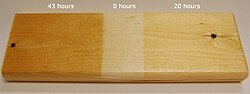
Effects of UV on finished surfaces in 0, 20 and 43 hours: Effects of UV on finished surfaces in 0, 20 and 43 hours
Specialized Uses
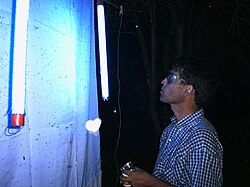
Entomology: Scientists use UV lamps to collect specific insects, such as beetles. Entomologist using a UV lamp for collecting beetles in Chaco, Paraguay: Entomologist using a UV lamp for collecting beetles in Chaco, Paraguay
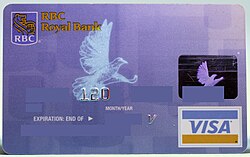
Security: UV light is used to reveal hidden features on credit cards or official documents. A bird appears on many Visa credit cards when they are held under a UV light source.: A bird appears on many Visa credit cards when they are held under a UV light source.
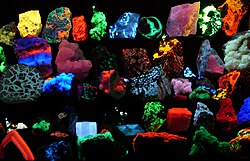
Mineralogy: Many minerals exhibit brilliant fluorescence under UV light. A collection of mineral samples fluorescing brilliantly at various wavelengths as seen while being irradiated by UV: A collection of mineral samples fluorescing brilliantly at various wavelengths as seen while being irradiated by UV
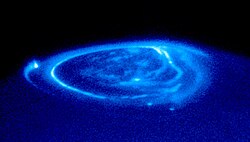
Astronomy: The Hubble Space Telescope uses UV to observe phenomena like the auroras at Jupiter's poles. Aurora at Jupiter's north pole as seen in ultraviolet light by the Hubble Space Telescope: Aurora at Jupiter's north pole as seen in ultraviolet light by the Hubble Space Telescope
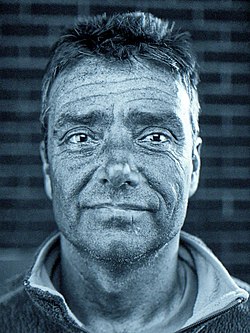
A portrait taken using only UV light between the wavelengths of 335 and 365 nanometers: A portrait taken using only UV light between the wavelengths of 335 and 365 nanometers
Frequently Asked Questions
What is the difference between UVA, UVB, and UVC?
The difference lies in their wavelength and energy. UVA has the longest wavelength (315–400 nm) and lowest energy; UVB is mid-range (280–315 nm); and UVC has the shortest wavelength (100–280 nm) and highest energy.
How does UV light cause sunburn?
Sunburn is caused by the interaction of UV radiation (primarily UVB) with the skin. The radiation can cause chemical changes and damage to cells, including the formation of thymine dimers in DNA.
Can UV light be used for cleaning?
Yes. Short-wave UV radiation is used for sterilization and disinfection because it can destroy microbiological contaminants on surfaces.
Why do some things glow under UV light?
This is called fluorescence. Certain substances absorb the high-energy UV photons and immediately re-emit them as lower-energy visible light, which our eyes can see.
Is all UV radiation harmful?
While high-energy UV can damage DNA and eyes, UV radiation also has beneficial applications in medicine, material science, and forensic analysis.