Electromagnetism: The Fundamental Force Shaping Our Universe
At the heart of almost every physical interaction we experience—from the touch of a hand to the glow of a smartphone screen—lies electromagnetism. In physics, electromagnetism is a fundamental interaction that occurs between particles possessing an electric charge, mediated by electromagnetic fields. As one of the four fundamental forces of nature, it is the dominant force governing the behavior of atoms and molecules.
Electromagnetism serves as the unifying framework for three closely intertwined phenomena: electricity, magnetism, and optics. To study these, scientists divide the field into three primary sub-disciplines: electrostatics (stationary charges), magnetostatics (constant magnetic fields), and electrodynamics (changing fields and currents).
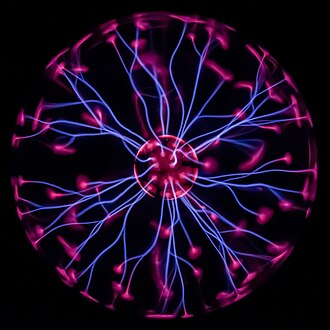
Key Facts
- Fundamental Nature: It is one of the four fundamental forces of nature and dominates atomic and molecular interactions.
- Unification: It combines electricity, magnetism, and optics into a single theoretical framework.
- Atomic Stability: The electrostatic attraction between atomic nuclei and electrons is what holds atoms together.
- Light as Radiation: Visible light, X-rays, and radio waves are all forms of self-sustaining electromagnetic radiation.
- Quantum Basis: In Quantum Electrodynamics (QED), the electromagnetic field is quantized into particles called photons.
The Mechanics of Electromagnetic Force
The electromagnetic force is responsible for a vast array of chemical and physical phenomena. On a microscopic scale, electric forces allow atoms to combine into molecules. Furthermore, the magnetic interactions between the spin and angular momentum magnetic moments of electrons influence chemical reactivity, a field of study known as spin chemistry.
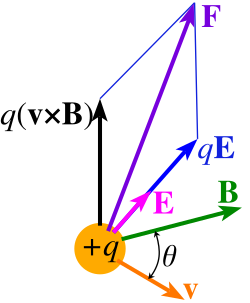
A central concept in this field is the Lorentz force, which describes the force exerted on a charged particle moving through electric and magnetic fields. This law allows physicists to define both the electric field (E) and the magnetic flux density (B).
Everyday Examples of Electromagnetism
We encounter electromagnetic effects constantly, often without realizing it. Static electricity is a prime example; for instance, when foam peanuts cling to fur, it is due to the triboelectric effect (charging via friction) and electrostatic induction, which polarizes the molecules of the plastic.

The Evolution of Electromagnetic Theory
Humanity's fascination with these forces began thousands of years ago. Ancient Chinese, Mayan, and Egyptian civilizations utilized magnetite, a naturally magnetic mineral. Around 600 B.C.E., the Greek philosopher Thales of Miletus observed that rubbing amber with cloth allowed it to attract light objects, foreshadowing the discovery of electric charges.
From Separate Forces to Unified Theory
For centuries, electricity and magnetism were viewed as distinct. In 1600, William Gilbert proposed they were separate effects in his work De Magnete. It wasn't until the 18th and 19th centuries that the link became clear. In 1752, Thomas-François Dalibard successfully extracted electrical sparks from a cloud, confirming Benjamin Franklin's theories on lightning.
The bridge between current and magnetism was further built in 1820 when Hans Christian Ørsted noticed a wire carrying current deflected a compass needle. This led André-Marie Ampère to establish the mathematical foundations of electrodynamics.
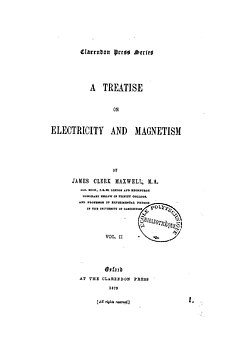
The culmination of these discoveries arrived in 1873 with James Clerk Maxwell's A Treatise on Electricity and Magnetism. Maxwell unified these phenomena into a single theory, proposing that light itself is an electromagnetic wave. His work is summarized in the famous Maxwell's equations.
Modern Physics and Quantum Electrodynamics
The theoretical implications of Maxwell's work helped inspire Albert Einstein's theory of special relativity in 1905, particularly regarding the speed of light and moving frames of reference. Later, Quantum Electrodynamics (QED) modified these classical equations to align with the quantized nature of matter, treating changes in the electromagnetic field as discrete excitations called photons.
Technical Summary of Electromagnetism
The following table summarizes the key units used to measure various electromagnetic properties.
| Quantity | SI Unit | Symbol |
|---|---|---|
| Electric Current | Ampere | A |
| Electric Charge | Coulomb | C |
| Electric Potential | Volt | V |
| Resistance | Ohm | Ω |
| Magnetic Flux Density | Tesla | T |
| Magnetic Flux | Weber | Wb |
| Capacitance | Farad | F |
| Inductance | Henry | H |
| Power | Watt | W |
Frequently Asked Questions
What is the difference between electrostatics and electrodynamics?
Electrostatics deals with the study of electric charges at rest, while electrodynamics focuses on the study of electric charges in motion and the resulting electromagnetic fields.
How does electromagnetism relate to light?
Light is a form of electromagnetic radiation. It consists of self-sustaining electromagnetic waves that propagate through space, spanning a spectrum that includes gamma rays, X-rays, ultraviolet, visible light, infrared, microwaves, and radio waves.
What is the Lorentz force?
The Lorentz force is the combined force exerted on a charged particle by both an electric field and a magnetic field, depending on the particle's charge and velocity.
What is Quantum Electrodynamics (QED)?
QED is the modern quantum field theory that describes how light and matter interact. It modifies classical Maxwell's equations to account for the fact that electromagnetic energy is exchanged in discrete packets called photons.
Why is electromagnetism important for modern technology?
It is the foundation for almost all electronic technology, including the production and distribution of electrical energy, wireless communication (fiber optics and radio), computation, sensors, and mechanical motors.