Queen Victoria's Golden Jubilee: A Global Celebration of 50 Years
In 1887, the British Empire paused to celebrate a monumental milestone: the 50th anniversary of Queen Victoria's accession to the throne. This Golden Jubilee was not merely a national holiday but a global spectacle designed to showcase the reach and stability of the British monarchy. From the heat of the Indian Empire to the rainy streets of London, the celebrations blended solemn religious gratitude with grand military displays.
Key Facts
- Date of Accession: 20 June 1837.
- Global Reach: Celebrations spanned the British Empire, starting in India in February 1887.
- Military Might: Over 58,000 troops at Aldershot and more than 100 warships at Spithead.
- Philanthropy: £70,000 was raised to establish the Queen Victoria's Jubilee Institute for Nurses.
- Public Engagement: 26,000 schoolchildren were hosted for a party in Hyde Park.
Celebrations in the Indian Empire
To avoid the intense summer heat, the official celebrations in India began early, peaking on 16 February. Orchestrated by the Viceroy, Lord Lytton, the events were intended to highlight the success of British administration, though local rulers largely ignored this political framing. A significant durbar (a formal court or assembly) was held in Bombay, attended by Prince Arthur, the Duke of Connaught.
The connection between India and the Jubilee extended to London, where a contingent of cavalry from the British Indian Army served as the Queen's personal escort. Additionally, the Queen employed two Indian Muslims as waiters, including Abdul Karim. Many rulers of the Indian Princely States traveled the great distance to London to attend the festivities.
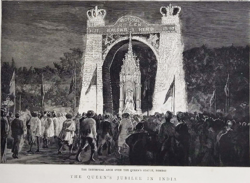
The Jubilee Festivities in London
June 20: Reflection and Royalty
The anniversary began on 20 June with a private moment of reflection. The Queen spent her morning at Frogmore, the burial site of Prince Albert, before traveling by train from Windsor to Buckingham Palace. The evening was marked by a lavish banquet attended by fifty foreign kings and princes, as well as governing heads of Britain's overseas colonies and dominions.
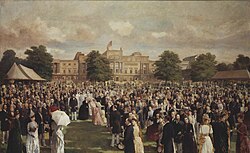
June 21: The Grand Procession and Thanksgiving
On 21 June, the Queen traveled through London to Westminster Abbey in an open landau (a four-wheeled carriage with a folding top) drawn by six cream-colored horses. Eschewing a crown for a bonnet and long dress, she was escorted by Colonial Indian cavalry. The crowds were immense; Mark Twain noted that the procession stretched to the limit of sight, with spectators viewing the event from 10 miles of specially erected scaffolding.
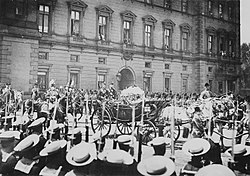
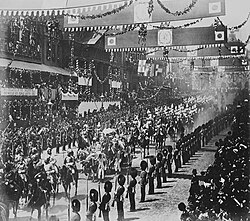
At Westminster Abbey, a Service of Thanksgiving was held. The music featured a Te Deum composed by the late Prince Albert. Following the service, the Queen returned to the palace balcony to be cheered by the public, later hosting a procession of diplomats and Indian princes before watching fireworks in the palace garden.
June 22: Community and Commemoration
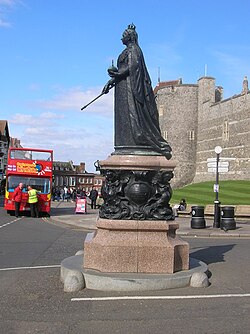
The festivities continued on 22 June with a visit to the dowager Duchess of Cambridge at St James's Palace. In a gesture of public goodwill, the Queen hosted 26,000 schoolchildren in Hyde Park, providing each child with a bun, a glass of milk, and a commemorative Jubilee mug. The day concluded at Castle Hill in Windsor, where the Queen unveiled a bronze statue of herself created by Sir Edgar Boehm.
Grand Military Reviews
The Aldershot Field State Review
On 9 July, the royal family attended a massive review of the British Army at Aldershot. The event featured over 58,000 troops, comprising 21,200 regular soldiers, 33,000 Volunteers, 4,500 Militia, and 270 Yeomanry. Despite efforts to water the ground with traction engines, the sheer volume of boots and hooves created clouds of dust that blanketed the spectators.
The Spithead Fleet Review
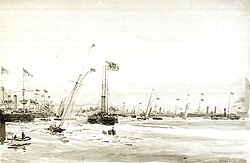
The naval celebrations took place on 23 July at Spithead, offshore from Portsmouth. This review featured over one hundred Royal Navy warships, including 26 ironclads, 14 cruisers, 31 gunboats, and 38 torpedo boats, totaling 442 guns and 16,136 personnel. The Queen viewed the fleet from the royal yacht, HMY Victoria and Albert. The event was so imposing that the United States Navy described it as the most impressive fleet review ever seen afloat.
Lasting Legacies and Commemorations
The Golden Jubilee left a permanent mark on the landscape and society of the Empire. Many cities commissioned monuments, such as the Jubilee Clock Towers in Brighton and Weymouth, and the Queen's Arcade in Leeds. A commemorative bust by Francis John Williamson was distributed throughout the Empire, and a special Golden Jubilee Medal was awarded to participants.
Beyond monuments, the Jubilee had a lasting social impact. On 20 September 1889, using £70,000 raised during the celebrations, the Queen issued a Royal Charter to establish the Queen Victoria's Jubilee Institute for Nurses.
| Category | Detail/Quantity | Location/Context |
|---|---|---|
| Army Troops | 58,000+ | Aldershot Review |
| Navy Vessels | 100+ Warships | Spithead Review |
| Schoolchildren | 26,000 | Hyde Park Party |
| Nursing Fund | £70,000 | Jubilee Institute for Nurses |
| Public Viewing | 10 miles of scaffolding | London Procession |
Frequently Asked Questions
Why were the celebrations in India held in February?
The celebrations in the Indian Empire began in February to avoid the extreme summer heat, ensuring the events could be conducted comfortably.
What was the significance of the music at Westminster Abbey?
The service included a Te Deum composed by Prince Albert, the Queen's late husband, adding a deeply personal element to the official thanksgiving service.
How did the public experience the London procession?
The public experience was massive in scale, with 10 miles of scaffolding and terraced benches erected to allow crowds to see the Queen's landau as it moved toward the Abbey.
What was the result of the funds raised during the Jubilee?
A sum of £70,000 was raised, which Queen Victoria used to establish the Queen Victoria's Jubilee Institute for Nurses via a Royal Charter in 1889.
Which naval ships participated in the Spithead review?
The British fleet included 26 ironclads, 14 cruisers, 31 gunboats, and 38 torpedo boats, alongside various foreign warships and merchant vessels.