Private Spaceflight Milestones of the 2020s
The 2020s have ushered in a transformative era for human space exploration, characterized by the shift from government-led initiatives to a thriving commercial ecosystem. Private companies are no longer just contractors; they are now the primary architects of orbital transport, lunar exploration, and space tourism.
From the first privately developed crewed missions to the International Space Station (ISS) to the first commercial lunar landings, the pace of innovation is accelerating. This transition is redefining who can access space and how frequently we can reach the stars.
Key Facts
- SpaceX achieved the first privately developed crewed orbital mission in May 2020.
- Blue Origin and Virgin Galactic successfully flew their founders to space in 2021.
- IM-1 Odysseus became the first private spacecraft to land on the Moon in February 2024.
- Starship stands as the most powerful rocket ever built, with double the thrust of the Saturn V.
- Polaris Dawn performed the first commercial extravehicular activity (EVA), or spacewalk, in September 2024.
The Rise of Commercial Crew and Orbital Access
The decade began with a historic milestone on May 30, 2020, when SpaceX launched the Demo-2 mission. Utilizing the Falcon 9 rocket and Crew Dragon capsule, this became the first privately developed crewed mission to reach orbit and visit the ISS, ending a decade-long gap in American crewed launches that had lasted since STS-135 in 2011.
Following this success, the industry expanded into private citizen flights. On September 16, 2021, SpaceX operated Inspiration4, the first orbital flight consisting entirely of private citizens. By April 2022, Axiom Space launched Axiom Mission 1, the first wholly commercially operated crewed mission to the ISS.
The commercial landscape further diversified in June 2024 when Boeing's Starliner, launched via a ULA Atlas V rocket, made Boeing the second company to send a crewed mission to orbit and the ISS. However, due to thruster issues, the crew was eventually transferred to a Dragon capsule for their return, while Starliner returned uncrewed.
Sub-orbital Tourism and Founder Flights
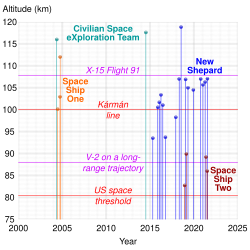
While SpaceX focused on orbit, other firms targeted sub-orbital flights—trips that reach the edge of space without completing a full orbit. On July 11, 2021, Richard Branson flew aboard Virgin Galactic's SpaceShipTwo. While a success for the founder, the flight did not cross the Karman Line, the internationally recognized boundary between Earth's atmosphere and outer space.
Shortly after, on July 20, 2021, Jeff Bezos flew on Blue Origin's New Shepard rocket. This mission successfully crossed the Karman Line and carried Oliver Daemen, the first teenager and first person born in the 21st century to enter space.
Pushing Technical Boundaries: Heavy Lift and Lunar Goals
The pursuit of deeper space exploration led to the development of massive hardware. On April 20, 2023, SpaceX launched Starship, the most powerful rocket to date, boasting twice the thrust of the historic Saturn V, though its maiden flight ended in failure after four minutes.
Lunar exploration also entered the private sector. In February 2024, the IM-1 Odysseus mission achieved the first successful private lunar landing, notably utilizing cryogenic propellants (fuels kept at extremely low temperatures to remain liquid). This was followed by Firefly Aerospace's Blue Ghost Mission 1, which completed a successful soft landing on the Moon on March 2, 2025.
Rapid Response and Orbital Records
Efficiency in launching has also peaked. In September 2023, Firefly Aerospace set a national security record by launching the VICTUS NOX mission for the U.S. Space Force just 27 hours after receiving notice. Additionally, Rocket Lab's Electron rocket became the fastest private orbital vehicle to reach 50 launches by June 2024.
New Frontiers in 2025
The momentum continued into 2025. Blue Origin launched its orbital launcher, New Glenn, on January 16. In April 2025, the Fram2 mission, launched via SpaceX, became the first crewed spaceflight to enter a polar retrograde orbit, meaning it flew over the Earth's poles.
Summary of Major Private Space Milestones
| Date | Entity | Achievement | Significance |
|---|---|---|---|
| May 2020 | SpaceX | Demo-2 Mission | First private crewed orbital mission to ISS |
| July 2021 | Blue Origin | New Shepard Flight | First founder to cross the Karman Line |
| Feb 2024 | Intuitive Machines | IM-1 Odysseus | First private lunar landing |
| Sept 2024 | Polaris Program | Polaris Dawn | First commercial spacewalk (EVA) |
| April 2025 | SpaceX / Fram2 | Polar Retrograde Orbit | First crewed flight over Earth's poles |
Frequently Asked Questions
What is the Karman Line?
The Karman Line is the widely accepted boundary between Earth's atmosphere and outer space, typically cited at an altitude of 100 kilometers.
How did the Polaris Dawn mission break records?
Polaris Dawn performed the first commercial extravehicular activity (EVA) and achieved the highest orbit flown since the Gemini 11 mission in 1966.
What makes the Starship rocket significant?
Starship is the largest and most powerful rocket ever built, featuring twice the thrust of the Saturn V rocket used during the Apollo era.
Who was the first teenager in space?
Oliver Daemen became the first teenager and the first person born in the 21st century to reach space during a Blue Origin New Shepard flight in July 2021.
What is a polar retrograde orbit?
A polar retrograde orbit is a flight path that travels over the Earth's poles, a feat first achieved by a crewed mission during the Fram2 launch in April 2025.