Spacecraft: Engineering, History, and the Evolution of Space Flight
A spacecraft is a sophisticated vehicle designed to operate in the vacuum of outer space. These machines serve a vast array of purposes, from enabling global telecommunications and monitoring Earth's meteorology to exploring distant planets and transporting humans across the cosmic void. Because most spacecraft lack the independent power to reach orbit, they rely on a launch vehicle—a carrier rocket—to propel them beyond the atmosphere.
Spaceflight is generally categorized into two types: sub-orbital and orbital. In a sub-orbital flight, a vehicle reaches space but returns to Earth without gaining the velocity required to maintain a closed orbit. Orbital flights, conversely, achieve sufficient speed to circle the Earth or other celestial bodies. While some missions are crewed, many are robotic, operating either autonomously or via telerobotics (remote control from Earth). Robotic missions used for scientific research are known as space probes, while those that remain in orbit are termed artificial satellites.
Key Facts
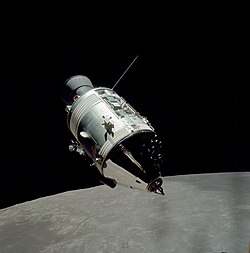
- First Spacecraft: The German V-2 rocket reached 189 km in June 1944.
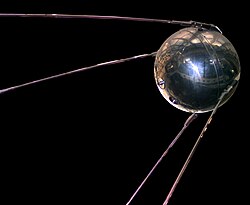
- First Satellite: Sputnik 1 was launched by the Soviet Union on October 4, 1957.
- The Kármán Line: The internationally recognized boundary of space, set at an altitude of 100 km.
- Human Spaceflight: Only three nations—the USSR/Russia, USA, and China—have flown crewed spacecraft.
- Farthest Object: Voyager 1 is the most distant human-made object from the Sun, exceeding 160 astronomical units (AU) as of August 2023.
- Fastest Object: The Parker Solar Probe is estimated to reach speeds of 700,000 km/h at its final perihelion.
The Dawn of the Space Age
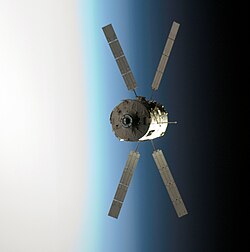
The journey into space began with the V-2 rocket, co-designed by Wernher von Braun, which first crossed the threshold of space in 1944. However, the true Space Age began with the launch of Sputnik 1. This Soviet satellite traveled at 29,000 km/h, completing an orbit every 96.2 minutes. Beyond its symbolic value, Sputnik 1 provided critical data on the ionosphere's radio-signal distribution and the density of the upper atmosphere.
Crewed Space Exploration
Human spaceflight evolved rapidly during the mid-20th century. The Soviet Union achieved the first orbital human flight in 1961 with Yuri Gagarin aboard Vostok 1. Shortly after, the United States launched Alan Shepard on a sub-orbital flight aboard Freedom 7.
Major Crewed Programs
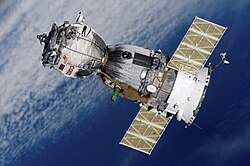
- Soviet/Russian: Vostok, Voskhod, Soyuz, and the Salyut and Mir space stations.
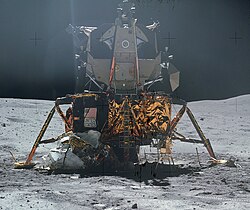
- United States: Mercury, Gemini, Apollo (including the Lunar Module), Skylab, the Space Shuttle, and the SpaceX Crew Dragon.
- China: The Shenzhou program, which began crewed missions in 2003.
The Space Shuttle Era
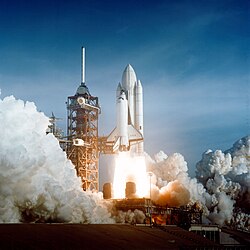
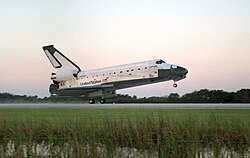
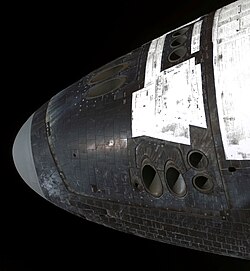
The US Space Shuttle was the first reusable orbital spaceplane, with Columbia launching in 1981. Over 30 years and 135 flights, the shuttle supported the Hubble Space Telescope and the International Space Station. Despite its versatility, the program was retired in 2011 due to high costs—often exceeding a billion dollars per flight—and the complex, slow process of refurbishing the orbiters and solid rocket boosters.
Uncrewed Spacecraft and Scientific Tools
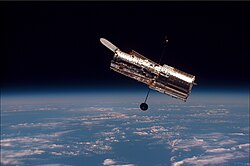
Uncrewed vehicles allow for long-term observation and exploration of environments too hostile for humans. Space telescopes, such as the Hubble and James Webb, are essential because they operate above the Earth's atmosphere, avoiding the light pollution and scintillation (twinkling) that distort ground-based observations.
Interstellar Probes: The Voyager Program
Launched in 1977, the Voyager 1 and 2 probes utilized a rare planetary alignment and gravity assists to visit Jupiter, Saturn, Uranus, and Neptune. Voyager 1 became the first spacecraft to exit the heliosphere in 2012. As of 2023, it remains the farthest spacecraft from the Sun, though NASA has had to disable several instruments to conserve power from its degrading radioisotope thermoelectric generators (RTGs).
Specialized Robotic Vehicles
- Communications Satellites: These relay radio signals via transponders. Many reside in geostationary orbit (35,900 km above the equator) to remain fixed relative to a ground station.
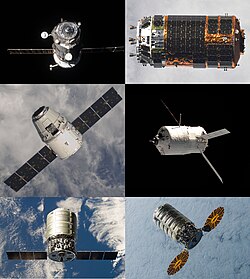
- Cargo Spacecraft: Vehicles designed to resupply space stations with food, fuel, and equipment.
- Mission Extension Vehicles (MEV): Robotic craft that dock with existing satellites to correct their orbit or orientation, effectively prolonging their operational life.
Spacecraft Technical Summary
| Category | Example | Key Characteristic/Record |
|---|---|---|
| Orbital Spaceplane | Space Shuttle | Reusable orbiter; 135 flights (1981-2011) |
| Interstellar Probe | Voyager 1 | Farthest from Sun (>160 AU) |
| Solar Probe | Parker Solar Probe | Fastest spacecraft (up to 700,000 km/h) |
| Crewed Capsule | Soyuz / Crew Dragon | Human transport to ISS |
| Space Telescope | Hubble / James Webb | Observation without atmospheric distortion |
Frequently Asked Questions
What is the difference between a space probe and a satellite?
A satellite is a spacecraft that remains in orbit around a planetary body, whereas a space probe is a robotic spacecraft sent to explore deep space or other celestial bodies, often traveling on a trajectory that leaves its home planet's orbit.
Why was the Space Shuttle retired?
The Space Shuttle was retired in 2011 primarily due to its extreme operational costs and the complexity of refurbishing its components, such as the heat shielding tiles and RS-25 engines, after each flight.
What is the Kármán line?
The Kármán line is the internationally recognized boundary between Earth's atmosphere and outer space, located at an altitude of 100 kilometers.
How do communications satellites stay in one spot in the sky?
Many communications satellites are placed in geostationary orbit, approximately 35,900 km above the equator. At this specific altitude, their orbital period matches Earth's rotation, making them appear stationary to an observer on the ground.
Which spacecraft is the fastest ever built?
The Parker Solar Probe holds the record for the fastest spacecraft, with an estimated top speed of 700,000 km/h during its final perihelion (closest approach to the Sun).