Principality of Reuss-Greiz: History of the Elder Line
The Principality of Reuss-Greiz, later known as the Principality of Reuss Elder Line, was a sovereign state within the German Empire. Ruled by the House of Reuss, this territory played a distinct role in the complex political landscape of Thuringia. Established in 1778 when the Counts of Reuss (specifically those of Greiz, Lower-Greiz, and Upper-Greiz) were elevated to princely status, the state remained under the rule of the Elder Line until the end of the monarchy in 1918.
One of the most peculiar traditions of the House of Reuss was the naming convention of its male members. In honor of Emperor Heinrich VI, who had historically benefited the family, every male member of the house was named Heinrich. To distinguish between individuals, they were numbered sequentially by birth rather than by their order of reign. This system continued through the final series, which began with Heinrich I (born 1693) and concluded with Heinrich XXIV.
Key Facts
- Official Names: Principality of Reuss-Greiz (1778–1848); Principality of Reuss Elder Line (1848–1918).
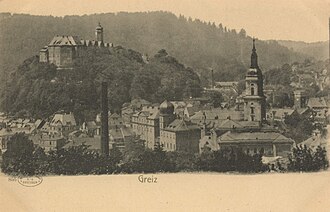
- Capital: Greiz.
- Motto: "Ich bau auf Gott" (I rely on God).
- Area: 317 square kilometers.
- Population: Over 72,000 inhabitants as of 1910.
- National Symbolism: The state preserved the Frankfurt Parliament flag, which later served as the flag of Germany.
Political Structure and Governance
The principality was governed by a Prince, supported by a Minister of State. The administration saw long tenures, such as that of Franz von Grün, the first Minister of State who served from 1782 to 1833, and Ernst von Meding, the final minister who served from 1901 until the state's dissolution in 1918.
Chronology of Princes
The leadership of the Elder Line was characterized by a succession of princes named Heinrich:
- Heinrich XI (1778–1800)
- Heinrich XIII (1800–1817)
- Heinrich XIX (1817–1836)
- Heinrich XX (1836–1859)
- Heinrich XXII (1859–1902)
- Heinrich XXIV (1902–1918)
Territorial Evolution and Legacy
Following the events of World War I, the political structure of the region shifted dramatically. On November 11, 1918, the principality was disestablished. In 1919, the territory of the Elder Line merged with that of the Junior Line to form the People's State of Reuss. By 1920, this new entity was incorporated into the state of Thuringia.
The Elder Line officially became extinct in 1927 upon the death of the childless Heinrich XXIV, at which point any remaining claims passed to the Junior Line.
Summary of the Principality
| Attribute | Details |
|---|---|
| Established | May 12, 1778 |
| Disestablished | November 11, 1918 |
| Preceded by | Imperial County of Reuss |
| Succeeded by | People's State of Reuss |
| Current Location | Germany (Thuringia) |
Notable Figures
The House of Reuss-Greiz produced several figures of historical significance, particularly through marital and military ties:
- Princess Hermine Reuss of Greiz: The second wife of the former German Emperor Wilhelm II.
- Princess Caroline Reuss of Greiz: Wife of Wilhelm Ernst, the Grand Duke of Saxe-Weimar-Eisenach.
- Prince Heinrich XV of Reuss-Plauen: A Generalfeldmarschall (Field Marshal) of the Holy Roman Empire.
Frequently Asked Questions
Why were all the men in the House of Reuss named Heinrich?
The family named all male members Heinrich to honor Emperor Heinrich VI, who had provided significant benefits to the family in the past.
How did the princes distinguish themselves if they had the same name?
They were numbered sequentially based on their birth order rather than the order in which they ascended to the throne.
What happened to the territory after 1918?
After the monarchy was abolished, the Elder Line merged with the Junior Line in 1919 to create the People's State of Reuss, which then became part of Thuringia in 1920.
What is the connection between Reuss-Greiz and the modern German flag?
The principality preserved the flag of the Frankfurt Parliament, whose colors match those of the modern flag of Germany.
When did the Reuss Elder Line officially end?
The line died out in 1927 with the death of the childless Prince Heinrich XXIV.