Polaris: The Science and Secrets of the North Star
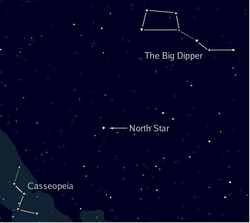
For centuries, Polaris, commonly known as the North Star, has served as a steadfast beacon for navigators and stargazers alike. Located in the constellation Ursa Minor, this star appears nearly stationary in the night sky, making it an essential tool for determining direction in the Northern Hemisphere.
However, beneath its calm appearance lies a complex stellar system. Far from being a single point of light, Polaris is a ternary system—a group of three stars—and a Classical Cepheid, a type of variable star that pulses in brightness over time. Because of these characteristics, Polaris is not just a navigational aid but a critical tool for astronomers measuring the scale of the universe.

Key Facts
- System Type: A ternary system consisting of Polaris Aa, Polaris Ab, and Polaris B.
- Variable Type: Polaris Aa is a Classical Cepheid variable.
- Distance: Approximately 446.5 light-years from Earth.
- Constellation: Ursa Minor.
- Role: Currently serves as the North Pole star due to its proximity to the celestial pole.
The Triple Star System
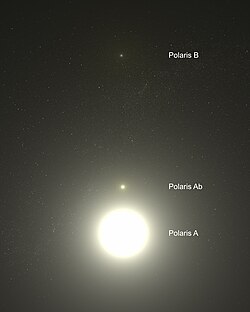
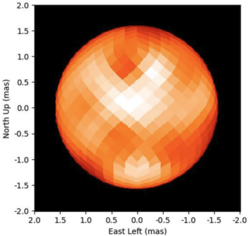
While it looks like one star to the naked eye, Polaris is actually composed of three distinct components. The primary star, Polaris Aa, is an evolved yellow supergiant. It is the dominant source of light in the system and is the first Cepheid variable to have its mass determined through its orbital motion.
Orbiting the primary are two smaller companions: Polaris Ab, a close F6 main-sequence star, and Polaris B, an F3 main-sequence star located much further away at a distance of roughly 2,400 astronomical units (AU). The interaction between these stars was first hinted at in 1899 when astronomers noticed variations in the radial velocity—the speed at which a star moves toward or away from the observer—of Polaris A.
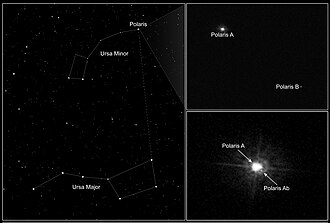
The orbital relationship between Polaris Aa and Ab is particularly tight, with a period of approximately 29.4 years and a high eccentricity of 0.6354, meaning their orbit is a stretched ellipse rather than a circle.
Variability and the Cosmic Distance Ladder
Polaris Aa is a Cepheid variable, a class of stars that periodically expand and contract, causing their luminosity to fluctuate. This pulsation occurs over a period of about four days. These stars are vital to astronomy because there is a direct relationship between their pulsation period and their intrinsic brightness.
By comparing a Cepheid's known intrinsic brightness to how dim it appears from Earth, astronomers can calculate precise distances to far-off galaxies. As the closest Cepheid variable to our solar system, Polaris serves as a foundational anchor for the cosmic distance ladder, the succession of methods used to measure the scale of the universe.
![A light curve for Polaris, plotted from TESS data[29]](/images/b2/af/b2afaf31e8c7bca91ad9b1be3e2fb377dde5ac51cade342f1cd9c98c73450ad2.png)
The Shifting Pole Star
Polaris is the North Star today, but it has not always been, nor will it always remain so. This is due to the precession of the equinoxes, a slow "wobble" in Earth's rotational axis that completes a full circle every 26,000 years.
As the axis shifts, different stars align with the North Celestial Pole. Polaris will reach its closest point to the pole around 2100 AD. After that, the pole will begin to drift away, eventually passing by the star Errai (Gamma Cephei) in 4000 AD, Deneb in 10,000 AD, and Vega in 14,500 AD, before eventually returning to Polaris.
![Polaris azimuths vis clock face analogy.[38]](/images/e0/07/e00749e515cbe0442b378c41085ea638776452e4c4ead9f10cb935e2a946d0b4.jpg)
Measuring the Distance to Polaris
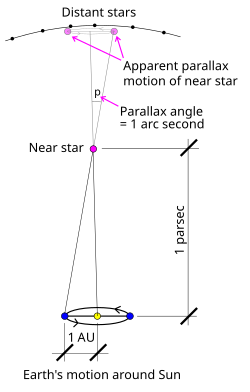
Determining the exact distance to Polaris has been a subject of scientific debate. Astronomers use stellar parallax—the apparent shift of a star's position against a distant background as Earth orbits the Sun—to calculate distance. A distance of one parsec (pc) is defined as the distance at which a star has a parallax angle of one arcsecond.
Recent data from the Gaia mission, which provides highly accurate astrometry, has refined this distance. Based on observations of Polaris B, the distance is estimated at 446.5 light-years (136.9 parsecs).
System Summary
| Component | Spectral Type | Mass (Solar Masses) | Radius (Solar Radii) | Apparent Magnitude |
|---|---|---|---|---|
| Polaris Aa | F7Ib | 5.13 ± 0.28 | 46.27 ± 0.42 | 1.98 (Variable) |
| Polaris Ab | F6V | 1.316 | 1.04 | N/A |
| Polaris B | F3V | 1.39 | 1.38 | 8.7 |

Frequently Asked Questions
Why is Polaris called the North Star?
Polaris is called the North Star because it is located almost directly above the Earth's North Pole. As Earth rotates, most stars appear to move in arcs across the sky, but Polaris remains nearly stationary, making it a reliable point of reference for navigation.
Is Polaris the brightest star in the sky?
No, Polaris is not the brightest star. While it is prominent due to its position, its apparent magnitude is around 1.98, which is significantly dimmer than stars like Sirius.
Will Polaris always be the North Star?
No. Due to the precession of the equinoxes, Earth's axis wobbles over a 26,000-year cycle. Other stars, such as Vega and Deneb, will take over as the pole star in the distant future.
What does it mean that Polaris is a Cepheid variable?
Being a Cepheid variable means the star physically pulses, changing its size and brightness over a regular period. This characteristic allows astronomers to use it as a "standard candle" to measure distances across the universe.
How many stars are actually in the Polaris system?
The Polaris system is a ternary system, meaning it consists of three stars: the supergiant Polaris Aa, the close companion Polaris Ab, and the more distant companion Polaris B.