Edwin Hubble: The Astronomer Who Expanded the Universe
Edwin Powell Hubble was a transformative figure in science whose work fundamentally altered our perception of the cosmos. By bridging the gap between observation and theory, he established the foundations of extragalactic astronomy (the study of galaxies outside our own) and observational cosmology (the study of the origin and evolution of the universe). Before Hubble, the scientific community believed the Milky Way constituted the entirety of the universe; Hubble proved that we are but one of many "island universes" in a vast, expanding void.
Key Facts
- Major Discovery: Proved that "nebulae" were actually distant galaxies beyond the Milky Way.
- Scientific Legacy: Formulated Hubble's law, describing the relationship between a galaxy's distance and its velocity.
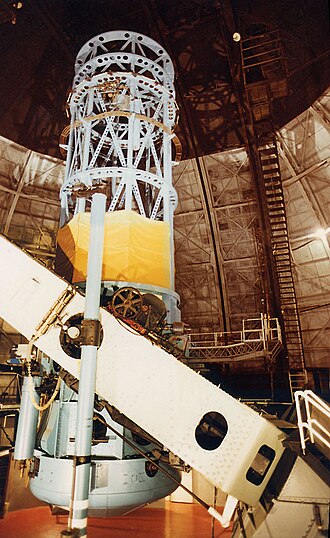
- Key Tool: Utilized the 100-inch Hooker telescope at Mount Wilson Observatory.
- Academic Background: Earned a PhD from the University of Chicago in 1921.
- Military Service: Served as a Major in the U.S. Army during World War I.
Early Life and Athleticism
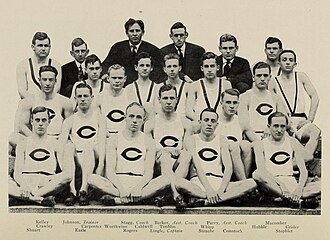
Born on November 20, 1889, in Marshfield, Missouri, Edwin Hubble was initially recognized more for his physical talents than his academic ones. A gifted athlete, he excelled in baseball, football, and track. During his time at the University of Chicago, he led the basketball team to its first Big Ten Conference title in 1907.
Education and the Path to Astronomy
Despite a lifelong passion for the stars, Hubble initially followed his father's wishes to study law. He pursued legal studies at the University of Chicago and later at Oxford University. However, following his father's death in 1913, Hubble shifted his focus. After a brief period teaching Spanish, physics, and mathematics at New Albany High School in Indiana, he returned to graduate studies.
Hubble entered the University of Chicago's Yerkes Observatory, where he utilized both a 40-inch refractor and a 26-inch reflector telescope. He completed his PhD in 1921 with a dissertation titled "Photographic Investigations of Faint Nebulae."
Military Service and Professional Beginnings
In 1917, the United States entered World War I. Hubble accelerated his doctoral work to enlist in the U.S. Army. He was assigned to the 86th Division, 2nd Battalion, 343rd Infantry Regiment, eventually rising to the rank of Major. While his division moved overseas, they did not engage in combat.
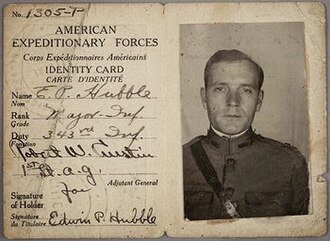
Following the war, Hubble spent a year at the University of Cambridge before accepting a staff position in 1919 at the Mount Wilson Observatory, part of the Carnegie Institution for Science. He remained there for the rest of his career.
Revolutionizing the Cosmos
Beyond the Milky Way
At the time, many astronomers believed the Milky Way was the entire universe. Hubble challenged this by studying Cepheid variables—stars with a direct relationship between their luminosity (brightness) and pulsation period, a discovery made by Henrietta Swan Leavitt in 1908. By using these stars as "standard candles" to measure distance, Hubble proved that the Andromeda galaxy was far beyond the boundaries of our own.
The Expanding Universe and Hubble's Law
Hubble's observations revealed that the redshift (the stretching of light toward longer wavelengths) of galaxies increased in proportion to their distance from Earth. This suggested that the universe was expanding. While he later expressed some skepticism regarding the "explosion" theory (the Big Bang) in 1941, his data provided the empirical basis for the expanding universe model.
The Hubble Sequence
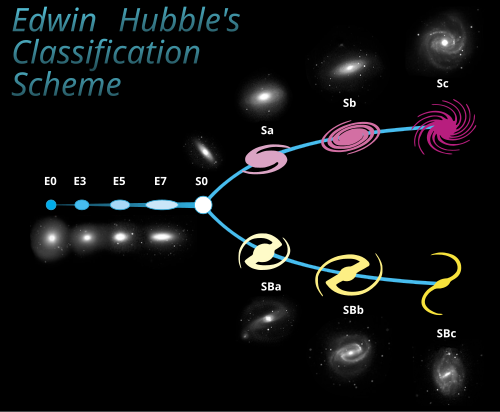
Hubble also developed a morphological classification scheme for galaxies, categorizing them based on their visual appearance into elliptical, spiral, and irregular types.
Summary of Career and Achievements
| Category | Details |
|---|---|
| Primary Institutions | University of Chicago, Mount Wilson Observatory, Carnegie Institution for Science |
| Key Laws/Sequences | Hubble's law, Hubble sequence, Hubble luminosity law, Hubble–Reynolds law |
| Major Awards | Bruce Medal, Franklin Medal, Gold Medal of the Royal Astronomical Society |
| Other Discoveries | Asteroid 1373 Cincinnati, Comet C/1937 P1 |
Personal Life and Final Years
Hubble married Grace Burke on February 26, 1924. Throughout his life, he remained a dedicated observer, preferring empirical evidence over theoretical speculation. In his final years, he became the first astronomer to use the 200-inch Hale Telescope at Palomar Observatory.
Hubble suffered a heart attack in 1949 and eventually died of cerebral thrombosis (a blood clot in the brain) on September 28, 1953, in San Marino, California. He was 63 years old.
Frequently Asked Questions
Did Edwin Hubble discover the Big Bang?
While Hubble did not formulate the Big Bang theory himself, his discovery that the universe is expanding provided the critical observational evidence that supported the theory.
What is the Hubble Sequence?
The Hubble Sequence is a classification scheme used to categorize galaxies based on their shape, dividing them into elliptical, spiral, and irregular galaxies.
Why is the Hubble Space Telescope named after him?
The telescope is named in his honor because of his pivotal role in proving the existence of other galaxies and discovering the expansion of the universe.
Did Hubble win a Nobel Prize?
No. Although reports suggest he was unanimously voted the prize in physics in 1953, he died suddenly that year before the award could be conferred.
What was Hubble's role in World War I?
Hubble served as a Major in the U.S. Army within the 86th Division, 2nd Battalion, 343rd Infantry Regiment, though his unit did not see combat.