Point Particles in Physics: From Classical Ideals to Quantum Reality
In the study of physics, a point particle (also known as an ideal or point-like particle) is a fundamental idealization. It describes a body with negligible spatial extension, meaning its size, shape, and internal structure are considered irrelevant to the problem at hand. This simplification allows physicists to model complex systems by focusing on the particle's position and additive properties rather than its physical dimensions.
From a distance, any finite-sized object behaves as a point-like object. In classical mechanics, because a point particle has no volume, the concept of rotation about its own center is generally disregarded. Mathematically, when a point particle possesses an additive property like mass or charge, it is often represented using a Dirac delta function, a tool used to describe a quantity that is concentrated at a single point.
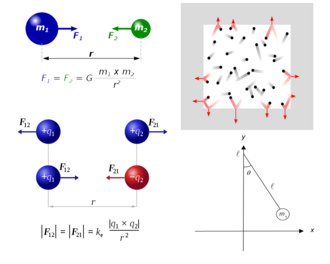
Key Facts
- Definition: An idealization of an object with negligible spatial extension.
- Application: Used when an object's size and shape do not affect the physical outcome.
- Classical Examples: Point masses in gravitation and point charges in electromagnetism.
- Quantum Distinction: Differentiates between elementary particles (no known internal structure) and composite particles (made of other particles).
- Constraint: In quantum mechanics, the Heisenberg uncertainty principle prevents particles from being perfectly spatially localized.
Point Mass in Classical Physics
A point mass is a theoretical object that possesses a non-zero mass but is considered infinitesimal in its volume or linear dimensions. This model is particularly powerful in the theory of gravity.
According to Newtonian gravitation, spherical objects interacting in three-dimensional space behave as if all their matter were concentrated at their centers of mass, provided they do not touch. This principle applies to all physical fields described by an inverse square law, where the force between two objects decreases in proportion to the square of the distance between them.
Point Charge in Electromagnetism
In the realm of electromagnetism, a point charge is a point particle with a non-zero electric charge. It is defined as a charge carrier whose effective diameter is significantly smaller than the distance to any other charged object.
The behavior of these particles is governed by Coulomb's law, the fundamental equation of electrostatics describing the force between two point charges. However, the model has limits: the electric field of a classical point charge increases to infinity as the distance to the charge approaches zero, indicating the model's inaccuracy at extremely close ranges. Additionally, Earnshaw's theorem proves that a collection of point charges cannot be maintained in a stable, static equilibrium using only electrostatic interactions.

Point Particles in Quantum Mechanics
The transition to quantum mechanics complicates the definition of a point particle due to the Heisenberg uncertainty principle. This principle dictates that no particle can be perfectly spatially localized; instead, a particle's wavepacket always occupies a non-zero volume.
Elementary vs. Composite Particles
Physicists distinguish between two types of particles based on their internal makeup:
- Elementary Particles: Particles such as electrons, quarks, or photons that have no known internal structure.
- Composite Particles: Particles such as protons and neutrons, which are composed of smaller constituents (quarks).
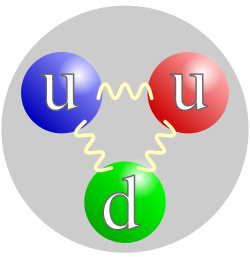
While elementary particles are often called "point particles," this refers to their lack of internal structure rather than their spatial localization. An elementary particle's wavepacket can be represented as a quantum superposition of states where the particle is exactly localized, a property not shared by composite particles.
This allows scientists to discuss the intrinsic "size" of a particle as the size of its internal structure. For example, experimental evidence indicates that the size of an electron is less than 10-18 m. This is distinct from the "classical electron radius," which is a separate theoretical value.
Summary of Particle Types
| Concept | Field | Defining Characteristic | Key Governing Law/Principle |
|---|---|---|---|
| Point Mass | Classical Mechanics | Infinitesimal volume with non-zero mass | Newtonian Gravitation |
| Point Charge | Electromagnetism | Infinitesimal volume with electric charge | Coulomb's Law |
| Elementary Particle | Quantum Mechanics | No known internal structure | Heisenberg Uncertainty Principle |
| Composite Particle | Quantum Mechanics | Internal structure (e.g., quarks) | Quantum Superposition |
Frequently Asked Questions
What is the difference between a point particle and an elementary particle?
A point particle is a general physics idealization of an object with negligible size. An elementary particle is a specific type of particle, like an electron, that has no known internal structure. While elementary particles are often called point particles, the term "point particle" in classical physics refers to the absence of spatial extension, whereas in quantum physics, it refers to the absence of internal components.
Can a real object ever be a true point particle?
No. In classical physics, the point particle is a mathematical model used to simplify calculations when an object's size is irrelevant. In quantum mechanics, the Heisenberg uncertainty principle ensures that particles always occupy a non-zero volume via their wavepackets.
Why does the point charge model fail at very short distances?
The model fails because the calculated electric field increases to infinity as the distance to the point charge reaches zero. In physical reality, such an infinite field is not possible, indicating that the point-like approximation is no longer accurate at that scale.
How do spherical objects behave like point masses?
Spherical objects interacting via Newtonian gravitation behave as if all their mass is concentrated at their center of mass, provided they do not touch. This allows them to be treated as point masses in gravitational calculations.
What is the intrinsic size of an electron?
Experimental evidence shows that the intrinsic size of an electron (the size of its internal structure) is less than 10-18 m. This should not be confused with the classical electron radius or the size of its quantum wavepacket.