Kinematics: The Geometry of Motion in Physics and Engineering
Kinematics is a specialized subfield of physics and a branch of geometry that describes the motion of physical objects. Unlike dynamics, which examines the forces that cause motion, kinematics focuses exclusively on the geometrical aspects of movement. It analyzes how the position, distance, and angular measure of an object change over time relative to a specific frame of reference.
From the simple trajectory of a single particle to the complex movements of linked machine parts, kinematics provides the mathematical framework necessary to specify positions and velocities. These are often expressed through various coordinate systems, such as rectangular Cartesian coordinates or curvilinear polar coordinates, and can be calculated relative to other moving objects.
Key Facts
- Focus: Studies the geometry of motion independent of the forces causing it.
- Core Quantities: Primarily deals with position, velocity, acceleration, and their time derivatives.
- Scope: Applies to point particles, rigid bodies, and constrained systems like mechanical linkages.
- Relativistic Aspect: Includes time dilation and length contraction via the Lorentz transformation.
- Quantum Aspect: Incorporates the uncertainty principle, where conjugate kinematic quantities cannot be measured simultaneously.
Foundations of Particle Kinematics
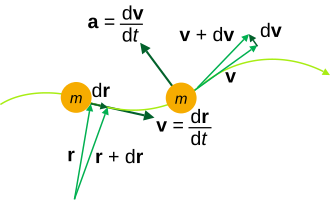
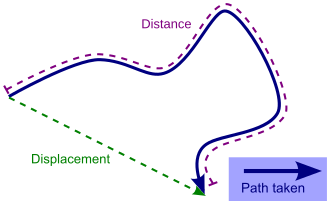
At its most basic level, kinematics studies the trajectory of a particle. The position vector (r) defines the coordinate from the origin of a reference frame to the particle. A trajectory is essentially a vector function of time, tracing a curve in space through coordinates x, y, and z.
Velocity and Acceleration
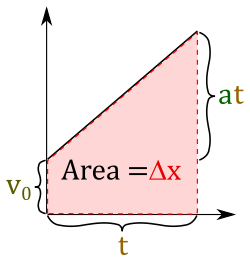
Velocity (v) is the first derivative of the position vector with respect to time, always acting tangent to the path of motion. Acceleration (a) is the first derivative of velocity, or the second derivative of position. In a non-rotating frame of reference, the directions of the coordinate axes remain constant.
Relative Motion
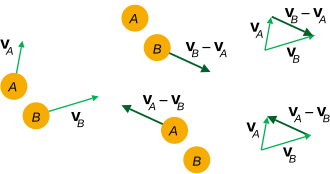
In many scenarios, it is necessary to describe the motion of one object relative to another. This is achieved through vector subtraction:
- Relative Position: The difference between the position vectors of two points.
- Relative Velocity: The difference between the velocity components of two points.
- Relative Acceleration: The difference between the acceleration components of two points.
Advanced Coordinate Systems and Trajectories
While Cartesian coordinates are standard, cylindrical-polar coordinates are often more convenient for particles moving in a plane or around an axis. In these systems, motion is described by a radius and an angle.
Planar Circular Motion
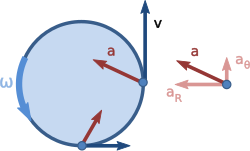
When a particle moves in a circular trajectory with a constant radius and no movement along the z-axis, its acceleration consists of two components: radial acceleration (pointing toward the center) and tangential acceleration (which changes the rate of rotation).
Rigid Body Kinematics
Kinematics also extends to rigid bodies—objects that do not change shape during motion. This involves rigid displacements, which are combinations of translation and rotation.
Pure Translation vs. Rotation
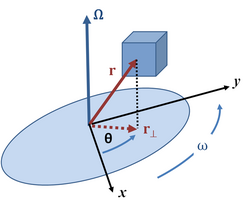
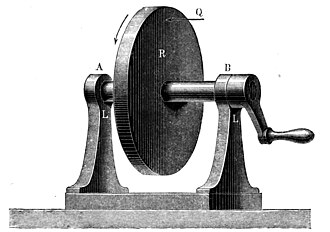
In pure translation, every point in the body moves with the same velocity and acceleration as the body's origin. However, in rotation, the velocity of a point depends on its distance from the axis of rotation and the angular velocity (ω), which is the rate of change of the angular position.
Matrix Representation
To mathematically handle complex 3D movements, engineers use a homogeneous transform. This 3x3 (for 2D) or 4x4 (for 3D) matrix combines a rotation matrix and a translation vector, allowing for the efficient calculation of a point's trajectory in a fixed reference frame.
Kinematic Constraints and Linkages
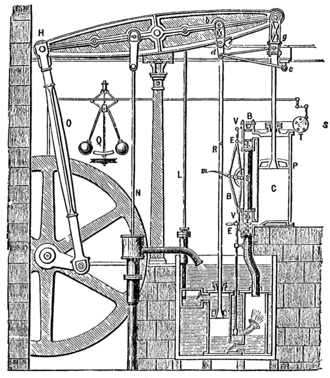
In mechanical engineering, kinematics describes constrained motion, where parts are linked to restrict movement in specific ways. These are known as kinematic pairs.
- Lower Pairs: Include spherical (ball) joints and planar joints, which maintain surface contact.
- Higher Pairs: Joints where contact occurs at a point or a line.
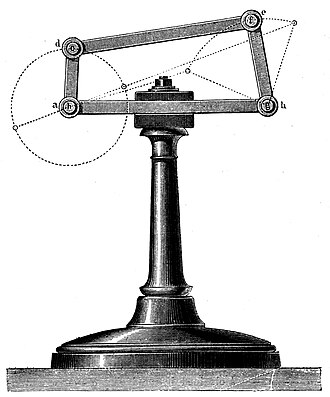
These pairs form kinematic chains. For example, a four-bar linkage is a common one-degree-of-freedom system used in machinery.
Summary of Kinematic Concepts
| Quantity | Symbol | Definition | Derivative Relation |
|---|---|---|---|
| Position | r | Location relative to origin | - |
| Velocity | v | Rate of change of position | dr/dt |
| Acceleration | a | Rate of change of velocity | dv/dt or d²r/dt² |
| Angular Velocity | ω | Rate of change of angle | dθ/dt |
Specialized Kinematics
Relativistic Kinematics
When objects move at speeds approaching the speed of light, classical kinematics is replaced by relativistic kinematics. This framework uses spacetime geometry and 4-vectors to account for phenomena such as length contraction and time dilation via the Lorentz transformation.
Quantum Kinematics
In the quantum realm, Werner Heisenberg reinterpreted kinematics to show that certain pairs of conjugate quantities (like position and momentum) cannot be measured simultaneously with absolute precision. This fundamental limit is known as the uncertainty principle.
Frequently Asked Questions
What is the difference between kinematics and dynamics?
Kinematics describes the motion of objects (position, velocity, acceleration) without considering the causes of that motion. Dynamics, on the other hand, studies the forces and torques that cause objects to move.
What is a homogeneous transform in kinematics?
A homogeneous transform is a matrix used to represent a combination of rotation and translation. It allows for the transformation of coordinates from a moving reference frame to a fixed reference frame in a single mathematical operation.
How does relative velocity differ from absolute velocity?
Absolute velocity is measured relative to a fixed, standard reference frame. Relative velocity is the velocity of one object as observed from another object, calculated as the vector difference between their absolute velocities.
What are kinematic constraints?
Kinematic constraints are restrictions on the movement of a system, often imposed by physical connections like joints or hinges. These constraints reduce the degrees of freedom of the system, ensuring parts move in a predictable, linked manner.