Free Fall: The Physics of Gravity and Motion
In the realm of classical mechanics, free fall is defined as any motion of a body where gravity is the only force acting upon it. While the common use of the word "fall" implies a downward vertical motion, the scientific definition is broader. Any object subject only to the force of gravity is in free fall, regardless of its direction. For example, the Moon is technically in free fall around the Earth; its high orbital speed prevents it from crashing into the surface, but gravity remains the sole governing force.
When an object is in free fall within a uniform gravitational field, gravity acts on every part of the body equally. This absence of opposing forces—such as the normal force provided by a floor or a seat—results in the sensation of weightlessness. This condition is also experienced in regions where the gravitational field is exceptionally weak.
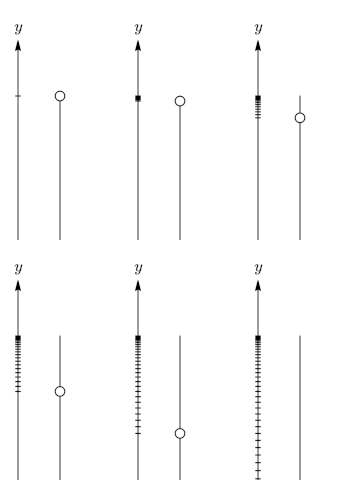
Key Facts
- Definition: Motion where gravity is the only acting force.
- Acceleration: Near Earth's surface, objects accelerate at approximately 9.8 m/s².
- Mass Independence: In a vacuum, all objects fall at the same rate regardless of their mass.
- Weightlessness: Occurs when no normal force counteracts gravity.
- Terminal Velocity: The constant speed reached when aerodynamic drag equals the force of gravity.
The Evolution of Gravitational Theory
Early Misconceptions and Challenges
Before the 16th century, the prevailing Western belief was that a falling body's speed was proportional to its weight. This Aristotelian view suggested that a 10 kg object would fall ten times faster than a 1 kg object. However, this was challenged as early as the 6th century by John Philoponus, who observed that objects of different weights fall at nearly the same speed. Later, in 12th-century Iraq, Abu'l-Barakāt al-Baghdādī proposed that a continuously applied force produces acceleration, anticipating the fundamental laws of classical mechanics.
The Contributions of De Soto and Galileo
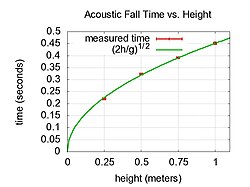
In 1551, Domingo de Soto stated that a body in free fall accelerates uniformly due to the mass of the Earth. This concept provided a foundation for later work by Galileo Galilei and Isaac Newton. Galileo famously studied falling bodies, though he primarily used rolling ramps rather than vertical drops to slow the motion enough for measurement using water clocks and his own pulse.
Galileo's discovery—that all objects accelerate at the same rate in the absence of air resistance—was famously demonstrated on the Moon in 1971. Astronaut David Scott dropped a hammer and a feather simultaneously; both hit the lunar surface at the same time, confirming that without atmospheric drag, mass does not affect fall rate.
Free Fall in Different Environments
Vacuum vs. Atmosphere
In a vacuum, an object near Earth's surface accelerates at 9.8 m/s². However, in an atmosphere, aerodynamic drag (air resistance) opposes gravity. As an object speeds up, the drag force increases until it equals the gravitational force. At this point, the object reaches terminal velocity—a constant speed where no further acceleration occurs.
For a human skydiver in a spread-eagle position, terminal velocity is approximately 53 m/s (190 km/h). This is typically reached after about 12 seconds, having fallen roughly 450 meters. Because of this drag, a skydiver is not in "true" scientific free fall, as they feel the air supporting their weight.
Orbital Motion and Space
Objects in space, such as satellites or the International Space Station, are in a state of continuous free fall. They are moving forward at such high speeds that as they fall toward Earth, the surface of the planet curves away beneath them, resulting in a stable orbit. This is often illustrated by the "Newton's cannonball" thought experiment.
Mathematical Frameworks
Newtonian Mechanics
In a uniform gravitational field without air resistance, the velocity (v) and position (y) of a falling object are calculated based on time (t) and the acceleration due to gravity (g). If an object starts from rest, the distance fallen grows as the square of the elapsed time.
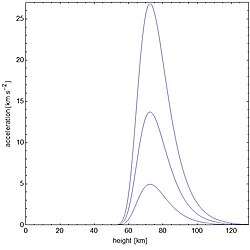
When air resistance is included, the equation becomes more complex, incorporating the object's mass, cross-sectional area, and the drag coefficient. For objects falling from extreme altitudes (like HALO jumps), numerical simulations are required because air density changes as the object descends.
General Relativity
Albert Einstein's theory of general relativity reimagines gravity not as a force, but as a curvature of space-time. In this context, an object in free fall is an inertial body moving along a geodesic (the shortest path between two points in curved space). This perspective explains phenomena that Newtonian mechanics cannot, such as the precession of orbits and gravitational waves.
Summary of Free Fall Conditions
| Scenario | Forces Acting | State | Sensation |
|---|---|---|---|
| Vacuum Drop | Gravity only | True Free Fall | Weightlessness |
| Orbiting Satellite | Gravity only | True Free Fall | Weightlessness |
| Skydiver (No Chute) | Gravity + Air Drag | Approximate Free Fall | Air Support |
| Standing on Ground | Gravity + Normal Force | Not Free Fall | Weight |
| Aircraft Flight | Gravity + Lift | Not Free Fall | Weight |
Frequently Asked Questions
Is an object moving upward still in free fall?
Yes. In physics, if gravity is the only force acting on an object, it is in free fall regardless of whether it is moving upward, downward, or is instantaneously at rest at the peak of its trajectory.
Why do humans feel weightless in orbit?
Weightlessness occurs because there is no normal force (like a floor) pushing back against gravity. Since the spacecraft and the astronaut are both falling toward Earth at the same rate, the astronaut floats relative to the ship.
Does mass affect the speed of a falling object?
In a vacuum, mass has no effect on the rate of acceleration. In an atmosphere, mass can influence the terminal velocity, but the initial acceleration remains the same for all objects.
What is the difference between Newtonian free fall and General Relativity?
Newtonian mechanics treats free fall as the result of a gravitational force pulling an object. General Relativity views it as an object following the natural curvature of space-time without any force acting upon it at all.