Equivalence Principle: The Foundation of General Relativity
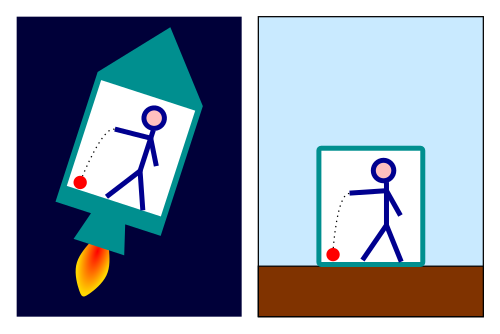
At the heart of modern physics lies a profound realization: the way an object resists acceleration is fundamentally linked to how it responds to gravity. This concept, known as the equivalence principle, posits that the observed equivalence between gravitational mass and inertial mass is not a coincidence, but a fundamental property of nature. This principle served as the critical catalyst for Albert Einstein's development of the theory of general relativity.
In classical mechanics, Newton's equation of motion in a gravitational field is expressed as: inertial mass × acceleration = gravitational mass × gravitational acceleration. The equivalence principle suggests that these two types of mass are effectively the same, meaning all objects, regardless of their composition, will behave identically when subjected to gravity alone.
Key Facts
- Weak Equivalence Principle (WEP): All masses in free fall follow the same trajectories and land at the same time, regardless of composition.
- Einstein Equivalence Principle (EEP): Extends the WEP by requiring that special relativity holds in free fall and that outcomes are independent of velocity and position.
- Strong Equivalence Principle (SEP): Extends the EEP to include stellar objects and strong gravitational fields.
- Experimental Precision: Modern tests, such as the MICROSCOPE mission, have limited deviations from equivalence to extremely small margins.
- Astrophysical Evidence: Observations of a millisecond pulsar in a triple star system have confirmed the SEP to within two parts per million.
Levels of the Equivalence Principle
The equivalence principle is not a single statement but a hierarchy of hypotheses, ranging from basic observations to complex relativistic requirements.
The Weak Equivalence Principle
The Weak Equivalence Principle is the most basic form, known for centuries. It states that the trajectory of a point mass in a gravitational field depends only on its initial position and velocity, and is independent of its composition. In simpler terms, in a vacuum, a feather and a hammer will fall at the same rate.
The Einstein Equivalence Principle
The Einstein Equivalence Principle builds upon the weak form by adding two critical constraints to ensure the laws of physics remain consistent:
- Local Lorentz Invariance: The outcome of any local non-gravitational experiment is independent of the velocity of the freely falling apparatus.
- Local Positional Invariance: The outcome of any local non-gravitational experiment is independent of where in the universe it is performed.
The Strong Equivalence Principle
The Strong Equivalence Principle is the most restrictive version. It requires that the laws of physics—including those governing gravitational energy itself—be the same for all observers in free fall, extending the Einstein form to include massive stellar objects.
Experimental Validation
Scientists have spent centuries testing these principles using increasingly sensitive instruments, from simple drop towers to satellites in Earth orbit.
| Year | Investigator | Method | Sensitivity |
|---|---|---|---|
| ~500 | John Philoponus | Drop tower | Small |
| 1585 | Simon Stevin | Drop tower | 5 × 10⁻ |
| 1590? | Galileo Galilei | Pendulum, drop tower | 2 × 10⁻ |
| 1908 (1922) | Loránd Eötvös | Torsion balance | 2 × 10⁻ |
| 1976 | Various | Lunar laser ranging | 10⁻ |
| 2017 | MICROSCOPE | Earth orbit | 10⁻ |
Beyond the weak principle, the Einstein Equivalence Principle has been tested by monitoring fundamental constants over time. For example, data from the Oklo natural nuclear reactor (1976) and observations of quasars (2002) have placed strict limits on the fractional change of the fine-structure constant and the electron-proton mass ratio.
The Strong Equivalence Principle was rigorously tested in 2014 through the discovery of a stellar triple system containing a millisecond pulsar (PSR J0337+1715) and two white dwarfs. By analyzing pulsar timing data, astronomers determined that any departure from the SEP is no more than two parts per million.
Frequently Asked Questions
What is the difference between inertial and gravitational mass?
Inertial mass is an object's resistance to acceleration when a force is applied, while gravitational mass is the property that determines the strength of the gravitational pull an object experiences. The equivalence principle states these two are identical.
Why is the Einstein Equivalence Principle important for General Relativity?
It provided the theoretical framework for Einstein to realize that gravity is not a force in the traditional sense, but a result of the curvature of spacetime, allowing special relativity to function locally within a gravitational field.
How does the MICROSCOPE mission test the equivalence principle?
The MICROSCOPE mission tests the Weak Equivalence Principle by measuring the acceleration of two different test masses in Earth orbit, where the effects of gravity can be monitored with extreme precision away from terrestrial interference.
What is local Lorentz invariance?
Local Lorentz invariance is the requirement that the results of a local experiment do not change based on the velocity of the observer or the apparatus, provided they are in a state of free fall.
How do pulsars help test the Strong Equivalence Principle?
Pulsars act as highly accurate cosmic clocks. By observing a pulsar in a triple star system, scientists can see if the pulsar's orbit is affected by the gravitational fields of the other stars in a way that violates the SEP.