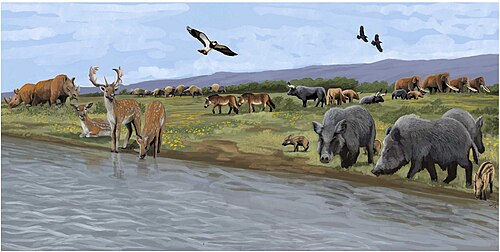
Pleistocene extinctionmegafaunaIce Age animalsbiogeographic realmsmammoth steppe

Pleistocene Megafauna Extinctions Across Biogeographic Realms

Pleistocene Megafauna Extinctions Across Biogeographic Realms The Late Pleistocene was a period of dramatic biological turnover, characterized by the disappearance of the world's largest ...

Pleistocene Megafauna Extinctions Across Biogeographic Realms

The Late Pleistocene was a period of dramatic biological turnover, characterized by the disappearance of the world's largest land animals. From the frozen steppes of Eurasia to the tropical woodlands of South America, megafauna—large animals typically weighing over 44 kg (100 lb)—faced a wave of extinctions that reshaped global ecosystems. This phenomenon was not uniform; different regions experienced varying rates of loss depending on their geography and the arrival of early humans.

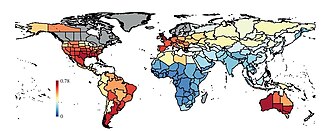
The scale of these losses is staggering. In some regions, such as North America and Australasia, more than 60% of large mammal species vanished. These extinctions removed apex predators and giant herbivores, fundamentally altering the vegetation and nutrient cycles of the planet.
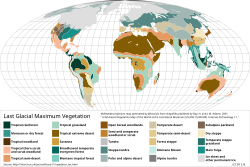
Vegetation types at the time of Last Glacial Maximum. The steppe-tundra, also known as mammoth steppe, was once the Earth's most extensive biome.

Key Facts

The proportion of extinct large mammal species (more than or equal to 10 kg (22 lb)) in each country during the last 132,000 years, only counting extinctions earlier than 1000 years BP (Note, Gray Areas on continents indicate land entirely covered in Glacial Ice at the time, and on islands, that man had not yet reached by this time ie no data either way)
  • Global Impact: Approximately 34% of all large mammal species (over 10 kg) went extinct during the last 132,000 years.
  • Hardest Hit Regions: North America (66% loss) and Australasia (67% loss) suffered the highest proportions of extinction.
  • Size Correlation: The largest animals (over 1,000 kg) were the most vulnerable, with a global extinction rate of 78.8%.
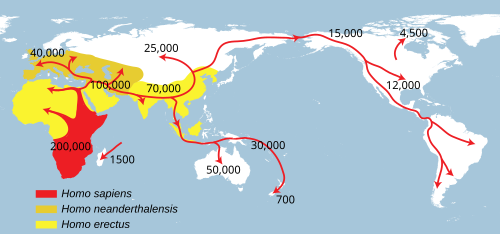
  • Human Correlation: Extinction timings often align with the "March of Man," the migration of Homo sapiens into new territories.
  • Diverse Loss: Extinctions spanned multiple groups, including proboscideans (elephants), xenarthrans (sloths/armadillos), and giant marsupials.

Regional Extinction Patterns
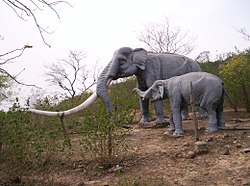
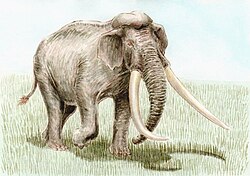
Life-sized models of Stegodon

The Palearctic (Eurasia and North Africa)

The Palearctic realm saw the loss of iconic Ice Age species. The mammoth steppe, once the world's most extensive biome, supported the woolly mammoth and woolly rhinoceros. Other notable losses included the Eurasian straight-tusked elephant and the cave lion.
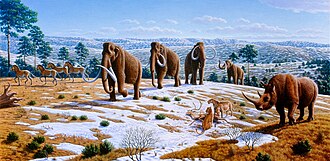
Late Pleistocene in northern Spain, by Mauricio Antón. Left to right: wild horse, woolly mammoth, reindeer, cave lion, woolly rhinoceros

In Europe, the landscape was home to the giant Irish elk and various dwarf hippopotamuses on islands like Malta and Cyprus. Predators such as the cave bear and cave hyena also disappeared as the climate shifted and human populations grew.
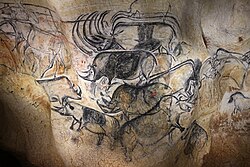
Cave paintings of the woolly rhinoceros (Coelodonta antiquitatis) in Chauvet-Pont-d'Arc Cave, France

The Nearctic (North America)

North America experienced one of the most severe extinction events. The loss included almost all native proboscideans, such as the Columbian mammoth and the American mastodon, as well as the feared saber-toothed cat (Smilodon fatalis).
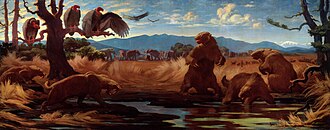
Mural of the La Brea Tar Pits by Charles R. Knight, including sabertooth cats (Smilodon fatalis, left) ground sloths (Paramylodon harlani, right) and Columbian mammoths (Mammuthus columbi, background)

Other significant losses included the giant short-faced bear, the dire wolf, and various camelids like the western camel. The region also lost unique herbivores such as the giant beaver and several species of ground sloths.
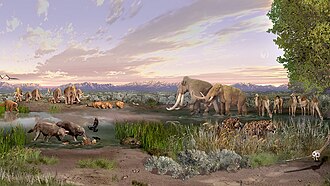
Environment of what is now White Sands National Park in New Mexico, with Columbian mammoths, a ground sloth, dire wolves, lions, camels, and saber-toothed cats.

The Neotropic (Central and South America)

South America's extinction event was marked by the loss of the Meridiungulata (native ungulates) and giant xenarthrans. The massive Megatherium (giant ground sloth) and armored glyptodonts were among the most prominent casualties.
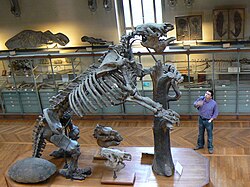
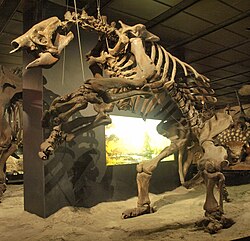
Skeleton of the giant ground sloth Megatherium

The region also lost its native horses (Hippidion) and the predatory Smilodon populator, the largest of the saber-toothed cats.
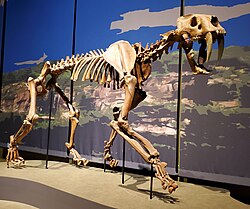
Fossil of Smilodon populator

Australasia and the Pacific

In Sahul (Australia and New Guinea), the extinction focused heavily on giant marsupials. The Diprotodon, the largest known marsupial, and the marsupial lion vanished alongside giant kangaroos and wombats.
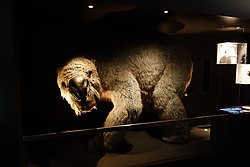
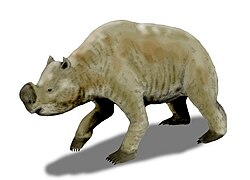
Reconstruction of a hippopotamus-sized Diprotodon

The region also saw the disappearance of massive reptiles, including Megalania (a giant monitor lizard) and Quinkana (a terrestrial crocodilian).
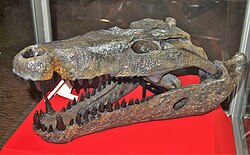
Quinkana a mekosuchine crocodilian with a possibly terrestrial lifestyle

Afrotropic and Indomalaya

Africa and Southeast Asia experienced lower extinction rates compared to the Americas and Australasia. However, losses still occurred, including the giant buffalo in Africa and the giant tapir in Southeast Asia.
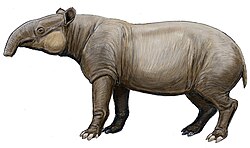
Giant tapir (Tapirus augustus) restoration

Comparative Extinction Data

Palaeoloxodon namadicus

The following table summarizes the loss of large mammal species by biogeographic realm, categorized by body mass.

Large Mammal Extinction Rates by Realm (Last 132,000 Years)
Biogeographic Realm Giants (>1,000kg) Loss % Very Large (400-1,000kg) Loss % Large (150-400kg) Loss % Medium (10-50kg) Loss % Total Loss %
Afrotropic 16.6% 25% 12% 2.9% 5.1%
Indomalaya 40% 16.7% 10% 1.8% 8.2%
Palearctic 100% 50% 35.7% 2.4% 22.9%
Nearctic 100% 80% 84.6% 36% 66%
Neotropic 100% 100% 82% 14.3% 54%
Australasia 100% 100% 100% 40% 67%
Global 78.8% 67.4% 54.7% 10.1% 34%

Theories of Extinction

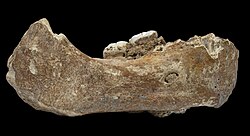
Fossil jaw (Xiahe mandible) of a denisovan

Scientists have debated the primary drivers of these extinctions for over a century. Most modern research focuses on two main hypotheses, or a combination thereof:

  • The Overkill Hypothesis: This theory suggests that humans were the primary cause, hunting large, slow-breeding animals to extinction as they migrated into new lands.
  • Climate Change: This hypothesis posits that the transition from the Pleistocene to the Holocene caused rapid habitat loss and temperature shifts that the megafauna could not survive.
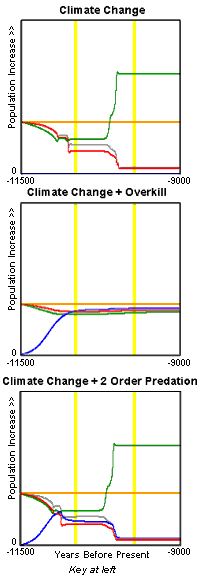
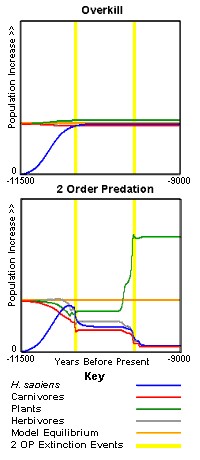
Combination Hypotheses: Climate Change, Overkill + Climate Change, Second-Order Predation + Climate Change

Other contributing factors may include second-order predation (where the loss of one species triggers the collapse of another) and landscape alterations. The timing of these extinctions often mirrors the arrival of humans in specific regions, supporting the theory that human activity played a critical role.
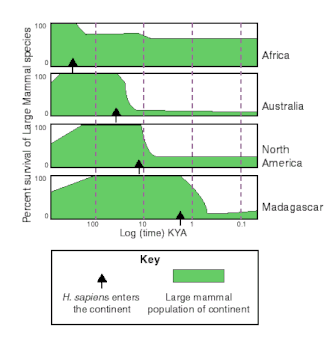
The timing of extinctions follows the "March of Man"

Frequently Asked Questions
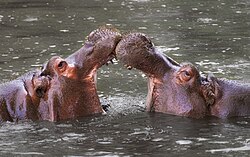
Hippopotamus (Hippopotamus amphibius) formerly inhabited Europe as far north as Great Britain at the beginning of the Late Pleistocene, becoming extinct in Europe around 30,000 years ago
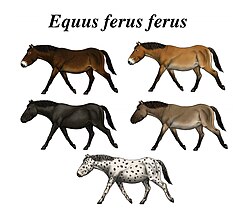
Reconstruction of the five phenotypes of Pleistocene wild horse. The coat colours and dimensions are based on genetic evidence and historic descriptions
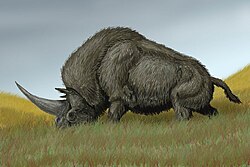
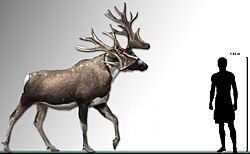
Elasmotherium sibiricum reconstruction
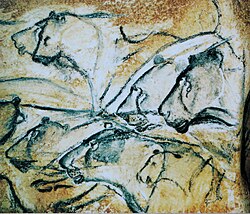
The 'Gallery of Lions', representations of the Eurasian cave lion in Chauvet-Pont-d'Arc Cave, France
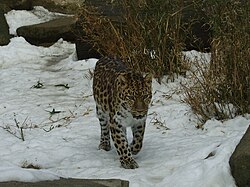
The leopard (Panthera pardus) inhabited the entire expanse of Afro-Eurasia below the 54th parallel north, from modern day Spain and the UK in the west, to South Africa in the south, and Siberia, Japan and Sundaland in the east during the Late Pleistocene
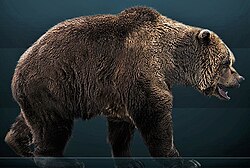
Cave bear (Ursus spelaeus) reconstruction
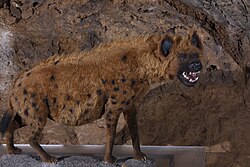
Cave hyena (Crocuta crocuta spelaea) reconstruction
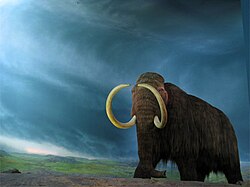
The woolly mammoth became extinct around 10,000 BCE – except for diminutive relict populations on St. Paul Island and Wrangel Island, which humans did not colonise until 3,600 BCE and 2,000 BCE respectively
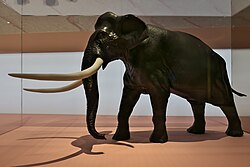
Model of the European straight-tusked elephant (Paleoloxodon antiquus)
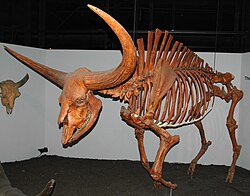
Long-horned/Giant bison (Bos latifrons), fossil bison skeleton (public display, Cincinnati Museum of Natural History & Science, Cincinnati, Ohio, United States)
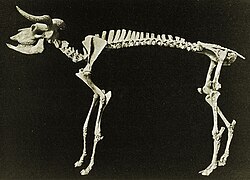
Mounted skeleton of a shrub-ox (Euceratherium collinum)
Life restoration of Stag-moose
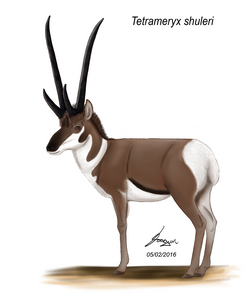
Tetrameryx shuleri restoration
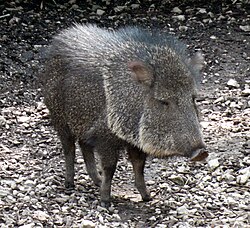
A Chacoan peccary (Catagonus wagneri), believed to be the closest surviving relative of the extinct Platygonus
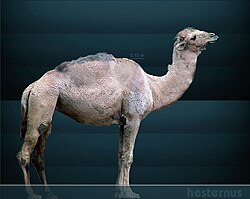
Western camel (Camelops hesternus) reconstruction
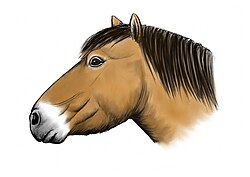
Life restoration of the Yukon horse (Equus lambei)
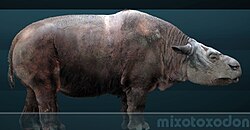
Reconstruction of Mixotoxodon larenis, a toxodontid notoungulate
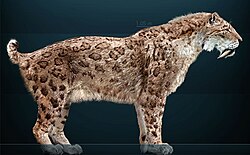
Saber-toothed cat (Smilodon fatalis) reconstruction
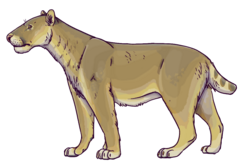
Reconstruction of the sabertooth cat Homotherium
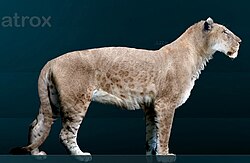
American lion (Panthera atrox) reconstruction
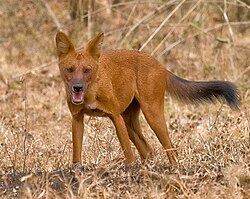
The dhole (Cuon alpinus), now restricted to the southern portions of Asia, was present from Iberia to Mexico during the Late Pleistocene
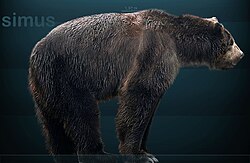
Giant short-faced bear (Arctodus simus) reconstruction
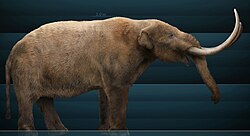
American mastodon (Mammut americanum) reconstruction
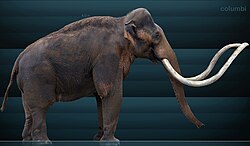
Columbian mammoth (Mammuthus columbi) reconstruction
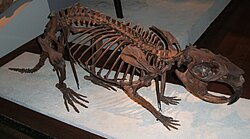
Giant beaver (Castoroides ohioensis) skeleton displayed at the Field Museum of Natural History, Chicago, Illinois, United States
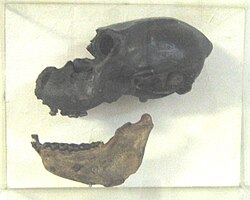
Skull of Paralouatta marianae, one of the two Cuban members of the extinct Antilles monkeys (Xenotrichini)
Eremotherium laurillardi skeleton displayed at the Houston Museum of Natural Science
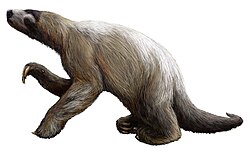
Life restoration of Nothrotheriops texanus
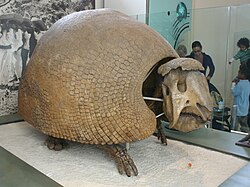
Glyptotherium reconstruction
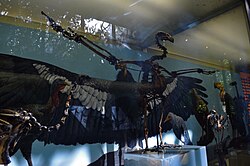
Californian turkey (Meleagris californica) and ancestral condor (Gymnogyps amplus) fossil displays at La Brea Tar Pits
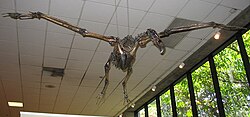
Teratornis merriami skeleton from the La Brea Tar Pits in flight pose
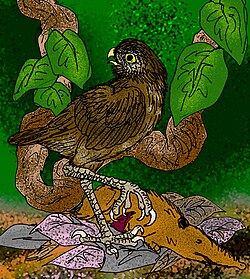
Reconstruction of the Cuban giant owl (Ornimegalonyx oteroi), of Pleistocene Cuba, with the carcass of a large solenodon
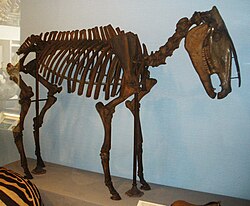
Fossil of Hippidion, a genus of horse native to South America.
Reconstruction of Macrauchenia, a member of the extinct order Litopterna
Skeleton of Toxodon, a member of the extinct order Notoungulata
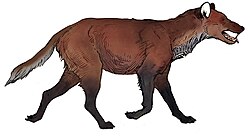
Reconstruction of the Dire wolf (Aenocyon dirus)
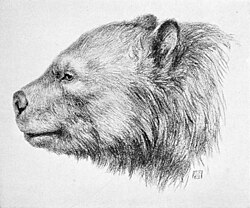
Life restoration of Arctotherium bonariense
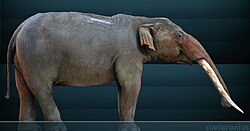
Reconstruction of the gomphothere Cuvieronius
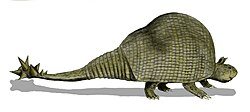
Reconstruction of the glyptodont Doedicurus clavicaudatus, distributed in the temperate savannah and woodland of South America
Fossil reconstruction of Panochthus frenzelianus with metal model
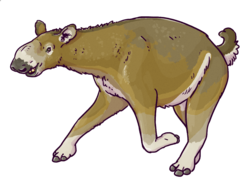
Reconstruction of Zygomaturus
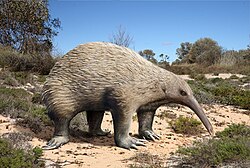
Reconstruction of the giant echidna Murrayglossus
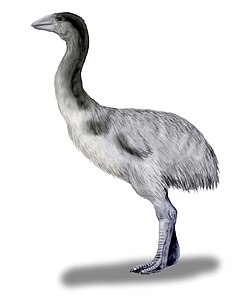
Reconstruction of Genyornis newtoni
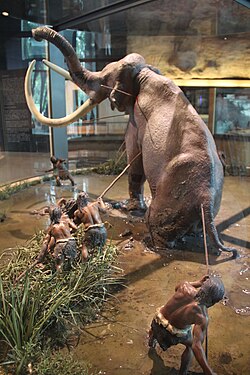
Diorama of a Paleoindian Columbian mammoth (Mammuthus columbi) hunting scene at the National Museum of Anthropology, Mexico City
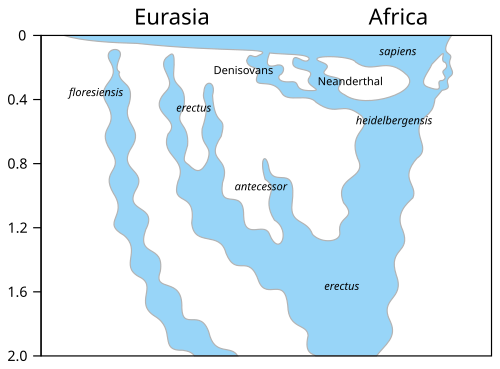
Despeciation within the genus Homo.
A map of early human migrations
Overkill Hypothesis and Second-Order Predation
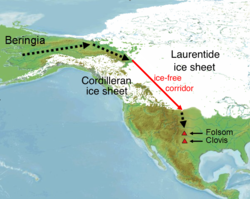
Approximate location of the ice-free corridor and specific Paleoindian sites, according to the Clovis theory
A European Last Interglacial landscape, featuring the straight-tusked elephant (background right), the narrow-nosed rhinoceros (far left), steppe bison (background centre left), wild horse (background centre) and aurochs (background centre right).

Which region suffered the most megafauna loss?

Australasia and North America suffered the highest percentages of loss, with approximately 67% and 66% of their large mammal species going extinct, respectively.

Why were larger animals more likely to go extinct?

Animals over 1,000 kg had a global extinction rate of 78.8%. Their vulnerability is generally attributed to slower reproductive rates and higher caloric requirements, making them more susceptible to both hunting and habitat loss.

What was the "mammoth steppe"?

The mammoth steppe (or steppe-tundra) was the Earth's most extensive biome during the Last Glacial Maximum, supporting a diverse array of cold-adapted megafauna across Eurasia and North America.

Did humans cause all these extinctions?

While the Overkill Hypothesis emphasizes human hunting, many scientists believe a combination of human pressure and rapid climate change during the Pleistocene-Holocene transition was responsible.

What are some examples of extinct giant marsupials?

Notable examples include the Diprotodon, the largest known marsupial, the marsupial lion (Thylacoleo carnifex), and various species of giant kangaroos and wombats.