Equus neogeus: The Prehistoric Horse of South America
During the Pleistocene epoch, the landscapes of South America were home to a variety of massive mammals, among which was Equus neogeus. This extinct species of equine represents a fascinating chapter in the evolutionary history of horses, showcasing how these animals adapted to the diverse environments of a continent they once called home.
Once thought to be a collection of several different species, modern scientific analysis has revealed that these animals were actually a single, morphologically variable species. This means that while they appeared different in size or shape across different regions, they belonged to the same biological group.
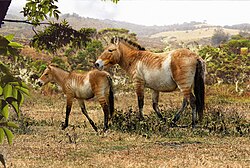
Key Facts
- Temporal Range: Lived during the Pleistocene (Ensenadan to Lujanian), approximately 1 million to 11,700 years ago.
- Physical Size: Stood roughly 1.5 meters (4.9 ft) tall and weighed about 400 kg (880 lb).
- Diet: Primarily grazers, consuming both C3 and C4 grasses.
- Distribution: Found across South America, including Argentina, Bolivia, Chile, Colombia, Ecuador, and Venezuela.
- Relationship: Closely related to caballine horses (true horses).
Taxonomy and Classification
The classification of Equus neogeus has undergone significant revision. Historically, researchers identified up to five separate species within the subgenus Amerhippus. Over time, this was reduced to three species based on size: the large E. neogeus (found from the Pampas to Northeast Brazil), the medium-sized E. insulatus (Bolivia to Venezuela), and the smaller E. andium (northern-central Andes).
Recent evidence has simplified this further, grouping them into one variable species. While the subgenus Amerhippus was widely used, its validity has been questioned. A 2008 study of mitochondrial DNA (genetic material passed from mother to offspring) suggested that E. neogeus is nested within the lineages of Equus caballus, the modern horse. This genetic link was further supported by a 2019 morphological analysis, which studied the physical structure of the animals.
Distribution and Paleobiology
Equus neogeus was one of two equine groups in South America, sharing the continent with Hippidion. They first appeared between 1 million and 800,000 years ago, with some of the earliest remains discovered near Tarija, Bolivia.
Their fossils have been recovered from a wide geographic range, including the Tarija Formation in Bolivia, the Serranía del Perijá in Venezuela, the Chiu-Chiu Formation in Chile, and the Sabana Formation in Colombia, as well as various sites in Ecuador.
Regarding their lifestyle, a 2019 study of specimens from Uruguay indicates that these horses were primarily grazers. They fed on a mix of C3 and C4 grasses—two different types of photosynthetic pathways used by plants—within open woodlands and prairies.
| Feature | Details |
|---|---|
| Height | ~1.5 meters (4.9 ft) |
| Weight | ~400 kg (880 lb) |
| Diet | C3 and C4 Grasses (Grazer) |
| Time Period | Pleistocene (1 Ma – 11,700 BP) |
| Key Locations | Argentina, Bolivia, Chile, Colombia, Ecuador, Venezuela |
Extinction and Human Interaction
The disappearance of Equus neogeus occurred at the end of the Late Pleistocene as part of a wider extinction event that claimed most of South America's large mammals. The youngest known remains date back to approximately 11,700 years Before Present (BP) in the Buenos Aires province of Argentina.
Evidence suggests that the arrival of humans in the Americas may have played a role in their extinction. Several archaeological sites provide clues to this interaction:
- Paso Otero 5 (Argentina): Burned bones of E. neogeus were found associated with Fishtail points (stone projectile points), suggesting the bones were used as fuel.
- Taguatagua 3 (Chile): A horse phalanx (toe bone) was found near a hearth alongside other megafauna, such as gomphotheres.
- Arroyo Seco 2 (Argentina): Remains show fracture marks indicative of butchery and are associated with human artifacts from between 14,782 and 11,142 cal yr BP.
Frequently Asked Questions
What was Equus neogeus?
Equus neogeus was an extinct species of horse native to South America during the Pleistocene epoch, closely related to modern caballine horses.
How large was Equus neogeus?
On average, these prehistoric horses stood about 1.5 meters tall and weighed approximately 400 kilograms.
What did Equus neogeus eat?
They were grazers that fed on both C3 and C4 grasses, typically inhabiting prairies and open woodland environments.
Why did Equus neogeus go extinct?
They became extinct at the end of the Late Pleistocene. While the exact cause is debated, evidence of butchery and the use of their bones for fuel suggests that human interaction was a contributing factor.
Was it a single species or multiple species?
While previously classified as up to five different species (including E. andium and E. insulatus), modern research suggests they were a single, morphologically variable species.