Glyptodonts: The Armored Giants of the Pleistocene
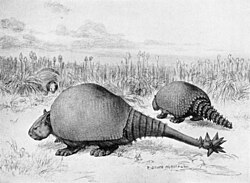
Imagine a creature with the appearance of a modern armadillo, but scaled up to the size of a small car. These were the glyptodonts, an extinct clade of massive, heavily armored mammals that once roamed the landscapes of the Americas. Reaching heights of up to 1.5 meters (4.9 ft) and weighing as much as 2 tonnes, these prehistoric herbivores were defined by their impenetrable bony shells and, in some species, formidable weaponized tails.
From their origins in the Eocene to their abrupt disappearance at the end of the Pleistocene, glyptodonts represent one of the most striking examples of evolutionary specialization in the order Cingulata.
Key Facts
- Temporal Range: Existed from the Eocene to the Late Pleistocene (~38 to 0.011 million years ago).
- Maximum Size: Up to 1.5 meters tall and approximately 2 tonnes in mass.
- Armor: A rigid carapace composed of hundreds of individual bony scutes (osteoderms).
- Distribution: Originated in South America; later spread to North America via the Isthmus of Panama.
- Extinction: Vanished approximately 12,000 years ago during the end-Pleistocene extinction event.
Evolutionary History and Classification
For many years, scientists classified glyptodonts within their own distinct family, Glyptodontidae. However, modern genetic research has reshaped our understanding of their lineage. A 2016 analysis of the mitochondrial genome of Doedicurus revealed that glyptodonts are actually nested within the modern armadillo family. Specifically, they are the sister group to a clade containing fairy armadillos (Chlamyphorinae) and giant, three-banded, and naked-tailed armadillos (Tolypeutinae).
Consequently, most glyptodonts and armadillos (excluding the long-nosed Dasypus) were relocated to the family Chlamyphoridae, with glyptodonts now designated as the subfamily Glyptodontinae. Morphological studies of the inner ear also suggest a close relationship with pampatheres.
Diversification and Migration
Glyptodonts split into two primary groups during or before the Early Miocene:
- Traditional Glyptodontinae: Including well-known genera like Glyptodon and Glyptotherium, likely originating in Northern South America.
- The Austral Clade: A group containing the majority of glyptodont diversity, which likely originated in Southern South America.
Around 2.7 to 3 million years ago, the formation of the Isthmus of Panama enabled the Great American Interchange. This land bridge allowed the genus Glyptotherium, along with other xenarthrans like ground sloths and pampatheres, to migrate from South America into southern North America.
Physical Description and Anatomy
The most defining feature of the glyptodont was its carapace—a massive, immobile shell made of hundreds of bony scutes, also known as osteoderms (bony deposits forming scales). This armor reached thicknesses of 2.5 centimeters (0.98 in) and protected not only the back but also the underside of the body and the top of the head.
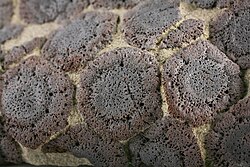
To support this immense weight, glyptodonts evolved short, robust limbs and a wide pectoral girdle. Their vertebral columns were extensively fused to provide structural stability. Their heads were short and blunt, featuring deep jaws and ever-growing, grooved teeth suited for their diet.
The Weaponized Tail
While the carapace provided defense, the tail provided offense. In many members of the Austral clade, the tail ended in a fused "caudal tube." Evidence suggests these tubes were anchored with keratinous spikes, creating a tail club similar to those found in ankylosaurid dinosaurs. These clubs were likely used as weapons, potentially for combat between males during sexual contests.
Ecology and Diet
Glyptodonts were herbivores that focused on low-lying vegetation. Depending on the species, they employed different feeding strategies: some were selective feeders, while others were bulk grazers. Their massive size and armor likely protected them from many predators, though their slow movement made them reliant on their physical defenses.
| Feature | Description |
|---|---|
| Body Mass | Up to 2 tonnes |
| Armor Type | Bony carapace of osteoderms |
| Diet | Herbivorous (grazing/mixed feeding) |
| Key Genera | Glyptodon, Doedicurus, Glyptotherium |
| Primary Range | South and Southern North America |
The Path to Extinction
Approximately 12,000 years ago, glyptodonts vanished abruptly during the end-Pleistocene extinction event. This event claimed the majority of large mammals in the Americas. The cause of this extinction remains a subject of scientific debate, centering on the interplay between climatic shifts and the arrival of humans.
Evidence suggests that Paleoindians may have hunted glyptodonts. At the Muaco and Taima-Taima sites in Venezuela, Glyptotherium skulls show fracture marks on the skull roof. These injuries are believed to have been caused by deliberate percussive blows from stone tools or clubs delivered around the time of death, suggesting human predation played a role in their demise.
Frequently Asked Questions
Were glyptodonts related to modern armadillos?
Yes. While once thought to be a separate family, genetic analysis of the mitochondrial genome shows that glyptodonts are nested within the armadillo lineage, specifically as a sister group to fairy armadillos and giant/three-banded armadillos.
How did glyptodonts use their tail clubs?
Tail clubs were likely used for defense and intra-species combat. Damage found on some carapaces suggests that glyptodonts may have struck one another, possibly during contests between males.
Where did glyptodonts live?
They originated in South America. Following the formation of the Isthmus of Panama roughly 3 million years ago, some genera, such as Glyptotherium, migrated into southern North America.
What caused the extinction of the glyptodonts?
They became extinct about 12,000 years ago. The extinction is attributed to a combination of climatic factors and hunting by Paleoindians, as evidenced by percussive skull fractures found in fossil records.
How large were the biggest glyptodonts?
The largest species, such as Doedicurus, could reach 4 meters (13 ft) in length, 1.5 meters (4.9 ft) in height, and weigh over 2 tonnes.