Neosclerocalyptus: The Armored Glyptodont of Ancient South America
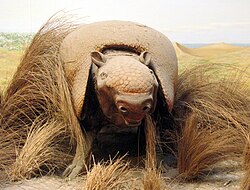
Among the diverse array of prehistoric mammals that once roamed South America, few are as visually striking as the glyptodonts. Within this group, Neosclerocalyptus stands out as a medium-sized genus of armored mammals that thrived during the Pliocene, Pleistocene, and Holocene epochs. Primarily found in Argentina, these creatures were characterized by their rigid, protective shells and a complex evolutionary history that has challenged paleontologists for nearly two centuries.
Unlike some of their gargantuan relatives, Neosclerocalyptus was relatively modest in size, typically reaching lengths of around 2 meters. Their weight varied across species, with some estimates placing them at 320 kilograms, while others range between 383 kg and 598 kg. One of the largest known specimens, designated as CCA-16A, is estimated to have weighed approximately 471 kilograms.
Key Facts
- Temporal Range: Lived from the Pliocene to the Holocene (~3 to 0.001 million years ago).
- Distribution: Primarily located in Southern South America, specifically Argentina.
- Physical Build: Medium-sized glyptodonts, generally around 2 meters in length.
- Defining Feature: A rigid carapace composed of fused osteoderms (bony deposits forming armor).
- Type Species: Neosclerocalyptus ornatus.
Etymology and Meaning
The name Neosclerocalyptus is derived from Greek roots: neo- meaning "young" or "new," scleros meaning "hard," and -calyptos meaning "covering." This literally translates to a "new hard covering," a direct reference to the animal's armored shell. The type species, N. ornatus, takes its specific name from the Latin word for "adorned," referring to the intricate patterns found on its armor plates.
Taxonomic History and Evolution
The scientific journey of Neosclerocalyptus began in 1845 when Sir Richard Owen described fossils collected near the Matanzas River in Buenos Aires. Initially classified as Glyptodon ornatus, the original specimens were unfortunately destroyed during World War II bombing raids. This loss led to a series of taxonomic shifts and the designation of neotypes to maintain a scientific standard for the species.
Throughout the late 19th and early 20th centuries, the genus was often confused with others, such as Hoplophorus and Sclerocalyptus. It wasn't until 1957 that paleontologist Paula Couto established Neosclerocalyptus as a distinct genus to resolve these nomenclature conflicts. Today, while many fragmentary fossils have led to the naming of dubious species, five are generally recognized as valid.
Recognized Species
- N. ornatus: The type species and a primary reference for the genus.
- N. pseudornatus: One of the best-known and smallest species.
- N. castellanosi: The oldest record of the genus, dating to the late Pliocene.
- N. gouldi: A middle Pleistocene species.
- N. paskoensis: A late Pleistocene to early Holocene species.
Anatomy of the Armored Carapace
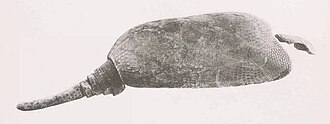
The most defining characteristic of Neosclerocalyptus was its carapace, a rigid shell that covered the body and head. This shell was composed of fused osteoderms, which were thinner and more strongly sutured than those of the larger Glyptodon or Panochthus.
The carapace was elongated and low, featuring two lateral "wings" that projected forward near the neck. The armor displayed a distinct "rosette" pattern—a flat, sub-circular central figure surrounded by 7 to 10 polygonal peripheral figures. The shape of these plates varied by location: rectangular plates lined the dorsal midline, while circular plates covered the sides. Toward the front, the plates became pentagonal or hexagonal.
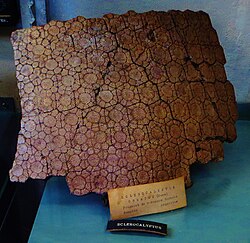
Additional anatomical details include large hair holes located around the cervical inlet (the neck opening) and a gradual decrease in plate size from the center of the back toward the edges of the shell.
Summary of Neosclerocalyptus Characteristics
| Feature | Details |
|---|---|
| Classification | Order Cingulata, Family Chlamyphoridae |
| Time Period | Pliocene to Holocene (~3 Ma to 0.001 Ma) |
| Average Length | Approximately 2 meters |
| Weight Range | 320 kg to 598 kg |
| Primary Region | Argentina, South America |
| Armor Type | Fused osteoderms with rosette patterns |
Frequently Asked Questions
What is a glyptodont?
A glyptodont is an extinct relative of modern armadillos, belonging to the order Cingulata. They are best known for their massive, bony armor shells called carapaces.
How did Neosclerocalyptus differ from other glyptodonts?
Neosclerocalyptus was smaller than many other glyptodonts and possessed a thinner, more low-profile carapace with a specific "rosette" pattern on its osteoderms, unlike the taller, more robust shells of Glyptodon.
Where were Neosclerocalyptus fossils primarily found?
Most fossils have been recovered from Southern South America, with a high concentration of finds in the Buenos Aires Province of Argentina.
Why was the taxonomy of this genus so confusing?
The confusion stemmed from the loss of original holotype fossils during World War II and the initial misclassification of species into other genera like Hoplophorus and Sclerocalyptus before the genus Neosclerocalyptus was formally established in 1957.
What does the term "osteoderm" mean?
An osteoderm is a bony deposit that forms in the dermal layers of the skin, creating a protective armor plate. In glyptodonts, these plates fused together to form a solid shell.