Saichania: The Heavily Armored Tank of the Cretaceous Desert
During the Late Cretaceous period, the landscapes of Mongolia and China were home to some of the most formidable herbivores to ever walk the Earth. Among them was Saichania, a genus of ankylosaurid dinosaur renowned for its massive build and impenetrable armor. Its name, derived from the Mongolian word saikhan meaning "beautiful," reflects the stunning state of preservation of its type specimen.
As a member of the Ankylosauridae family, Saichania was a low-slung, four-legged powerhouse designed for defense. From its bulbous skull armor to its devastating tail club, every inch of this dinosaur was evolved to survive in a harsh, arid environment filled with apex predators.
Key Facts
- Temporal Range: Late Cretaceous (Campanian to early Maastrichtian).
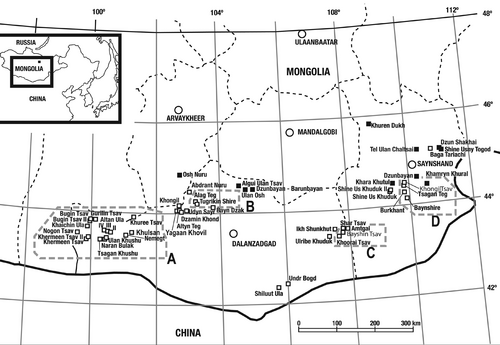
- Location: Primarily Mongolia (Barun Goyot and Nemegt Formations) and China.
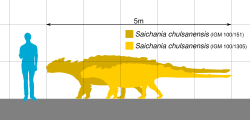
- Size: 5 to 7 meters in length; weighing between 1.4 and 2.0 metric tons.
- Diet: Herbivorous, utilizing a horny beak to crop desert vegetation.
- Defense: Covered in keeled osteoderms (bony plates) and equipped with a heavy tail club.
Discovery and Taxonomic History
The story of Saichania began in 1970 and 1971, when a joint Polish-Mongolian expedition uncovered fossils in the Gobi Desert near Chulsan. In 1977, Polish paleontologist Teresa Maryańska officially named the type species, Saichania chulsanensis.
The holotype specimen (GI SPS 100/151) is remarkably complete, featuring a skull and the anterior portion of the skeleton. Over the decades, the classification of Saichania has evolved. While some specimens were previously attributed to other genera like Tarchia, recent research by Victoria Megan Arbour suggests that certain Chinese taxa, such as Tianzhenosaurus and Shanxia, may actually be junior synonyms of Saichania.
Physical Characteristics and Build
Saichania was exceptionally robust, even by ankylosaur standards. Its body was flat and low to the ground, supported by powerful forelimbs and short legs. To support its massive weight and resist the impact of predators, several parts of its skeleton were fused, including the neck vertebrae, shoulder girdle, and ribs.
The Armored Skull
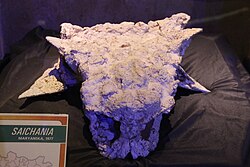
The skull of Saichania was a fortress of bone, measuring approximately 455mm long and 480mm wide. It featured bulbous osteoderms (bony deposits forming armor) and pyramid-shaped horns at the rear corners. Large triangular horns also extended from the cheeks.
Complex Nasal Anatomy
One of the most fascinating aspects of Saichania was its internal nasal structure. It possessed complex air passages, including a nasal vestibule and a crista maxilloturbinalis—a scroll-like bone typically found in warm-blooded animals to preserve moisture. These adaptations suggest that Saichania lived in a hot, arid climate, using its nasal cavities to cool inhaled air and minimize water loss.
Postcranial Skeleton and Armor
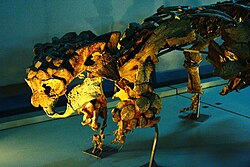
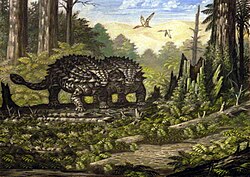
The dinosaur's body was encased in a sophisticated armor system. Its neck was protected by two cervical halfrings made of rectangular segments. Along its back, a central row of conical osteoderms was flanked by larger, keeled plates. The rump was further reinforced with three rows of conical plates, providing a shield against attacks from the rear.
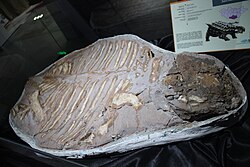
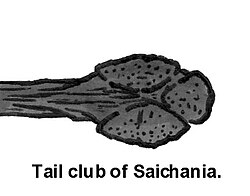
The most iconic weapon was the tail club, a massive bony structure used to fend off predators such as the theropod Tarbosaurus.
Paleobiology and Habitat
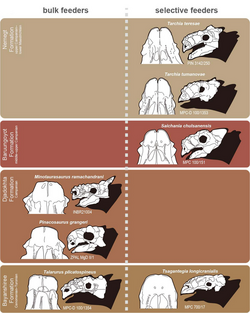
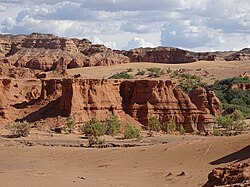
Saichania inhabited a desert environment characterized by vast sand dunes and scattered oases. It shared this habitat with other herbivores like Lamaceratops and Bagaceratops. Because multiple species of ankylosaurs (including Tarchia and Zaraapelta) coexisted in the same region, paleontologists believe they occupied different ecological niches or used their distinct head ornamentation for species recognition.
Summary of Saichania Characteristics
| Feature | Description |
|---|---|
| Length | 5–7 meters |
| Mass | 1.4–2.0 metric tons |
| Skull Features | Bulbous osteoderms, pyramid horns, complex nasal turbinates |
| Armor | Cervical halfrings, keeled dorsal plates, tail club |
| Habitat | Arid desert with oases (Mongolia/China) |
Frequently Asked Questions
What does the name Saichania mean?
The name comes from the Mongolian word "saikhan," which means "beautiful," referring to the excellent preservation of the original fossils found.
How did Saichania protect itself from predators?
Saichania used a combination of heavy bony armor (osteoderms) covering its body and a powerful tail club to strike and deter predators like Tarbosaurus.
What evidence suggests Saichania lived in a desert?
Its complex nasal passages, including ossified turbinate bones, were likely adaptations to conserve water and cool air, which are critical traits for survival in hot, arid environments.
How does Saichania differ from other ankylosaurs?
Saichania is notably more robust than many of its relatives, with a higher degree of bone fusion in the shoulder girdle and ribs, and distinct bulbous armor on its skull.
Was Saichania a solitary animal?
While fossil evidence doesn't definitively prove social behavior, the presence of multiple ankylosaur species in the same region suggests they were common herbivores in their ecosystem.