Late Cretaceous Epoch: The Final Age of the Dinosaurs
The Late Cretaceous (100.5 to 66 million years ago) represents the grand finale of the Mesozoic Era. As the more recent of the two epochs within the Cretaceous Period, it is characterized by a world of dramatic geological shifts, the peak of dinosaur diversity, and a catastrophic conclusion that reshaped life on Earth. The epoch takes its name from the Latin word creta, meaning chalk, referring to the massive white limestone deposits found in northern France and the iconic white cliffs of south-eastern England.
Key Facts
- Time Span: 100.5 ± 0.1 to 66.0 million years ago (Ma).
- Defining Feature: The rise of flowering plants and the dominance of specialized dinosaur clades.
- Geography: The Atlantic Ocean expanded as the Americas moved westward, and Europe existed as a chain of islands.
- Climate: Generally warmer than today, though a gradual cooling trend occurred toward the end of the epoch.
- The End: Concluded with the K-Pg mass extinction event approximately 66 million years ago.
Geological and Climatic Shifts
The Late Cretaceous was a period of intense tectonic activity. Plate tectonics drove the Americas westward, widening the Atlantic Ocean. In North America, the Western Interior Seaway—a vast inland sea—split the continent into two landmasses: Appalachia to the east and Laramidia to the west. Meanwhile, India drifted northward toward Asia, and Australia and Antarctica remained connected while drifting away from Africa and South America.
Climate conditions were warmer than modern levels, though the tropics were restricted to equatorial zones. Northern latitudes began experiencing more distinct seasonal weather patterns as a general cooling trend progressed throughout the epoch.
The Diverse Fauna of the Late Cretaceous
Non-Avian Dinosaurs
In the region known as Asiamerica (Western North America and Eastern Asia), hadrosaurs, ankylosaurs, and ceratopsians flourished. The large predator niche in North America was dominated by tyrannosaurs, while their Asian counterparts were generally smaller and more primitive. Pachycephalosaurs and dromaeosaurids were also widespread across both continents, alongside therizinosaurs.
Gondwana (the southern supercontinent) hosted a distinct set of dinosaurs. Here, titanosaurs were the dominant herbivores, while abelisaurids and carcharodontosaurids served as the primary predators. Spinosaurids also remained present during this era.
Birds and Pterosaurs
Avian dinosaurs, or birds, diversified rapidly into enantiornithe and ornithurine forms. While many were small, the Hesperornithes evolved into large, flightless marine birds adapted for the open sea. Pterosaurs, primarily represented by the azhdarchids, continued to thrive. Contrary to older theories, evidence suggests pterosaurs did not systematically decline due to competition with birds, as the two groups occupied different ecological niches.
Mammals and Marine Life
Mammals remained generally small but occupied diverse roles, ranging from the carnivorous Deltatheroida to the mollusc-eating Stagodontidae. While multituberculates and metatherians were common in the north, the southern hemisphere featured a complex mix of dryolestoids and gondwanatheres. True placental and marsupial mammals only evolved at the very end of the epoch.
The oceans saw the sudden appearance and rapid radiation of mosasaurs. Modern sharks emerged, and plesiosaurs diversified into the 3-meter-long polycotylids and the massive 13-meter-long elasmosaurs. These predators fed on advanced teleost fishes (Neoteleostei), while ichthyosaurs and pliosaurs vanished during the Cenomanian-Turonian anoxic event (a period of oxygen depletion in the oceans).
Flora
The Late Cretaceous witnessed the diversification of flowering plants. By the end of the period, temperate regions were populated by ancestors of modern plants, including roses, sassafras, and magnolias.
The K-Pg Mass Extinction
The epoch ended abruptly 66 million years ago with the Cretaceous-Paleogene (K-Pg) extinction event. This event is marked globally by a thin, iridium-enriched layer of sediment. The "K" stands for the German Kreidezeit (Cretaceous), and "Pg" refers to the Paleogene.
Non-avian dinosaurs, pterosaurs, mosasaurs, and plesiosaurs were wiped out. While some dinosaur fossils appear above the boundary, these are considered reworked fossils—older remains eroded and redeposited in newer layers. In contrast, many bird and mammal clades survived, eventually undergoing rapid evolutionary radiation.
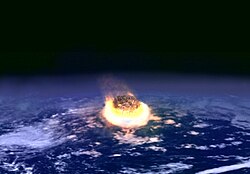
Scientists hypothesize that the extinction was caused by a combination of a massive asteroid impact (creating the Chicxulub crater) and intense volcanic activity (the Deccan Traps). These catastrophes likely blocked sunlight, hindered photosynthesis, and collapsed the global food chain.
Summary of the Late Cretaceous
| Category | Details |
|---|---|
| Timeframe | 100.5 to 66.0 Million Years Ago |
| Key Landmasses | Laramidia, Appalachia, Gondwana |
| Dominant Land Predators | Tyrannosaurs (North America/Asia), Abelisaurids (Gondwana) |
| Dominant Marine Predators | Mosasaurs, Plesiosaurs |
| Major Flora | Diversifying flowering plants (Magnolias, Roses) |
| Extinction Cause | Asteroid impact (Chicxulub) and Volcanism (Deccan Traps) |
Frequently Asked Questions
What does the name "Cretaceous" mean?
The name is derived from the Latin word creta, which means chalk. This refers to the extensive chalk deposits formed during this period, such as the White Cliffs of Dover.
Did birds evolve from dinosaurs during this time?
Birds are considered avian dinosaurs. During the Late Cretaceous, they became increasingly common and diversified into various forms, including flightless marine birds and early ancestors of modern birds.
What was the Western Interior Seaway?
The Western Interior Seaway was a large body of water that divided North America into two separate landmasses, Laramidia in the west and Appalachia in the east.
Why is the extinction event called K-Pg instead of K-T?
Historically, it was called the K-T boundary (K for Cretaceous, T for Tertiary). However, because "Tertiary" is no longer a formal unit in the International Commission on Stratigraphy, researchers now use "Pg" for Paleogene.
What happened to the pterosaurs?
Pterosaurs, including the azhdarchids, went extinct during the K-Pg mass extinction event along with the non-avian dinosaurs.