Tarchia: The Brainy Armored Dinosaur of Late Cretaceous Mongolia
Among the diverse array of armored dinosaurs that roamed the prehistoric landscapes of Asia, Tarchia stands out as a fascinating example of the ankylosaurid family. Living during the Late Cretaceous period, specifically the Maastrichtian stage, this herbivorous giant was built like a living fortress, combining heavy armor with a powerful tail club for defense.
The name Tarchia is derived from the Mongolian word tarkhi, meaning "brain," and the Latin suffix -ia. This name reflects the scientific observation that its braincase was presumed to be larger than that of its close relative, Saichania.
Key Facts
- Temporal Range: Late Cretaceous (Maastrichtian stage).
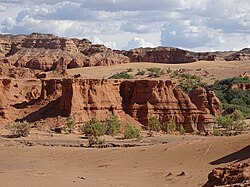
- Location: Mongolia (Barun Goyot and Nemegt Formations).
- Size: Approximately 5.5 to 6 meters long, weighing between 2.5 and 3 metric tons.
- Diet: Herbivorous low-level bulk feeder.
- Defining Feature: Heavy skin ossifications (osteoderms) and a bony tail club.
Discovery and Taxonomic History
The story of Tarchia began in 1970 when a Polish-Mongolian expedition discovered an ankylosaurian skull near Khulsan. In 1977, Teresa Maryańska formally described the type species, Tarchia kielanae. The holotype specimen (ZPal MgD-I/111) was recovered from the Barun Goyot Formation, an area characterized by ancient eolian dunes and seasonal streams.
The classification of Tarchia has been a subject of significant scientific debate. For years, researchers struggled to distinguish it from other ankylosaurs. At one point, Dyoplosaurus giganteus was considered a synonym for Tarchia, and some specimens were mistakenly attributed to Saichania. However, modern revisions have clarified the genus, identifying three distinct species:
- Tarchia kielanae: The original type species.
- Tarchia teresae: Named in 2016, distinguished by its non-fused accessory osteoderm and specific cranial nerve openings.
- Tarchia tumanovae: Named in 2021 from the Nemegt Formation, coeval with T. teresae.
Physical Characteristics and Anatomy
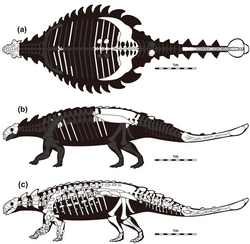
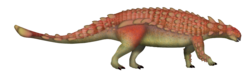
Tarchia was a medium-sized ankylosaur with a broad, low-slung body supported by short, powerful legs. Its primary defense mechanism consisted of osteoderms—bony deposits that formed a protective layer of armor within the skin. Most notably, it possessed a heavy bony club at the end of its tail, used to repel predators.
Anatomically, Tarchia is distinguished from its relative Saichania by several key traits. It possesses a larger basicranium (the floor of the braincase) and a postorbital fossa, which is a depression that separates the squamosal horn from the supraorbital. Additionally, the back of its head is visible from a top-down view, and it features a deep groove along the front and outer side of the squamosal horn.
Palaeobiology and Diet
The environment of Tarchia consisted of interdune regions with small intermittent lakes. As a low-level bulk feeder, it used its broad, sub-rectangular muzzle to graze on vegetation. Because it lived in a relatively dry environment, scientists believe Tarchia may have relied on hindgut fermentation to digest its food or focused on succulent plants that required less chewing.
Evidence from microwear pits on the teeth suggests that these dinosaurs dealt with more grit during feeding than those in tropical climates. Recent research suggests a shift from bulk feeding to more selective feeding during the Campanian and Maastrichtian stages, possibly due to climate changes or competition with immigrating hadrosaurids (duck-billed dinosaurs).
Predation and Pathology
Life was not without danger for Tarchia. One recovered skull bears tooth marks attributed to Tarbosaurus, a formidable tyrannosaurid theropod. This provides direct evidence that Tarchia was hunted by the apex predators of its ecosystem.
Summary of Tarchia Species
| Species | Discovery/Naming | Key Distinctions | Formation |
|---|---|---|---|
| T. kielanae | 1977 | Type species; specific braincase traits | Barun Goyot |
| T. teresae | 2016 | Non-fused accessory osteoderm; bifurcated cranial nerve openings | Barun Goyot/Nemegt |
| T. tumanovae | 2021 | Partial skeleton with associated skull | Nemegt |
Frequently Asked Questions
What does the name Tarchia mean?
The name comes from the Mongolian word "tarkhi," meaning brain, referring to the animal's relatively large braincase compared to other ankylosaurs.
How did Tarchia defend itself?
Tarchia used a combination of heavy skin armor (osteoderms) and a bony club at the end of its tail to protect itself from predators like Tarbosaurus.
What did Tarchia eat?
It was a herbivore that acted as a low-level bulk feeder, grazing on plants and possibly utilizing hindgut fermentation for digestion.
Where were Tarchia fossils found?
Fossils have been discovered in Mongolia, specifically within the Barun Goyot and Nemegt Formations of the Nemegt Basin.
How many species of Tarchia are recognized?
There are currently three recognized species: Tarchia kielanae, Tarchia teresae, and Tarchia tumanovae.