Ground Sloths: The Giant Mammals of the Pleistocene
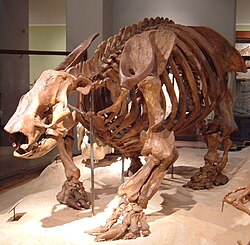
Long before the modern tree-dwelling sloths of Central and South America existed, the landscape was dominated by their massive cousins: the ground sloths. These prehistoric mammals, belonging to the order Pilosa, ranged in size from modest to truly gargantuan, roaming the Americas for millions of years. From the frozen reaches of Alaska to the tropical islands of the Caribbean, ground sloths were a cornerstone of the Cenozoic megafauna.
These creatures were part of the Xenarthra group, a clade of mammals characterized by unique vertebral structures. Unlike their modern relatives, ground sloths were terrestrial, though many possessed the strength to stand on their hind legs to reach high foliage.
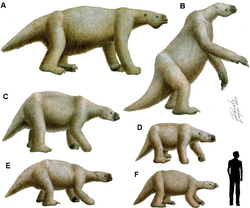
Key Facts
- Temporal Range: They existed from approximately 35 million to 0.005 million years ago (Ma).
- Distribution: Primarily found in North and South America, with late survivors in the Caribbean.
- Diversity: Classified into several families, including Megatheriidae and Mylodontidae.
- Dietary Variety: While mostly herbivores, some species, such as Darwin's ground sloth, show evidence of non-herbivorous diets.
- Extinction: Most vanished during the Late Pleistocene, though Caribbean species survived until roughly 1550 BCE.
Classification and Diversity
Ground sloths are categorized under the suborder Folivora. Their evolutionary history is marked by a wide array of morphological adaptations, split across several key families:
- Megatheriidae: The giants of the group, including the famous Megatherium americanum.
- Mylodontidae: Known for their robust builds and, in some species, the presence of osteoderms (bony deposits in the skin).
- Megalonychidae: A diverse group that included Megalonyx jeffersonii, which reached as far north as Alaska and Canada.
- Nothrotheriidae: Smaller ground sloths, including Nothrotheriops shastensis.
- Scelidotheriidae: A family characterized by distinct skull and limb proportions.
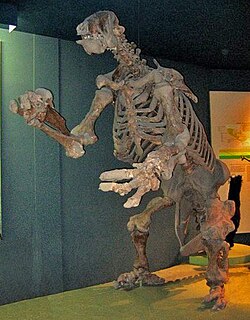
Ecology and Behavior
The ecology of ground sloths was as varied as their sizes. Most were browsers, using their powerful limbs and claws to pull down branches or dig for roots. Biomechanical studies of their limbs suggest that some were capable of significant digging, while others were more adapted for walking.
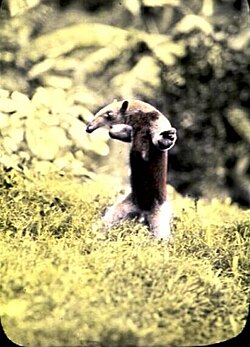
Interestingly, trackway evidence from New Mexico suggests that some ground sloths adopted an upright defensive stance, similar to the behavior seen in modern Tamandua anteaters.
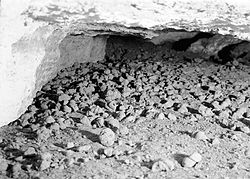
Dietary analysis has provided surprising insights. While dental microwear generally points to herbivory, isotope data from amino acids indicate that Darwin's ground sloth may not have been a strict herbivore. Furthermore, the study of subfossilized dung (coproscopy) from Nothrotheriops shastensis has allowed scientists to reconstruct the specific plant matter these animals consumed.
Locomotion and Anatomy
Ground sloths evolved a pedolateral foot, a specialized foot structure that allowed them to support immense weight. Their inner ear and vestibular systems were also adapted to their massive body sizes, though research suggests their hearing frequency range remained relatively independent of their overall size.
The Path to Extinction
The disappearance of ground sloths was not a single event but a staggered process. On the American mainland, most species vanished during the Late Pleistocene. However, the Caribbean ground sloths—found on Cuba, Hispaniola, and Puerto Rico—survived significantly longer. Radiocarbon dating suggests Megalocnus in Cuba may have persisted until 2819–2660 BCE, with some survivors potentially lasting until 1550 BCE.
This survival gap of 5,000 to 6,000 years correlates with the later arrival of humans in the Caribbean compared to the mainland.
The Role of Human Hunting
Evidence from "kill sites" and fossil footprints suggests that humans actively hunted ground sloths. In North America, footprints have been found that appear to track a prehistoric hunt. Humans utilized weapons such as the atlatl (a spear-thrower) to overcome the sloths' size advantage. While the sloths' thick skin and size provided some defense, they were vulnerable to coordinated human hunting strategies.
Summary of Ground Sloth Families
| Family | Notable Genus | Key Characteristics |
|---|---|---|
| Megatheriidae | Megatherium | Massive size, capable of bipedal standing. |
| Mylodontidae | Paramylodon | Robust build, often possessed osteoderms. |
| Megalonychidae | Megalonyx | Wide geographic range, including Arctic regions. |
| Nothrotheriidae | Nothrotheriops | Generally smaller, well-preserved dung fossils. |
| Scelidotheriidae | Scelidotherium | Distinctive muzzle and limb morphology. |
Frequently Asked Questions
Did ground sloths live in the Arctic?
Yes. Fossils of Megalonyx have been discovered in Pleistocene deposits in Alaska and the Old Crow Basin of the Yukon, Canada, proving they could survive in cold climates.
Were all ground sloths herbivores?
While the majority were herbivores, scientific evidence suggests exceptions. Isotope analysis of Darwin's ground sloth indicates it may not have been a strict herbivore.
How did humans hunt such large animals?
Humans likely used coordinated efforts and specialized tools, such as the atlatl, to deliver powerful spear strikes from a distance, mitigating the danger of the sloth's size and claws.
Why did Caribbean sloths survive longer than mainland ones?
Their survival is closely linked to the timing of human colonization. Humans reached the Caribbean islands thousands of years after they arrived on the American mainland, delaying the hunting pressure that contributed to the mainland extinctions.
What are osteoderms?
Osteoderms are bony deposits that form in the dermal layers of the skin. These provided a form of biological armor for certain families, such as the Mylodontidae.