Pleistocene Epoch: Earth's Era of Glaciation and Human Evolution
The Pleistocene, colloquially known as the Ice Age, represents a monumental chapter in Earth's history. Spanning from approximately 2.58 million to 11,700 years ago, this geological epoch was defined by repeated cycles of massive glaciation. It was a time of dramatic climatic shifts, shifting continents, and the profound evolutionary journey of the human genus.
The name itself is derived from the Ancient Greek words pleîstos ("most") and kainós ("new, recent"), aptly describing a period of significant change that shaped the modern world.
![Evolution of temperature in the Post-Glacial period at the very end of the Pleistocene, according to Greenland ice cores[6]](/images/92/0b/920b6e27a12e25a8da739fe905d293c8db337524c76856f7c6ef4e256c701578.jpg)
Key Facts
- Time Span: Approximately 2.58 million to 11,700 years ago.
- Climate Pattern: Characterized by repeated glacial (cold) and interglacial (warm) cycles.
- Human Milestone: The era saw the rise of Homo erectus and the eventual emergence and spread of modern humans (Homo sapiens).
- Geological Shift: The Mid-Pleistocene Transition changed glacial cycles from 41,000-year to 100,000-year periodicities.
- Sea Level Changes: During peak glaciation, sea levels dropped by as much as 120 meters due to water being locked in ice sheets.
Chronology and Scientific Definition
The scientific understanding of the Pleistocene has evolved. While older publications might cite a start date of 1.806 million years ago, the International Union of Geological Sciences (IUGS) updated the definition in 2009. The epoch now officially begins at the base of the Gelasian stage, dated to roughly 2.58 million years ago.
The epoch is subdivided into four primary stages:
- Gelasian
- Calabrian
- Chibanian (formerly known as the Middle Pleistocene)
- Upper Pleistocene (unofficially the Tarantian)
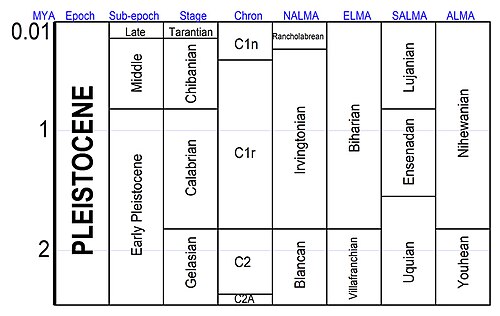
The End of the Pleistocene
The transition from the Pleistocene to the current Holocene epoch is marked by the end of the Younger Dryas, a significant cold spell that concluded approximately 11,700 years ago. This boundary is formally tied to data from the NGRIP2 ice core in Greenland.
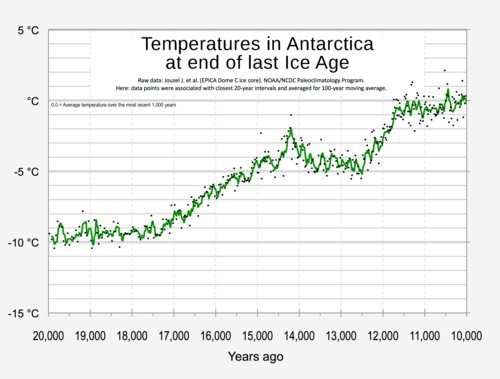
Climate Dynamics and Glacial Cycles
The Pleistocene climate was a rhythmic dance between extreme cold and temperate warmth. During glacials, massive continental ice sheets—sometimes reaching thicknesses of 3,000 meters—pushed toward the equator. During interglacials, these ice sheets retreated, leading to warmer, more temperate conditions.
A critical turning point occurred during the Mid-Pleistocene Transition about one million years ago. Before this, glacial cycles followed a 41,000-year pattern; afterward, they shifted to more extreme, asymmetric 100,000-year cycles. Scientists believe these patterns are influenced by Milankovitch cycles—periodic changes in Earth's orbit and tilt—though other factors like CO2 levels and ocean circulation also play vital roles.
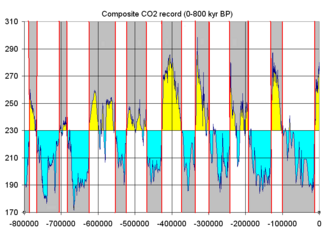
Glacial Extent and Permafrost
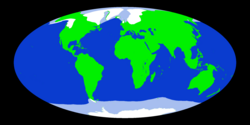
At the height of glaciation, it is estimated that 30% of the Earth's surface was covered by ice. This massive accumulation of ice caused sea levels to plummet, exposing continental shelves as dry land. South of the ice sheets, vast zones of permafrost (ground that remains frozen for two or more consecutive years) stretched across North America and Eurasia.
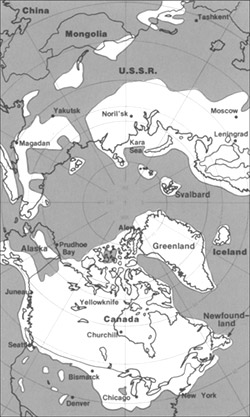
Paleogeography and the Rise of Humans
While the continents were largely in their modern positions, the landscape was vastly different due to fluctuating sea levels. A major geological event at the end of the Pliocene was the formation of the Isthmus of Panama, which connected North and South America. This bridge allowed for a massive faunal interchange, where animals moved between the two continents, and fundamentally altered global ocean circulation.
Parallel to these environmental shifts, the genus Homo underwent rapid evolution. The Early Pleistocene saw the spread of Homo erectus across Afro-Eurasia. By the Middle Paleolithic, Homo sapiens appeared (roughly 300,000 years ago). Eventually, modern humans migrated out of Africa, spreading to Australia and the Americas, while other human species faced extinction.
Summary of Pleistocene Characteristics
| Feature | Description |
|---|---|
| Primary Climate Driver | Glacial/Interglacial cycles influenced by Milankovitch cycles. |
| Sea Level Impact | Drops of up to 120m during peak glaciation. |
| Key Human Species | Homo erectus, Homo sapiens, and various archaic humans. |
| Major Geological Event | Formation of the Isthmus of Panama. |
| Transition Point | Mid-Pleistocene Transition (shift to 100,000-year cycles). |
Frequently Asked Questions
What is the difference between a glacial and an interglacial?
A glacial is a period of significant advance of continental ice sheets (a cold phase), while an interglacial is a shorter, more temperate period between these cold phases.
How did the Mid-Pleistocene Transition affect the climate?
It changed the periodicity of ice ages from 41,000-year cycles to 100,000-year cycles, resulting in more extreme climate variations.
When did modern humans appear during the Pleistocene?
Evidence suggests that Homo sapiens appeared approximately 300,000 years ago during the Pleistocene.
What caused the sea levels to drop so significantly?
As massive amounts of water were frozen into continental ice sheets that were up to 3,000 meters thick, the volume of liquid water in the oceans decreased, causing sea levels to drop by 100 to 120 meters.
What defines the end of the Pleistocene?
The end of the Pleistocene is defined by the conclusion of the Younger Dryas cold spell, approximately 11,700 years ago, which marks the beginning of the Holocene epoch.