Plant Hardiness Zones: A Comprehensive Guide to Temperature and Survival
For gardeners, landscapers, and botanists, knowing which plants can survive the winter is a fundamental challenge. This is where hardiness zones become essential. A hardiness zone is a geographic area defined by its average annual minimum temperature—a critical metric that determines whether a specific plant species can withstand the coldest part of the year.
While various systems exist globally, the most widely recognized standard is the system developed by the United States Department of Agriculture (USDA). This system provides a rough guide for landscaping by categorizing regions into zones based on long-term extreme minimum temperatures.
Key Facts
- Hardiness zones are primarily defined by average annual extreme minimum temperatures.
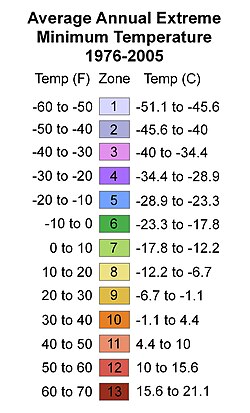
- The USDA system uses 13 distinct zones to categorize temperature ranges.
- A plant described as "hardy to zone 10" can withstand temperatures between −1.1 to 4.4 °C (30 to 40 °F).
- Heat zones, unlike hardiness zones, are defined by annual high temperatures and the number of days exceeding 30 °C (86 °F).
- Climate change is causing hardiness zones to shift northward in many regions.
The USDA Hardiness Scale
In American contexts, the term "hardiness zone" almost always refers to the USDA scale. This scale is divided into zones (0 through 13), often further subdivided into 'a' and 'b' to provide more granular temperature ranges. For example, Zone 7a covers 0 to 5 °F, while Zone 7b covers 5 to 10 °F.
It is important to distinguish these from climate zones used in building and HVAC (Heating, Ventilation, and Air Conditioning) discussions. In the International Energy Conservation Code, climate zones follow a different logic where Zone 1 is warm and Zone 8 is cold.
USDA Temperature Definitions
| Zone | Sub-zone | From (°F) | To (°F) | From (°C) | To (°C) |
|---|---|---|---|---|---|
| 0 | a | < −65 | −65 | < −53.9 | −53.9 |
| 1 | a | −60 | −55 | −48.3 | −45.6 |
| 5 | a | −20 | −15 | −28.9 | −26.1 |
| 10 | a | 30 | 35 | −1.1 | 1.7 |
| 13 | b | > 65 | > 65 | > 18.3 | > 18.3 |
Note: Table shows selected samples of the full USDA scale.
Global Variations and Alternative Systems
While the USDA scale is a global benchmark, many countries have adapted or created their own systems to better suit local flora and climate patterns.
Canada and Europe
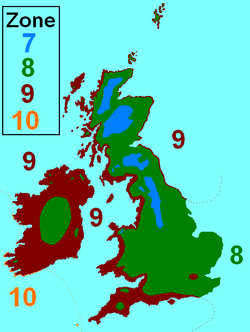
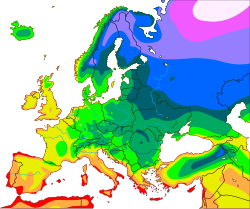
Canada uses a specific formula to estimate an index of suitability, taking into account factors like the monthly mean of daily minimum temperatures, the frost-free period, and even maximum wind gusts. In Europe, hardiness zones vary significantly by country, from the warmer Mediterranean zones in Spain and Italy to the colder northern regions of Finland and Russia.
Heat Zones vs. Hardiness Zones
It is a common mistake to confuse cold hardiness with heat tolerance. The American Horticultural Society (AHS) utilizes heat zones. While hardiness zones focus on the minimum winter temperature, heat zones are defined by the average number of days per year when the temperature exceeds 30 °C (86 °F). This is vital for plants that might survive a cold winter but perish in intense summer heat.
![Global Plant Hardiness Zones (approximate). Antarctica is not shown; most of it except the peninsula is zone 0 or 1,[citation needed] and is almost completely covered by the Antarctic ice sheet.](/images/1d/99/1d99cd78c05b7583a9afd2ccdf559e6b16f436b526a6a5d7b730a338b25d19d7.png)
Climate Change and Shifting Zones
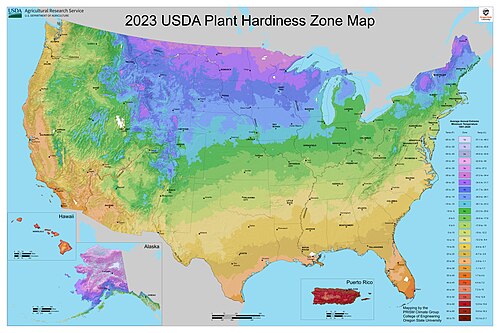
Hardiness maps are not static. The USDA released an updated map in November 2023, based on weather data from 1991–2020. This update reflects a continued warming trend, showing a northward movement of hardiness zones across the United States.
Data from 2012 indicated that much of the US had already become a half-zone (approximately 2.8 °C or 5 °F) warmer in winter compared to the 1990 release. Research suggests that as climate change continues, these shifts will persist, requiring gardeners to rethink their plant selections over time.
Frequently Asked Questions
What does it mean if a plant is "hardy to zone 10"?
This means the plant is capable of surviving minimum temperatures ranging from −1.1 to 4.4 °C (30 to 40 °F).
How do heat zones differ from hardiness zones?
Hardiness zones are based on the lowest annual minimum temperatures (winter survival), whereas heat zones are based on annual high temperatures and the frequency of days exceeding 30 °C (summer survival).
Why do hardiness maps change over time?
Maps are updated as new long-term weather data becomes available. Recent updates reflect warming trends caused by climate change, which shift zones toward higher temperature ranges.
Is the USDA scale used everywhere?
No. While it is a widely used guide, other organizations like the Royal Horticultural Society (UK) and the American Horticultural Society use different rating schemes.
Can I use a climate zone for my house to pick plants?
No. Be careful not to confuse plant hardiness zones with building climate zones used in the International Energy Conservation Code, which follow a different numbering logic.