Nandina domestica: The Vibrant Allure of Heavenly Bamboo
With its striking red berries and foliage that shifts colors with the seasons, Nandina domestica is a standout choice for ornamental gardens. Commonly known as nandina, heavenly bamboo, or sacred bamboo, this plant is prized for its elegance and resilience. However, despite its common names, it is not a true bamboo, but rather a unique member of the Berberidaceae family.
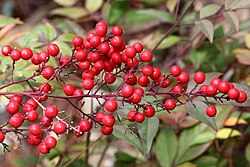
Key Facts
- Scientific Name: Nandina domestica
- Common Names: Heavenly Bamboo, Sacred Bamboo, Nandina
- Origin: Eastern Asia (Himalayas to Japan)
- Type: Monotypic genus (the only species in the genus Nandina)
- Key Feature: Evergreen shrub with seasonal color changes and bright red berries
- Toxicity: Poisonous to birds, cats, and grazing animals due to cyanide-producing compounds
Botanical Profile and Description
Nandina domestica is an erect evergreen shrub that typically reaches up to 2 meters (7 ft) in height and 1.5 meters (5 ft) in width. It is characterized by numerous stems that grow directly from the ground level, often without branching.
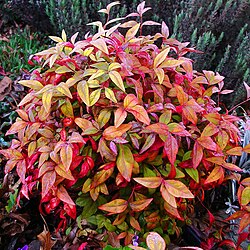
The foliage is one of the plant's most attractive features. The leaves are bi- or tri-pinnately compound (meaning the leaf is divided into smaller leaflets) and range from 50 to 100 cm in length. In the spring, young leaves emerge in bright pink or red hues before transitioning to green. As the weather cools, the old leaves turn red or purple before eventually falling, a trait that can make the plant appear deciduous in colder climates.
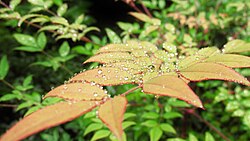
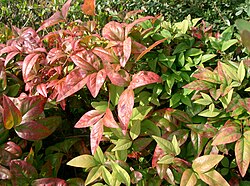
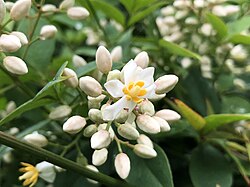
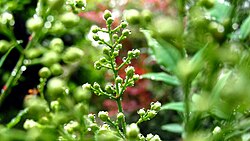
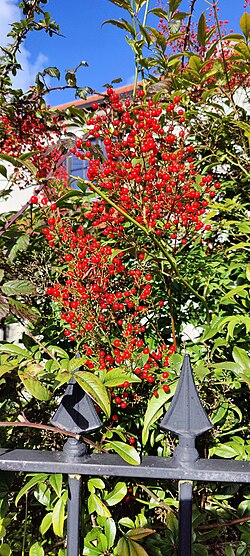
In early summer, the plant produces conical clusters of flowers known as panicles. These hermaphrodite flowers feature six white petals and pinkish-white sepals. Following the bloom, bright red berries (5–10 mm in diameter) ripen in late autumn and often persist throughout the winter, providing a vivid contrast against the foliage.
Etymology
The name Nandina is a Latinized version of the Japanese word nanten, which originates from the Chinese nantian zhu, meaning "southern heavenly bamboo." The specific epithet domestica refers to its status as a domesticated or household plant.
Cultivation and Garden History
Nandina has been a staple in Chinese and Japanese gardens for centuries. Historical records mention its presence in the Kaibao Bencao (a Song dynasty materia medica from 973 CE) and the diaries of Fujiwara no Teika in 1230 CE, who noted its use in the Japanese imperial garden.
The plant entered Western horticulture in 1804 when William Kerr sent specimens from Canton to London. While initially kept in greenhouses due to concerns about hardiness, it is now known to thrive in USDA hardiness zones 6–10, with some cultivars surviving in zone 5. It is highly adaptable, tolerating temperatures from −10 to 110 °F (−23 to 43 °C).
Gardeners appreciate that Nandina generally requires no pruning. However, it can be aggressive, spreading via underground runners (rhizomes), which can make it difficult to remove once established.
Popular Cultivars
There are over 65 cultivars, particularly in Japan. Some of the most popular include:
- Blush: Produces red new growth in spring and autumn, turning vivid red in winter.
- Fire Power: A compact variety (2 to 2.5 feet tall) known for impressive red winter foliage.
- Gulfstream: Features narrow, diamond-shaped leaves that transition from coppery-orange to turquoise, and finally to orange-red.
- Lemon Lime: Noted for yellowish-green spring foliage that becomes chartreuse in summer.
- Moon Bay: An upright variety with leaves that shift between lime green, red, apricot, and burgundy.
- Nana: A dwarf variety ideal for low hedges, featuring crimson red and scarlet-bronze tones.
- Royal Princess: A taller variety (up to 8 feet) with blush-colored blooms.
Toxicity and Environmental Impact
While visually stunning, Nandina domestica contains phytochemicals that decompose into hydrogen cyanide. All parts of the plant are poisonous if ingested. While generally considered non-toxic to humans, the berries are dangerous to cats and grazing animals.
The berries are particularly hazardous to birds, such as cedar waxwings. Because other food sources are scarce in late winter, birds may consume these berries in large quantities, leading to fatal cyanide toxicosis. Interestingly, the berries also contain nantenine, an alkaloid used in scientific research as an antidote to MDMA (ecstasy).
Invasive Status
Due to its resilience and the way birds spread its seeds, Nandina has become an invasive species in several parts of the United States, including Texas, North Carolina, Tennessee, Georgia, and Florida. In Florida, it is classified as a Category I invasive species. It is also listed as a tier 2 invasive plant in Maryland. In these regions, the plant often crowds out native species through seeding and rhizomatous growth.
Cultural Significance
Beyond its botanical properties, Nandina holds various roles in folklore. Historically, its wood was carved into gourd-shaped charms worn by children to protect against whooping cough. In Japan, it was traditionally planted near washbasins to ward off evil, and it was also believed to prevent fires when grown in a garden.
Summary Table: Nandina domestica Overview
| Feature | Details |
|---|---|
| Plant Type | Evergreen Shrub (Non-bamboo) |
| Max Height | 2 meters (7 ft) |
| Hardiness Zones | USDA 6–10 (some to 5) |
| Temperature Range | −10 to 110 °F (−23 to 43 °C) |
| Flower Color | White |
| Fruit | Bright red berries |
| Toxicity | High (Cyanogenic compounds) |
Frequently Asked Questions
Is Nandina actually a type of bamboo?
No. Despite the common names "heavenly bamboo" and "sacred bamboo," Nandina domestica is not a bamboo. It is the sole member of the genus Nandina in the family Berberidaceae.
Why are Nandina berries dangerous to birds?
The berries contain compounds that produce hydrogen cyanide. Birds, particularly cedar waxwings, can suffer from cyanide toxicosis and death if they consume large quantities of the berries during winter.
Is Nandina an invasive species?
Yes, in certain regions. It is considered invasive in several southeastern US states, including Florida, Georgia, and Texas, where it spreads via seeds and underground runners, displacing native vegetation.
How do I choose the right cultivar for my garden?
Selection depends on your space and color preference. For low hedges, the dwarf variety Nana is ideal. For vivid winter color, Fire Power or Blush are excellent choices, while Gulfstream offers unique diamond-shaped leaves.
Can Nandina be used for pest-resistant landscaping?
Yes. Because of its naturally occurring phytochemicals, Nandina is frequently used in landscapes designed to be resistant to deer, rabbits, and javelina.