Clematis: A Comprehensive Guide to the Queen of Climbers
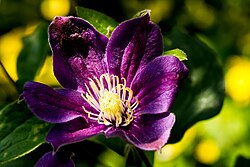
The Clematis genus, a member of the buttercup family (Ranunculaceae), comprises approximately 380 species of climbing plants. Renowned for their stunning blooms and versatile growth habits, these plants have become staples in gardens worldwide. From the classic deep purple of 'Jackmanii'—a favorite since 1862—to modern hybrids of Chinese and Japanese origin, Clematis offers an extraordinary array of colors and forms for any landscape.
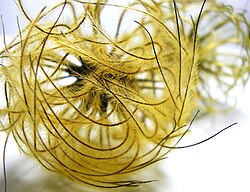
The name "Clematis" is derived from the Classical Greek word klēma, meaning vine or tendril. While most are simply called clematis, some species carry evocative common names. For instance, C. vitalba is known as "traveller's joy," while others like C. terniflora are referred to as "virgin's bower." Some species are colloquially called "old man's beard" due to their distinctive, fluffy seedheads.
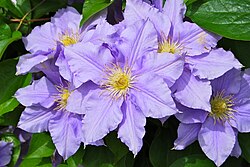
Key Facts
- Genus Size: Approximately 380 species.
- Family: Ranunculaceae (Buttercup family).
- Origin: Wide distribution, with many popular cultivars originating from China and Japan.
- Flower Size: Ranges from small (1.5–18 cm) to large (10–29 cm).
- Growth Habit: Primarily vigorous climbers used for pergolas, archways, and trellises.
Botanical Classification and Taxonomy
First formally published by Carl Linnaeus in 1753, the genus has undergone various taxonomic refinements. Because of its diversity, botanists use different systems to categorize the species. Magnus Johnson divided the genus into 19 sections, while Christopher Grey-Wilson proposed 9 subgenera, including Clematis, Cheiropsis, and Viorna.
Another practical approach used by gardeners, defined by John Howell, groups them into twelve categories based on growth and flowering habits, such as the Evergreen, Montana, and Viticella groups.
Popular Garden Groups and Cultivars
Many of the most sought-after garden varieties belong to the Viticella section. These are often large-flowered hybrids resulting from crosses between C. patens, C. lanuginosa, and C. viticella. These cultivars typically produce upward-facing flowers measuring 12–15 cm in diameter.
Early Large-Flowered Group
These varieties bloom on the previous year's growth. Notable examples include:
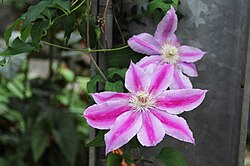
- 'Nelly Moser': White with distinctive pink stripes.
- 'The President': A striking blue bloom.
- 'Arctic Queen' (or 'Polar Bear'): Double white flowers.
- 'Niobe': Deep maroon tones.
Late Large-Flowered Group
These bloom on the current year's growth and are often more robust. Popular choices include:
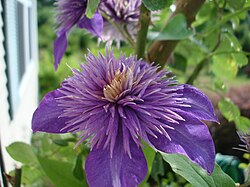
- 'Jackmanii': The iconic purple climber.
- 'Polish Spirit': A rich purple variety.
- 'Prince Charles': Elegant violet blooms.
The Montana Group
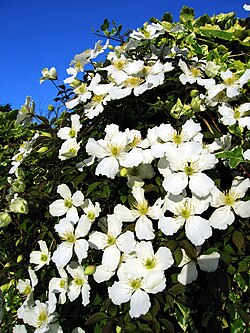
Known as vigorous climbers that flower in the spring, this group includes C. montana var. grandiflora (white) and 'Madame Julia Correvon' (crimson).
Species Diversity and Characteristics
The genus spans a vast range of species, from the alpine C. alpina to the Asian C. florida. Some species are prized for their foliage, while others are known for their unique fruit, such as the achenes (small, dry, one-seeded fruits) that give some species their "beard" appearance.
In terms of horticultural classification, the genus is broadly split into two divisions based on flower size:
| Division | Flower Diameter | Typical Characteristics |
|---|---|---|
| Small-flowered | 1.5 cm to 18 cm | Diverse sizes, often more numerous blooms. |
| Large-flowered | 10 cm to 29 cm | Usually flat, prominent blooms. |
Notable Species Examples
- C. armandii: Known as Armand clematis.
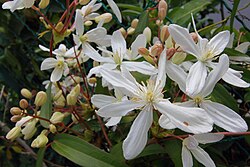
Clematis armandii - C. vitalba: The British native "traveller's joy."
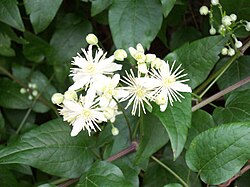
Flowers of C. vitalba - C. terniflora: Sweet autumn clematis.
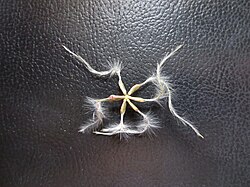
C. terniflora seed cluster - C. dioica: Found in regions like Costa Rica.
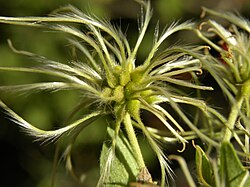
Fruits of C. dioica in Guanacaste, Costa Rica
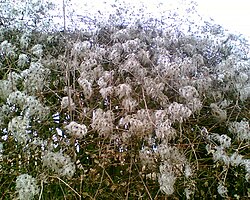
The seed heads of C. vitalba are particularly famous for their appearance in hedges, illustrating why the plant is colloquially linked to an "old man's beard."
Frequently Asked Questions
What is the difference between early and late large-flowered Clematis?
The primary difference is when they bloom and which growth they flower on. Early large-flowered varieties bloom on the growth from the previous year, while late large-flowered varieties bloom on the current year's new growth.
Which Clematis species is the most common for breeding large flowers?
Clematis patens, native to Japan and introduced to Europe in 1836, is the most frequently used species for developing large-flowered cultivars.
What are achenes in Clematis?
Achenes are the small, dry, one-seeded fruits produced by the plant. In some species, these form prominent, fluffy seed heads.
Are all Clematis plants climbers?
While most are famous as climbers used for trellises and pergolas, there are exceptions, such as Clematis recta, which is known as the ground clematis.
What does the name "Clematis" mean?
The name comes from the Greek word klēma, which translates to "vine" or "tendril."