Photovoltaics: Powering the Future with Solar Energy
Photovoltaics (PV) is the process of converting light directly into electricity using semiconducting materials. This process relies on the photovoltaic effect, a scientific phenomenon studied across physics, photochemistry, and electrochemistry. Today, this technology is widely used for large-scale electricity generation and as the foundation for photosensors.
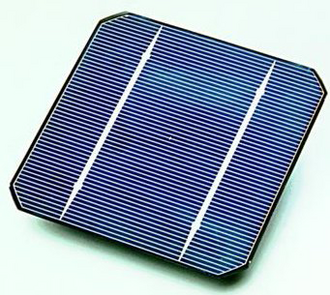
A standard photovoltaic system consists of solar modules, which are made up of multiple solar cells. These installations are highly versatile and can be ground-mounted, rooftop-mounted, wall-mounted, or even floating on water. To maximize energy capture, some systems remain fixed, while others utilize solar trackers that follow the sun's path across the sky.
Key Facts
- Environmental Impact: PV systems emit significantly less carbon dioxide than fossil fuels and produce no pollution or greenhouse gases during operation.
- Cost Reduction: Module prices dropped by over 90% between 2011 and 2024, reaching as low as $0.11/W due to massive production increases in China.
- Efficiency: Commercial solar modules can exceed 24% efficiency, with the best reaching 24.5% as of 2025.
- Scalability: Silicon, the primary material for PV, is abundant in the Earth's crust, allowing for high scalability.
- Global Leadership: China leads the world in total solar capacity, followed by the United States and Japan.
How Solar Cells Work
At the heart of every PV system is the solar cell. These cells generate power when light transmits through a transparent conducting electrode, creating electron-hole pairs. These pairs are then collected by electrodes to create an electrical current. The efficiency of this process depends heavily on the thickness of the active layer and the design of the transparent conductors.
![Schematic of charge collection by solar cells. Light transmits through transparent conducting electrode creating electron hole pairs, which are collected by both the electrodes. The absorption and collection efficiencies of a solar cell depend on the design of transparent conductors and active layer thickness.[36]](/images/d5/87/d587dc36a4d8b6e051d04b4db785bd06714956bbdf333181ad728f25b0743c2f.gif)
Efficiency and Performance
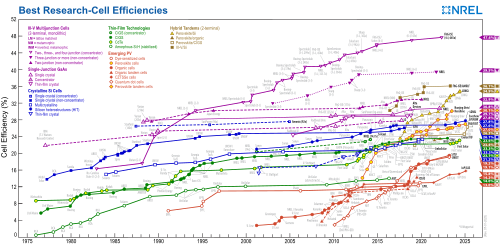
Efficiency refers to the percentage of sunlight that a cell can convert into usable electricity. While individual research cells often achieve higher rates, mass-produced modules typically have lower efficiencies. The most efficient mass-produced modules currently exhibit power density values of 175 W/m².
Factors Affecting Output
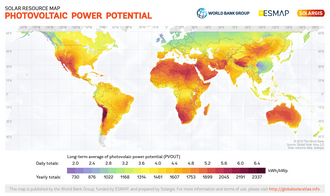
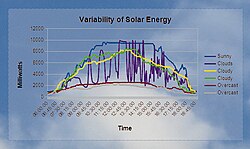
Solar energy production is not constant. It is heavily influenced by weather conditions, particularly cloud cover, which can significantly reduce output. Additionally, the angle of the panels relative to the equator and the local weather data over a ten-year average help determine the long-term power potential of a site.
Environmental and Economic Considerations
Photovoltaic technology is a critical tool for mitigating climate change. Once installed, the operation of PV systems is clean. However, the manufacturing and installation phases do produce some pollution and greenhouse gas emissions, though these are only a small fraction of those produced by fossil fuels.
Economically, the industry follows Swanson's Law, which observes that solar module prices drop by approximately 20% for every doubling of installed capacity. This "learning rate" has made solar one of the most competitive energy sources globally.
![Swanson's law–stating that solar module prices have dropped about 20% for each doubling of installed capacity—defines the "learning rate" of solar photovoltaics.[89]](/images/d8/3e/d83e12eccf9687e5fea813f3ca101d1176775f6060d46478c1d785739a2639c5.webp)
Material Constraints and Infrastructure
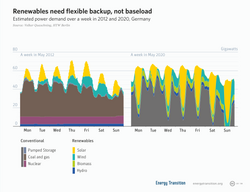
While silicon is abundant, other necessary materials like silver may limit future growth. Furthermore, because solar power is variable, its use as a primary energy source requires investments in energy storage systems or high-voltage direct current (HVDC) power lines for global distribution. Grids with high renewable penetration generally require flexible generation rather than traditional baseload generation.
Comparative Technology Analysis
Different materials result in different performance metrics. Monocrystalline silicon (Mono-Si) and Cadmium Telluride (CdTe) are two of the most common technologies used in the industry.
| Parameter | Mono-Si | CdTe |
|---|---|---|
| Cell efficiency | 16.5% | 15.6% |
| Module efficiency | 15.1% | 13.4% |
| Wafer/Layer thickness | 190 μm | 4.0 μm |
| Glass thickness | 4.0 mm | 3.5 mm |
| Operational lifetime | 30 years | 30 years |
Global Adoption and Applications
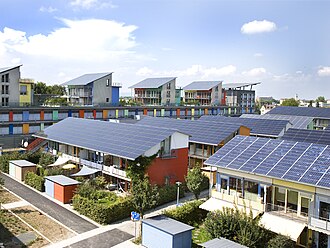
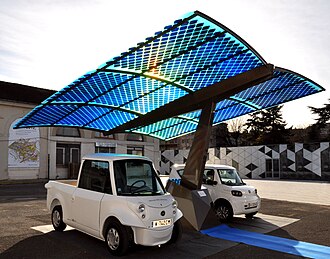
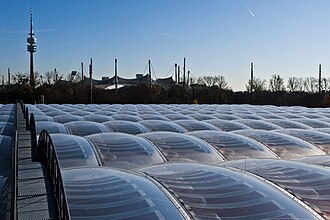
Solar PV is being integrated into diverse environments, from the International Space Station to sustainable housing projects like the Solar Settlement in Freiburg, Germany. It is also used in specialized applications such as electric vehicle charging stations and ETFE cushion photovoltaics.

Emerging Technologies
Research continues into "third generation" PV, including Perovskite solar cells, Dye-Sensitized Solar Cells, and Organic Photovoltaics (OPV). Perovskites, in particular, are viewed as a potential "wonder material" that could further transform the efficiency and cost of solar energy.
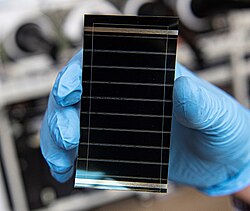
Global Capacity (2022)
The adoption of solar energy has seen explosive growth. As of 2022, the leading nations in total capacity include:
- China: 393,000 MW
- United States: 113,000 MW
- Japan: 78,800 MW
- Germany: 66,600 MW
- India: 63,100 MW
Frequently Asked Questions
What is the photovoltaic effect?
The photovoltaic effect is the physical and chemical process by which a semiconducting material converts light energy directly into electricity.
How efficient are modern solar panels?
Commercial solar modules can exceed 24% efficiency, with some reaching 24.5% as of 2025. Research-grade cells often achieve higher efficiencies than mass-produced modules.
Does solar panel production cause pollution?
Yes, the production and installation of PV systems cause some pollution and greenhouse gas emissions, but these are significantly lower than the emissions produced by fossil fuel energy sources.
What is Swanson's Law?
Swanson's Law is the observation that the price of solar modules drops by about 20% for every doubling of the total installed capacity worldwide.
What are the main disadvantages of solar PV?
The primary challenges include variable power generation (intermittency), the need for expensive energy storage or high-voltage distribution, and competition for land use.