Understanding Solar Cells: From Scientific Theory to Global Energy Solutions
Solar energy has transitioned from a scientific curiosity to a cornerstone of the global renewable energy landscape. At the heart of this revolution is the solar cell, a device capable of converting sunlight directly into electricity. While the concept has existed for nearly two centuries, recent advancements in materials science and manufacturing have driven costs down and efficiency up, making solar power more accessible than ever before.
The Science of Photovoltaics
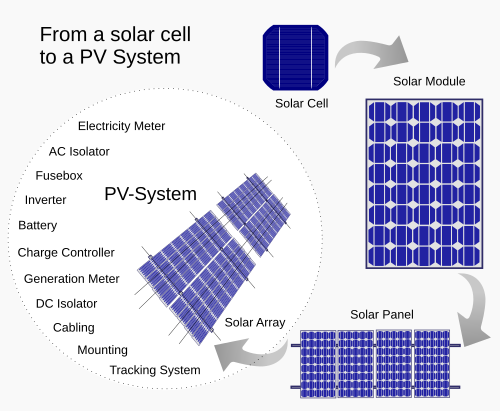
The fundamental principle behind solar energy is the photovoltaic effect. This process occurs when light strikes a semiconductor material, creating an electric current. This phenomenon was first discovered by Edmond Becquerel in 1839.
To function effectively, a photovoltaic (PV) cell requires specific physical attributes to manage the movement of electrons. In a conventional crystalline silicon solar cell, electrical contacts are applied to a silicon wafer. These contacts consist of busbars (larger silver-colored strips) and fingers (smaller strips) that collect the generated electricity.
![Schematic of charge collection by solar cells. Light transmits through transparent conducting electrode creating electron hole pairs, which are collected by both the electrodes.[62]](/images/e9/e0/e9e089f0362b2f45fa4d4827d429828c43305c177fb593657d98ca57632efbc2.gif)
Understanding the mechanism requires looking at the microscopic level. When light hits the cell, it creates electron-hole pairs, which are then collected by electrodes to produce power.
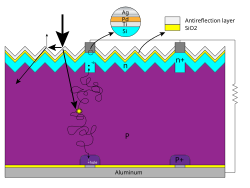
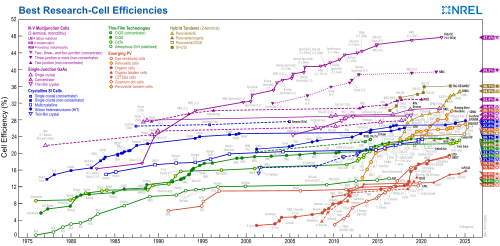
However, there is a theoretical ceiling to how efficient a single-junction solar cell can be. This is known as the Shockley-Queisser limit. For semiconductors with a band gap between 1 and 1.5eV, this limit defines the maximum possible efficiency. Modern research into multijunction cells aims to bypass this limit by stacking different materials to capture more of the solar spectrum.

Generations of Solar Technology
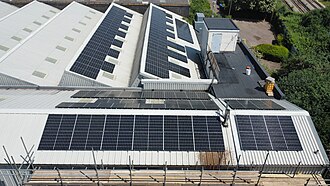
Solar technology is generally categorized into three distinct generations based on the materials used and the complexity of the manufacturing process.
First Generation: Crystalline Silicon
This is the most mature and widely used technology. It includes:
- Monocrystalline silicon: Highly efficient cells made from a single crystal structure.
- Polycrystalline silicon: A more affordable option made from multiple silicon crystals.
- Ribbon silicon: A variation used in specific manufacturing processes.
Second Generation: Thin-Film Cells
Thin-film technology uses layers of photovoltaic material deposited on substrates like glass or metal. Common types include:
- Cadmium telluride
- Copper indium gallium selenide (CIGS)
- Silicon thin film
- Gallium arsenide thin film
Third Generation and Emerging Research
The frontier of solar research focuses on breaking efficiency records and reducing costs through novel materials and structures. Key areas of study include:
- Perovskite solar cells: A rapidly advancing class of materials.
- Bifacial solar cells: Cells that can collect light from both the front and the back.
- Multijunction cells: Using multiple layers to capture different wavelengths of light.
- Quantum dots and Organic/polymer solar cells: Utilizing nanotechnology and specialized polymers.
Applications: From Calculators to Outer Space
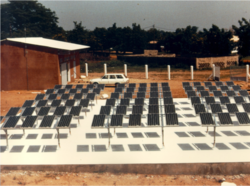
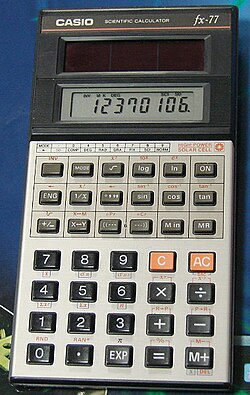
The versatility of solar cells allows them to be used in a vast array of environments. In everyday life, we see them in residential rooftops, commercial buildings, and even small consumer electronics.
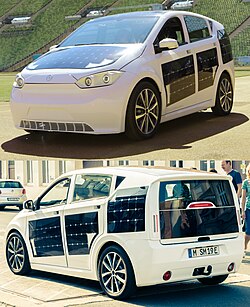
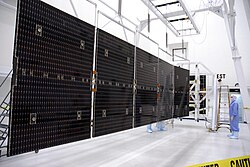
In the automotive and aerospace sectors, solar power is used to extend the range and lifespan of vehicles and spacecraft. For example, specialized solar arrays power satellites and deep-space probes, where traditional fuel is impractical.
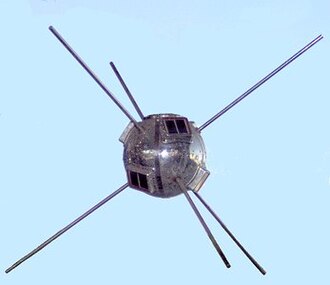
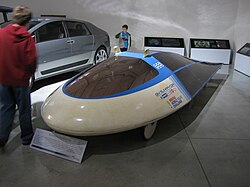
Even in aviation, solar power has enabled long-duration flights using aircraft designed specifically to harness photovoltaic energy.

Global Market and Manufacturing
The solar industry has seen exponential growth due to declining costs, improved manufacturing, and increased subsidies. A significant shift in production has occurred over the last few decades, with China becoming the dominant force in the global supply chain. As of 2021, China's share of solar PV module production reached approximately 70%.
![Solar cell production by region[179]](/images/47/a0/47a07bd7f745841470f7ce78a9cfa2a3d1ec775db180c41885256b7f8650d74c.png)
![Global photovoltaics market share by technology 1980–2021[76]: 24, 25](/images/1b/fe/1bfecd561f097db3ef1b32a59d80bf29552772d3c8fc7441795222d59ad1c9be.webp)
Regional Solar Capacity by Sector
The following table illustrates the varying levels of solar deployment across different sectors in several key nations.
| Country | Residential | Commercial | Utility-scale |
|---|---|---|---|
| Australia | 1.8 | 1.7 | 2.0 |
| China | 1.5 | 1.4 | 1.4 |
| France | 4.1 | 2.7 | 2.2 |
| Germany | 2.4 | 1.8 | 1.4 |
| Italy | 2.8 | 1.9 | 1.5 |
| Japan | 4.2 | 3.6 | 2.9 |
| United Kingdom | 2.8 | 2.4 | 1.9 |
| United States | 4.9 | 4.5 | 3.3 |
Key Facts
- Inventor: Edmond Becquerel discovered the photovoltaic effect in 1839.
- First Production: Commercial production of solar cells began in the 1950s.
- Market Leader: China produced approximately 70% of the world's solar PV modules in 2021.
- Efficiency Limit: The Shockley-Queisser limit defines the maximum theoretical efficiency for single-junction cells.
- Primary Material: Crystalline silicon remains the most common material for solar cells.
Frequently Asked Questions
What is the difference between a solar cell and a solar thermal collector?
A solar cell (photovoltaic) converts sunlight directly into electricity. In contrast, a solar thermal collector absorbs sunlight to produce heat, which can be used for hot water or as a thermal module.
What are bifacial solar cells?
Bifacial solar cells are designed to capture sunlight from both the front and the rear sides, often utilizing light reflected from the ground (albedo) to increase energy production.
Why are solar cells used in space?
Solar cells provide a reliable, long-term power source for spacecraft and satellites where carrying large amounts of traditional fuel is difficult or impossible.
How are solar cells classified?
They are classified into three generations: first-generation (crystalline silicon), second-generation (thin-film), and third-generation (emerging technologies like perovskites and organic cells).
What is the Shockley-Queisser limit?
It is the theoretical maximum efficiency that a single-junction solar cell can achieve based on the physics of semiconductors and the solar spectrum.