Agrivoltaics: Maximizing Land Use Through Dual-Purpose Solar and Agriculture
As the global demand for renewable energy rises alongside the need for sustainable food production, a synergistic solution has emerged: agrivoltaics. Also known as agrophotovoltaics, agrisolar, or dual-use solar, this practice involves utilizing the same parcel of land for both solar energy generation and agricultural activities.
By integrating photovoltaic (PV) modules—devices that convert sunlight directly into electricity—with farming, land managers can optimize resources. This approach can take many forms, such as installing panels between crop rows, elevating them above plants, integrating them into greenhouses, or arranging them to support pollinators.
![Vertical solar panels, east-to-west orientation, with bifacial modules, near Donaueschingen, Germany[1]](/images/3c/83/3c83ec64ddb84a080fdc552ba390c871236332079acb077c61acc427a00d6fd4.jpg)
Key Facts
- Dual-Use: Agrivoltaics allows for simultaneous solar energy production and agricultural cultivation on a single site.
- Diverse Applications: Systems can support crops, livestock grazing, or even desert rehabilitation.
- Crop Benefits: Certain shade-tolerant crops, such as leafy greens and spices, can see increased yields under solar arrays.
- Livestock Integration: Sheep and other animals can be used for solar grazing to manage vegetation.
- Historical Roots: Experimental photovoltaic greenhouses and open-field systems have been developed in Europe since the early 2000s.
System Design and Approaches
Agrivoltaic systems are not one-size-fits-all; they are engineered based on the specific needs of the land and the intended use. Design strategies vary significantly to balance light availability with energy capture.
Fixed and Vertical Systems
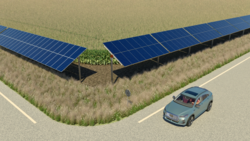
Some installations use fixed panels, which remain at a constant angle. Other designs utilize vertical systems, where panels are oriented east-to-west. Vertical modules can be particularly effective for certain land uses as they allow for easier movement of machinery or livestock between the rows.
Integrated and Dynamic Designs
More advanced systems may be dynamic, utilizing trackers that move to follow the sun, or integrated directly into agricultural structures like greenhouses. Furthermore, spectrally selective modules are being developed to manage how light is distributed, potentially allowing specific wavelengths of light to pass through to the plants below while capturing others for electricity.
Impacts on Agriculture: Light, Water, and Heat
The primary interaction in an agrivoltaic system is the management of light. Because solar panels consume sunlight to generate power, there is a potential trade-off between energy production and crop yield. However, this interaction is complex and can actually benefit certain environments.
The Role of Shade and Microclimates
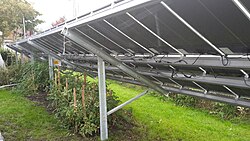
The shade provided by solar panels can alter the microclimate—the local atmospheric conditions near the ground. This can reduce water evaporation from the soil and protect plants from extreme heat. While staple crops like wheat, rice, soybeans, or pulses generally require high sun exposure, many other crops thrive in the partial shade provided by these systems.
Crop Compatibility and Yields
Research has shown that increased yields can be observed in a wide variety of plants when integrated with solar arrays. The suitability of a crop often depends on its shade tolerance.
| Category | Examples of Crops |
|---|---|
| Leafy Greens & Vegetables | Lettuce, Spinach, Broccoli, Celery, Tomatoes, Potatoes |
| Spices & Peppers | Turmeric, Ginger, Chiltepin peppers, Basil |
| Other Fruits & Grains | Strawberries, Amaranth, Corn/Maize, Wheat |
| Pasture & Forage | Pasture grass, Turnips |
Livestock and Grazing
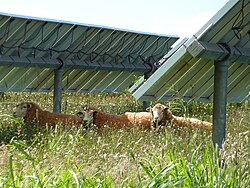
Agrivoltaics is not limited to plant cultivation. Solar grazing involves using livestock, such as sheep, to manage the vegetation beneath solar panels. This can reduce the need for mechanical mowing and provide a secondary income stream for farmers.
Economic and Environmental Considerations
Implementing agrivoltaic systems involves balancing capital costs (initial investment) and operating costs against the dual revenue streams of energy and agriculture. Beyond economics, these systems offer environmental potential, including desert rehabilitation and the ability to use floating solar on canals to conserve water and generate power simultaneously.
Frequently Asked Questions
Do solar panels reduce crop yields?
It depends on the crop. While staple crops that require full sun (like wheat or rice) may face trade-offs, many shade-tolerant crops like leafy greens and certain spices can actually see improved yields due to the moderated microclimate.
What is solar grazing?
Solar grazing is the practice of using livestock, such as sheep, to graze on the vegetation growing underneath solar panels. This helps keep weeds in check and provides forage for the animals.
Can agrivoltaics be used in arid regions?
Yes. In arid regions, the shade from solar panels can help retain soil moisture and reduce heat stress, making it a potentially effective pathway for both energy and food production in dry climates.
What are spectrally selective modules?
These are specialized solar modules designed to manage the light spectrum. They can be engineered to allow certain wavelengths of light—which are essential for photosynthesis—to pass through to the crops while capturing other wavelengths to generate electricity.
Is agrivoltaics a new concept?
While the term is modern, experimental work has been ongoing for decades. Europe saw experimental photovoltaic greenhouses in the early 2000s, with open-field experiments following in Italy, France, and Germany throughout the 2000s.