Biological Control: Harnessing Nature to Manage Pests
In the effort to protect crops and ecosystems, humans often turn to nature's own defense mechanisms. Biological control, or biocontrol, is the practice of using living organisms to manage pests. These pests can include insects, mites, weeds, or pathogens that threaten plants and animals. By leveraging natural processes such as predation, parasitism, and herbivory, biocontrol serves as a vital component of Integrated Pest Management (IPM) programs.
While the concept is ancient, modern biocontrol is a highly managed science. In the United States and Europe, regulatory authorities distinguish between invertebrates and macroorganisms, which are registered as biological control agents, and microorganisms, which are classified as biopesticides.
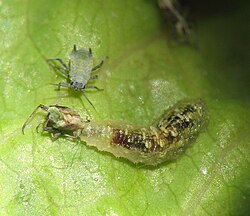
Syrphus hoverfly larva (below) feed on aphids (above), making them natural biological control agents.
Key Facts
- Biological control uses natural enemies like predators, parasitoids, and pathogens to manage pest populations.
- There are three primary strategies: classical (importation), inductive (augmentation), and inoculative (conservation).
- Predators consume multiple prey items, while parasitoids develop inside or on a single host.
- Pathogens, including bacteria, fungi, and viruses, can be used to target specific pests.
- Effective biocontrol requires careful management to avoid negative side effects on native biodiversity.
Core Strategies of Biological Control
Depending on the goal and the specific pest, scientists and land managers employ three distinct approaches to biological control:
Classical Biological Control (Importation)
This strategy involves the introduction of a natural enemy from a pest's native range into a new area where the pest has become problematic. The goal is to establish a self-sustaining population of the natural enemy to achieve long-term control.
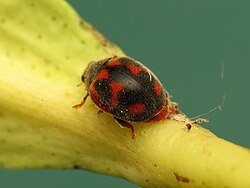
Rodolia cardinalis, the vedalia beetle, was imported from Australia to California in the 19th century, successfully controlling cottony cushion scale on orange trees.
Inductive Biological Control (Augmentation)
Also known as augmentation, this method involves the periodic release of large numbers of natural enemies to achieve rapid pest reduction. Unlike classical control, the goal is often immediate relief rather than permanent establishment.
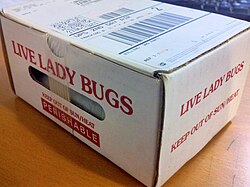
Hippodamia convergens, the convergent lady beetle, is commonly sold for biological control of aphids.
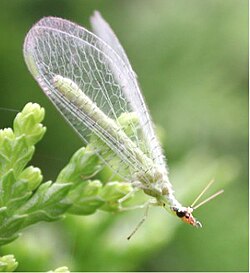
Predatory lacewings are available from biocontrol dealers.
Inoculative Biological Control (Conservation)
Conservation focuses on protecting and maintaining existing populations of natural enemies. This is achieved through measures that reestablish or support the habitat and resources these organisms need to thrive.
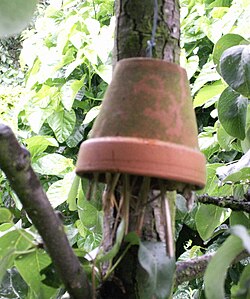
An inverted flowerpot filled with straw to attract earwigs
Types of Biological Control Agents
Natural enemies are categorized based on how they interact with their target pests. These agents are essential for limiting the density of potential threats in agricultural and natural environments.
Predators
Predators are organisms that hunt and consume many prey individuals throughout their lives. Common examples include lady beetles and lacewings.
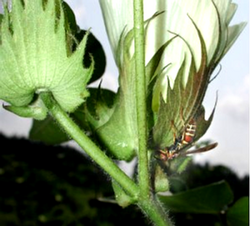
Predatory Polistes wasp searching for bollworms or other caterpillars on a cotton plant
Parasitoids
A parasitoid is an organism that spends a significant portion of its life cycle attached to or inside a single host organism, eventually killing it. This is a highly specialized form of biological control.
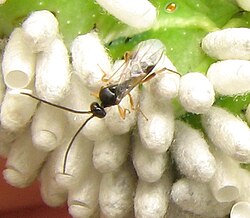
A parasitoid wasp (Cotesia congregata) adult with pupal cocoons on its host, a tobacco hornworm (Manduca sexta, green background), an example of a hymenopteran biological control agent
![The parasitoid wasp Aleiodes indiscretus parasitizing a spongy moth caterpillar, a serious pest of forestry[47]](/images/5f/cc/5fcc5bc4e83c5eb22e3de8905e9e9bdf507df40a0d9c6549ed8c317bf9b36149.jpg)
The parasitoid wasp Aleiodes indiscretus parasitizing a spongy moth caterpillar, a serious pest of forestry[47]
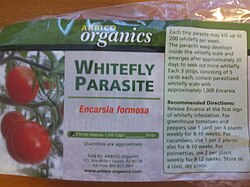
Encarsia formosa, widely used in greenhouse horticulture, was one of the first biological control agents developed.
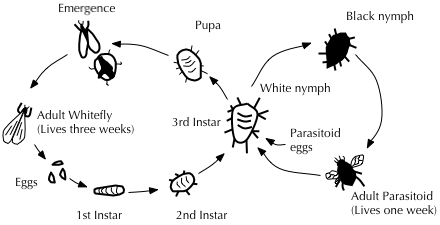
Life cycles of greenhouse whitefly and its parasitoid wasp Encarsia formosa
Pathogens
Pathogens are microorganisms that cause disease in pests. These can include bacteria, fungi, viruses, and oomycota. In the context of plant diseases, these agents are often called antagonists.
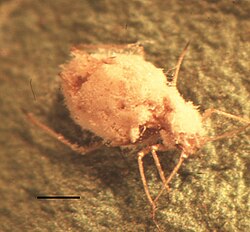
Green peach aphid, a pest in its own right and a vector of plant viruses, killed by the fungus Pandora neoaphidis (Zygomycota: Entomophthorales) Scale bar = 0.3 mm.
Competitors
Competitors are organisms that vie for the same resources (such as food or space) as the pest, thereby limiting the pest's ability to thrive and spread.
Targeting Different Pests
Biological control is not limited to insects. It is applied across various categories of biological threats:
- Insects and Mites: Managed via predators, parasitoids, and pathogens.
- Weeds: Controlled using seed predators, herbivores, and plant pathogens.
- Plant Diseases: Managed using microbial antagonists.
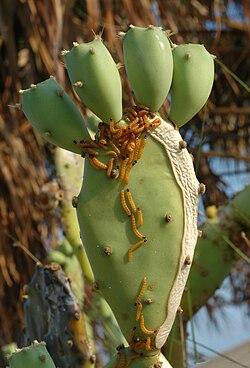
Cactoblastis cactorum larvae feeding on Opuntia prickly pear cacti
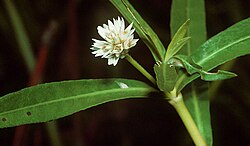
The invasive species Alternanthera philoxeroides (alligator weed) was controlled in Florida (U.S.) by introducing alligator weed flea beetle.
Challenges and Risks
While highly effective, biological control is not without risks. If an introduced agent is not properly vetted, it can lead to unintended side effects, such as attacking non-target native species. A historical example of an ineffective and problematic introduction is the cane toad in Australia.
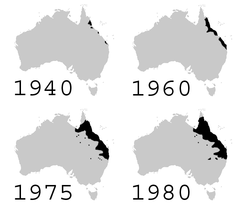
Cane toad (introduced into Australia 1935) spread from 1940 to 1980: it was ineffective as a control agent. Its distribution has continued to widen since 1980.
Summary of Biological Control Methods
| Strategy | Primary Mechanism | Goal |
|---|---|---|
| Classical | Importation of natural enemies | Long-term, self-sustaining control |
| Augmentation | Periodic release of agents | Rapid, temporary pest reduction |
| Conservation | Habitat and resource management | Maintaining existing natural enemies |
Frequently Asked Questions
What is the difference between a predator and a parasitoid?
A predator typically consumes many prey individuals throughout its life, whereas a parasitoid develops on or inside a single host, eventually killing that host as a part of its life cycle.
How does biological control differ from using chemical pesticides?
Chemical pesticides use synthetic substances to kill pests, while biological control uses living organisms (natural enemies) to manage pest populations through natural ecological interactions.
Can biological control agents harm the environment?
Yes, if not carefully managed, introduced agents can have side effects, such as attacking non-target native species or failing to control the intended pest while spreading elsewhere.
What is Integrated Pest Management (IPM)?
IPM is a holistic approach to pest management that combines various tactics, including biological control, to manage pests in an environmentally sustainable and effective manner.
Are microorganisms considered biological control agents?
In many regulatory frameworks, such as those in the US and Europe, microorganisms are specifically registered as biopesticides, while larger invertebrates are registered as biological control agents.