Understanding Scoliidae: The World of Mammoth Wasps
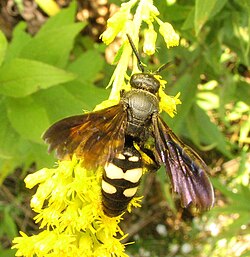
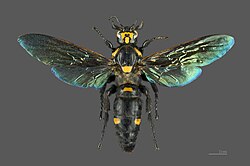
Commonly known as mammoth wasps, the Scoliidae family represents a fascinating group of insects within the order Hymenoptera. With approximately 300 described species found across the globe, these wasps are easily recognized by their striking appearance—typically black bodies accented with vibrant yellow or orange markings and distinctively corrugated wing tips.
While they may look intimidating, scoliid wasps play a vital role in our ecosystems. They are solitary parasitoids, meaning they live independent lives and rely on a single host to provide for their offspring. This biological trait makes them highly effective natural pest controllers.
![Face of a scoliid wasp in coded color, illustrating the main features: ocellar pits ocellar furrow three simple eyes two compound eyes vertex, above curved carina frontalis frons, below curved carina frontalis and bisected by fissura frontalis scrobe area frontalis clypeus anterior margin of clypeus mandibles antennal scapes lamina frontalis spatium frontale or frontal space Adapted from K. V. Krombein (1978)[8]](/images/95/45/95454d1b5dccf1c719fd1493460448848e75c1807c5b2c7718f430835d9e514f.jpg)
Key Facts
- Common Name: Mammoth wasps or scoliid wasps.
- Global Diversity: Approximately 300 described species.
- Ecological Role: Important biocontrol agents that parasitize beetle larvae.
- Physical Traits: Black bodies with yellow/orange markings and corrugated wing tips.
- Sexual Dimorphism: Males are more slender with longer antennae than females.
Biology and Life Cycle
The Parasitoid Lifestyle
The life cycle of a scoliid wasp is intimately tied to the larvae of scarab beetles. Female wasps are expert hunters; they fly close to the ground, searching through soil or rotting wood to locate beetle grubs. Once a host is found, the female uses her sting to paralyze the larva. In many cases, she will excavate a small chamber to house the paralyzed grub before depositing a single egg, often attached to one of the larva's abdominal segments.
Because many scarab beetles are considered agricultural or garden pests—such as the Japanese beetle—scoliid wasps serve as essential biocontrol agents, helping to regulate beetle populations naturally.
Pollination and Unique Behaviors
While their primary biological drive is parasitism, adult scoliids are also minor pollinators. They can frequently be seen visiting various wildflowers during the late summer months. Some species even exhibit highly specialized evolutionary relationships. For instance, in subtropical South America, the orchid Bipinnula penicillata utilizes pseudocopulation to ensure pollination. The flower mimics the appearance of a female Pygodasis bistrimaculata wasp, tricking males into attempting to mate with the bloom, thereby transferring pollen.
Taxonomy and Classification
The family Scoliidae is categorized into several subfamilies. While some are well-known in the modern world, others exist only in the fossil record, providing a glimpse into the evolutionary history of these insects.
Living Subfamilies
Current living genera are divided into three primary subfamilies:
- Proscoliinae: Includes the genus Proscolia.
- Campsomerinae: A large group containing many tribes, such as Campsomerini.
- Scoliinae: Includes well-known genera like Scolia and Megascolia.
Fossil Subfamilies
Paleontological evidence has identified two extinct subfamilies:
- Archaeoscoliinae: This group saw its greatest diversity during the Cretaceous period and went extinct by the late Eocene.
- Palaeoscoliinae: A single species described from the Late Eocene, which shows morphological similarities to the modern Scoliinae.
Summary of Scoliidae Classification
| Rank | Classification |
|---|---|
| Kingdom | Animalia |
| Phylum | Arthropoda |
| Class | Insecta |
| Order | Hymenoptera |
| Family | Scoliidae |
Frequently Asked Questions
Are scoliid wasps dangerous to humans?
While they possess a sting used to paralyze beetle larvae, they are solitary wasps and are generally not aggressive toward humans. Their primary focus is locating hosts in the soil or wood.
How can I identify a mammoth wasp?
Look for large wasps that are typically black with yellow or orange markings. A key identifying feature is their corrugated (wrinkled) wing tips.
Why are they called "biocontrol agents"?
They are called biocontrol agents because they naturally reduce the population of pest insects. By parasitizing scarab beetle larvae, they help prevent beetle outbreaks that could damage plants and crops.
What is the difference between male and female scoliid wasps?
The species exhibit sexual dimorphism, meaning males and females look different. Males are generally more slender and elongated than females and possess significantly longer antennae.
Do all scoliid wasps live in the same environment?
No, they are found worldwide. In North America alone, there are 36 reported species, with various genera distributed across the United States, Mexico, and the Caribbean.