Cuckoo Wasps: The Brilliant and Resourceful Parasitoids of the Insect World
In the sun-drenched landscapes of the world's deserts and Mediterranean climates, a group of insects dazzles the eye with intense, metallic hues. Known commonly as cuckoo wasps or emerald wasps, members of the family Chrysididae are far more than just beautiful ornaments of the insect world. These highly specialized wasps have mastered a complex lifestyle of parasitism, evolving remarkable physical and behavioral traits to survive in some of the harshest environments on Earth.
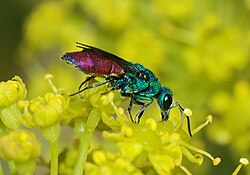
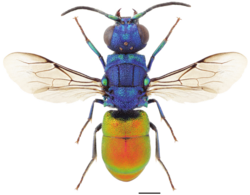
With over 3,000 described species, the Chrysididae family is a massive, cosmopolitan group. Their striking appearance—ranging from deep rubies to brilliant golds and emeralds—is not caused by pigments, but by structural coloration, a phenomenon where the physical structure of the insect's exoskeleton manipulates light to create shimmering colors.
Key Facts
- Scientific Family: Chrysididae
- Common Names: Cuckoo wasps, jewel wasps, emerald wasps, gold wasps, and ruby wasps.
- Lifestyle: Kleptoparasitic or parasitoid (laying eggs in the nests of other species).
- Appearance: Brilliant metallic colors created by structural coloration.
- Habitat: Most diverse in desert regions and sandy soils.
- Defense Mechanism: Some species use "volvation," curling into a protective ball.
Classification and Nomenclature
The scientific name Chrysididae finds its roots in the Greek word chrysis, meaning "gold vessel" or "gold-embroidered dress," a nod to their lustrous bodies. While the term "cuckoo wasp" is most strictly applied to this family, it is sometimes used more broadly for other insects, such as Sapyga louisi, due to their similar reproductive strategies.
Scientific Hierarchy
Taxonomically, cuckoo wasps belong to the following groups:
- Kingdom: Animalia
- Phylum: Arthropoda
- Class: Insecta
- Order: Hymenoptera
- Superfamily: Chrysidoidea
- Family: Chrysididae
The family is divided into several subfamilies, including Amiseginae, Chrysidinae, Cleptinae, and Loboscelidiinae.
Ecology and Survival Strategies
Cuckoo wasps are solitary insects, meaning they do not live in colonies. They are most active during the hottest and driest months of summer. Because they rely on the nests of other insects, they are most frequently found in areas where their hosts—typically solitary bees and wasps—are abundant, such as sandy soils and dry microhabitats.
Kleptoparasitism and Parasitoidism
The term kleptoparasite refers to an organism that steals food intended for another. In the largest subfamily, Chrysidinae, females lay their eggs in the nests of host species. Once the cuckoo wasp larva hatches, it consumes the host's egg or larva and then feeds on the provisions left by the host parent.
Other subfamilies exhibit parasitoidism, specifically targeting sawflies or walking sticks. To succeed in these high-stakes environments, some species have even evolved chemical mimicry, allowing them to imitate the odors of their hosts to avoid detection.
Physical Adaptations for Defense
Living in the nests of potentially aggressive hosts requires serious protection. Many Chrysidids have developed reinforced cuticles (exoskeletons) to withstand attacks. A unique adaptation found in the Chrysidinae subfamily is volvation. These wasps possess a flattened or concave lower abdomen, which allows them to curl into a tight, defensive ball—much like a pill bug—when threatened.
Evolutionary History
The evolutionary lineage of cuckoo wasps is ancient, with a temporal range extending from the Aptian period to the present day. While the fossil record is somewhat fragmentary, significant evidence of their long history has been found in various amber and limestone deposits:
- Russia: Fossils from the lower Aptian Turga Formation and upper Santonian Taimyr amber.
- France: Cretaceous specimens found in Albian-Cenomanian amber.
- Morocco: Specimens preserved in Cenomanian limestone.
- Canada: Fossils found in upper Campanian amber.
Summary of Cuckoo Wasp Characteristics
| Feature | Description |
|---|---|
| Primary Coloration | Metallic (via structural coloration) |
| Reproductive Strategy | Kleptoparasitic or parasitoid |
| Social Structure | Solitary |
| Preferred Climate | Subtropical, Mediterranean, and arid/desert regions |
| Key Defense | Volvation (curling into a ball) and reinforced cuticles |
Frequently Asked Questions
Why are they called cuckoo wasps?
They are named after the cuckoo bird because of their behavior of laying eggs in the nests of unrelated host species, rather than building their own nests and providing for their own young.
What makes their colors so bright?
Their brilliant colors are the result of structural coloration. Instead of using chemical pigments, their bodies are shaped in a way that reflects light in specific, intense metallic patterns.
How do they defend themselves from hosts?
Many species use volvation, curling their bodies into a hard, protective ball to protect their vulnerable undersides. They also possess reinforced exoskeletons to endure attacks from aggressive hosts.
Where are they most commonly found?
They are most diverse in desert regions and areas with sandy soils, as these environments support the high populations of solitary bees and wasps that they depend on for survival.
Are all cuckoo wasps the same?
No. While they share many traits, they are divided into different subfamilies. For example, Chrysidinae can curl into balls, whereas other subfamilies that parasitize sawflies or walking sticks cannot.