The Versatile World of Switchgrass: A Sustainable Powerhouse
In the search for sustainable, resource-efficient crops, few plants offer as much potential as switchgrass (*Panicum virgatum*). This hardy, perennial grass is more than just a common field plant; it is a biological marvel capable of thriving in challenging environments while providing massive benefits for bioenergy, livestock, and land conservation.
What is Switchgrass?
Switchgrass is a perennial, rhizomatous grass, meaning it grows via underground stems called rhizomes that allow it to spread and persist for many years. It is a warm-season plant that typically begins its growth cycle in late spring. Because it is a self-seeding crop, farmers often find it easier to manage than annual crops, as it does not require replanting after every harvest. Once a stand is established, it can remain productive for ten years or longer.
Physical Characteristics
This grass is known for its impressive stature, capable of reaching heights of up to 2.7 meters (8 ft 10 in), though it is generally shorter than species like big bluestem or indiangrass. Its leaves are quite long, ranging from 30 to 90 cm, and feature a prominent midrib. One of its most significant biological advantages is its use of C4 carbon fixation. This is a specialized photosynthetic process that allows the plant to capture carbon dioxide more efficiently, giving it a distinct advantage in high-temperature and drought-prone conditions.
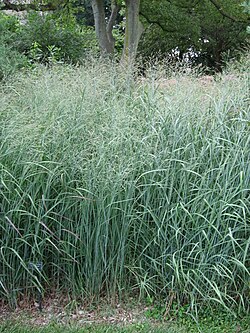
During its reproductive phase, switchgrass produces well-developed panicles (flower clusters) that can reach up to 60 cm in length. The seeds are small, measuring 3–6 mm in length, and can take on a pink or dull-purple hue when ripe, eventually turning golden brown alongside the autumn foliage.
Understanding the Two Main Types: Upland vs. Lowland
Switchgrass is a highly diverse species. This diversity is reflected in its two distinct forms, known as cytotypes. These forms represent different evolutionary adaptations that allow the species to thrive across various environments.
Lowland cultivars are typically found in more favorable environments and are bred for high biomass production. They often exhibit a "bunchgrass" habit and can grow to 2.7 meters or more. However, they tend to be more sensitive to moisture stress. In contrast, upland cultivars are generally of northern origin and are more cold-tolerant. These types are usually shorter (≤ 2.4 m) and more "sod-forming" due to their vigorous rhizomes. Both types are deeply rooted, often reaching depths of more than 1.8 meters, which helps stabilize soil and access deep water reserves.
![Panicum virgatum ecotypes and their distribution in the United States of America[6]](/images/38/f7/38f77c6e4a582d12e4ea7b0e099eed8cf5f8d23bd469c391bc412c2a41852f28.png)
| Feature | Upland Cultivars | Lowland Cultivars |
|---|---|---|
| Typical Height | ≤ 2.4 m (7 ft 10 in) | ≥ 2.7 m (8 ft 10 in) |
| Primary Advantage | Cold tolerance | High biomass production |
| Growth Habit | Sod-forming (vigorous rhizomes) | Bunchgrass habit |
| Environmental Sensitivity | More hardy in northern areas | More sensitive to moisture stress |
Cultivation and Management
Growing switchgrass successfully requires careful initial management. To control weeds, farmers are encouraged to use mowing or properly labeled herbicides. It is important to avoid hormone herbicides, such as 2,4-D, during the early establishment year, as these can hinder the plant's development. While a new stand might appear to struggle due to weed competition, many stands become well-established in subsequent years with proper care.
It is important to note that switchgrass is a long-term investment. It typically takes up to three years to reach its full production potential. In the first year, a stand may only produce 1/4 to 1/3 of its potential yield, increasing to about 2/3 in the second year after seeding.
A Leader in Bioenergy Production
Since the mid-1980s, switchgrass has been a primary candidate for renewable bioenergy. Because it can grow on marginal lands—land that is not suitable for high-value food crops—it does not compete directly with food production. It is currently being studied for several conversion processes, including cellulosic ethanol (fuel made from the non-edible parts of plants), biogas, and direct combustion for thermal energy.
Cellulosic Ethanol and Biogas
Switchgrass is highly efficient at converting solar energy into biomass. Compared to corn, switchgrass requires significantly less fossil energy to produce. For example, studies have shown it takes only 0.97 to 1.34 GJ to produce one tonne of switchgrass, whereas corn requires 1.99 to 2.66 GJ. This results in a highly favorable energy output-to-input ratio, which can reach as high as 20:1.
While corn ethanol yields about 400 liters of ethanol per tonne, current technology for converting switchgrass biomass yields approximately 340 liters per tonne. However, the production cost of switchgrass ethanol is generally about half that of grain corn, and it captures more biomass energy per hectare.
Thermal Energy and Fuel Pellets
Direct thermal applications, such as burning switchgrass for heat, are closer to large-scale commercial use than liquid biofuels. Switchgrass can be compressed into fuel pellets for use in home stoves or industrial boilers. Research indicates that switchgrass pellets are an excellent substitute for coal in power generation and offer a high energy output-to-input ratio of 14.6:1. Furthermore, using switchgrass pellets can help mitigate greenhouse gases, potentially removing 7.6–13 tonnes of $\text{CO}_2$ per hectare.
Beyond Fuel: Forage, Ornamentals, and Plastics
Switchgrass serves several other vital roles in agriculture and landscaping:
- Forage and Grazing: When managed correctly, switchgrass is a valuable forage for livestock. To ensure the grass survives, grazing should only begin when plants are 50 cm tall and should stop once they are eaten down to 25 cm.
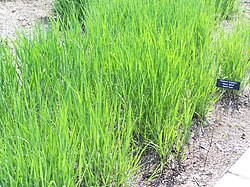
- Ornamental Use: Many cultivars have been developed for landscaping due to their aesthetic appeal. Popular varieties include 'Heavy Metal', 'Northwind', 'Shenandoah', and 'Dallas Blues'.
In the realm of advanced biotechnology, scientists have even experimented with genetically modifying switchgrass to produce polyhydroxybutyrate, a type of biodegradable plastic. While current accumulation rates in the leaves are too low for commercial use, it remains a fascinating area of research.
Key Facts
- Growth Habit: A hardy, perennial, rhizomatous grass that can grow up to 2.7 meters tall.
- Climate Advantage: Uses C4 carbon fixation, making it highly resistant to drought and heat.
- Energy Efficiency: Offers an energy output-to-input ratio of up to 20:1.
- Land Use: Can be grown on marginal lands with low requirements for fertilizer and herbicides.
- Longevity: Once established, a single stand can last for 10 years or more.
- Dual Forms: Exists as both cold-tolerant "upland" and high-biomass "lowland" types.
Frequently Asked Questions
How long does it take for switchgrass to reach full production?
It typically takes up to three years for a switchgrass stand to reach its full production potential. In the first year, it usually produces 1/4 to 1/3 of its potential, and in the second year, it reaches about 2/3.
Is switchgrass better for energy than corn?
While corn may produce more ethanol per tonne, switchgrass has a much lower production cost (about half that of corn) and requires significantly less fossil energy to grow. It also has a superior energy output-to-input ratio and can grow on land unsuitable for corn.
Can I use switchgrass for livestock grazing?
Yes, but it requires careful management. To protect the plant's growing point, grazing should only occur when the grass is at least 50 cm tall and should not be eaten below 25 cm. The pasture should also be rested for 30–45 days between grazing periods.
What are the main differences between upland and lowland switchgrass?
Upland switchgrass is generally shorter, more cold-tolerant, and tends to form sod. Lowland switchgrass is typically taller, produces more biomass, and is more suited for high-yield environments, though it is more sensitive to moisture stress.
Can switchgrass be used to make plastic?
Research is ongoing. Scientists have successfully genetically modified switchgrass to produce polyhydroxybutyrate, a biodegradable polymer, though current accumulation levels are not yet high enough for commercial production.