Peru–Bolivian Confederation
The Peru–Bolivian Confederation was a short-lived but ambitious sovereign state in South America that existed from 1836 to 1839. Formed as a loose union of three constituent states—North Peru, South Peru, and the Bolivian Republic—the Confederation sought to integrate the region under a single political framework. This union emerged from a period of intense political instability and civil war, ultimately aiming to create a powerful economic and military bloc in the South Pacific.
The state was led by Marshal Andrés de Santa Cruz, who served as the Supreme Protector. While the Confederation promised stability and regional cooperation, its existence sparked fierce opposition from neighboring powers, particularly Chile and Argentina, who viewed the union as a threat to the regional balance of power.
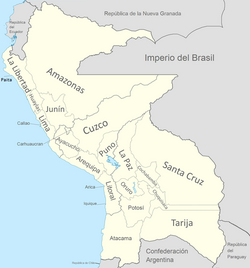
Key Facts
- Duration: 1836–1839.
- Constituent States: North Peru, South Peru, and Bolivia.
- Leader: Marshal Andrés de Santa Cruz (Supreme Protector).
- Capital: Tacna.
- Official Language: Spanish (with recognized regional languages including Quechua, Aymara, and Guarani).
- Estimated Population: Approximately 2,434,513 (1835–1836).
- Dissolution: Triggered by the Battle of Yungay and proclaimed by General Agustín Gamarra.
The Path to Unification
Political Chaos and Civil War
The roots of the Confederation lay in the Peruvian Civil War of 1834 and the subsequent Salaverry-Santa Cruz War (1835–1836). A power struggle erupted between the self-declared president Felipe Santiago Salaverry and constitutional president Luis José de Orbegoso. Orbegoso sought assistance from the president of Bolivia, Andrés de Santa Cruz, allowing Bolivian troops to enter Peru. Following Santa Cruz's victory in 1836, the groundwork for a unified state was laid.
The Assemblies of Sicuani and Huaura
Two key assemblies paved the way for the new political structure. The Sicuani Assembly (March 1836) represented southern regions and led to the recognition of South Peru as an independent state. Simultaneously, the Huaura Assembly (August 1836) established North Peru. By August 11, 1836, North Peru's constitution was promulgated, and Santa Cruz was named the Supreme Protector.
The Pact of Tacna
While the state existed de facto from October 28, 1836, its formal institutionalization occurred on May 1, 1837, through the Pact of Tacna. This agreement established the legal framework for the Confederation, though it was signed without significant debate and faced mixed reactions from its signatories, eventually leading to the creation of separate constituent congresses for each member state.
Government and Administration
The Confederation operated as a confederated presidential republic. At the top of the hierarchy was the Supreme Protector, who also remained the president of Bolivia. Each of the three states had its own provisional president.
Legislative Structure
The General Legislative Power consisted of two chambers: a Senate (15 members) and a Chamber of Representatives (21 members), with equal representation from each state. However, this body met only every two years for fifty days and was largely dependent on the Executive, making it a limited legislative authority.
| Constituent State | Key Administrative Divisions | Notable Leaders |
|---|---|---|
| North Peru | Lima, Callao, La Libertad, Junín, Amazonas, Huaylas | Luis Orbegoso, José de la Riva Agüero |
| South Peru | Arequipa, Cuzco, Puno, Ayacucho, Litoral | Ramón Herrera y Rodado, Pío de Tristán |
| Bolivia | La Paz, Potosí, Cochabamba, Santa Cruz, Oruro, Chuquisaca, Tarija | José Miguel de Velasco |
Conflict and Dissolution
Regional Hostility
The Confederation's rise created immediate tension with Chile and Argentina. Chile feared the union would disrupt the trade hegemony of the port of Valparaíso over Callao. Argentina entered a conflict with the Confederation after Bolivia annexed the disputed territory of Tarija in 1838. Both nations viewed Santa Cruz as a threat and supported dissidents in exile.
The Restoration Wars
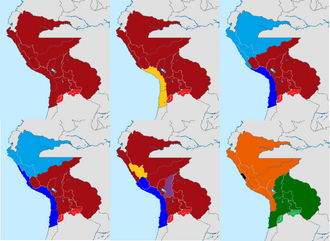
Chile launched two "Restorative Expeditions" to dismantle the union. The first ended in the Treaty of Paucarpata (1837), which was later repudiated by the Chilean government. The second expedition, led by Manuel Bulnes and supported by Peruvian restorationists under General Agustín Gamarra, proved decisive.
The conflict reached its climax at the Battle of Yungay on January 20, 1839. The Confederate forces were defeated, leading to the exile of Andrés de Santa Cruz. General Gamarra officially proclaimed the dissolution of the Confederation on August 25, 1839.
Frequently Asked Questions
Who was the primary leader of the Peru–Bolivian Confederation?
The primary leader was Marshal Andrés de Santa Cruz, who held the title of Supreme Protector and was also the president of Bolivia.
Why did Chile and Argentina oppose the Confederation?
Chile feared the Confederation would threaten its economic dominance in the South Pacific trade, while Argentina opposed it due to the annexation of Tarija and Santa Cruz's support for Argentine political dissidents.
What were the three constituent states of the union?
The union consisted of North Peru, South Peru, and the Bolivian Republic.
What event led to the final collapse of the Confederation?
The definitive blow was the Battle of Yungay on January 20, 1839, where the Confederate army was defeated by the United Restoration Army.
What was the significance of the Pact of Tacna?
The Pact of Tacna, signed on May 1, 1837, provided the formal legal framework and institutional structure for the operation of the Confederation.