Peafowl: The Biology, Evolution, and Cultural History of Nature's Most Ornate Birds
Peafowl are among the most visually striking birds in the animal kingdom, renowned for the extravagant plumage of the males. Belonging to the order Galliformes (heavy-bodied ground-feeding birds) and the family Phasianidae, these birds have captivated humans for millennia, serving as symbols of beauty, royalty, and divinity across various global cultures.
There are three primary species of peafowl. The blue or Indian peafowl is native to the Indian subcontinent, while the green peafowl hails from Southeast Asia. The third, the Congo peafowl, is found exclusively in the Congo Basin. While the Asiatic species are famous for their massive trains, the Congo peafowl differs significantly in its display habits and feather structure.
Key Facts

- Species: Three existing species: Indian, Green, and Congo peafowl.
- Sexual Dimorphism: Males (peacocks) possess ornate plumage; females (peahens) are typically dull grey or brown.
- The Train: The "tail" is actually composed of elongated covert feathers, not true tail feathers.
- National Symbol: The peacock was adopted as the national bird of India in 1963.
- Evolutionary Theory: A primary example of sexual selection and the "handicap principle."
Species and Physical Characteristics
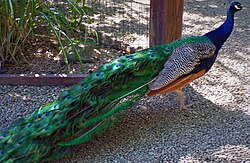
The most recognizable feature of the male Asiatic peafowl is the train—a magnificent array of covert feathers adorned with iridescent eyespots, known as ocelli. These are used in elaborate courtship rituals to attract females.
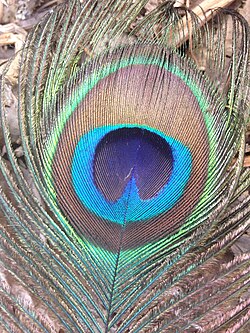
In contrast, the male Congo peafowl (Afropavo congensis) does not display covert feathers. Instead, he utilizes his actual tail feathers for courtship. These feathers are shorter than those of his Asiatic cousins, and the ocelli are far less pronounced. Across most species, females maintain a more muted coloration, which provides essential camouflage during nesting.
Iridescence and Coloration
The brilliant colors of a peacock's train are not produced by simple pigments but through structural coloration. This occurs when the microscopic structure of the feather interferes with light, creating an iridescent effect that changes based on the angle of view and the light source.
Courtship and Behavioral Biology
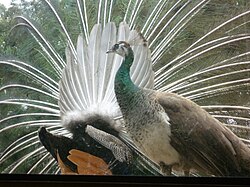
The courtship ritual of the peacock is a precise interaction of light and positioning. When a peahen approaches, she often stops directly in front of the male, allowing her to assess him at a 90-degree angle to the feather surface. The peacock then positions himself approximately 45 degrees to the right of the sun's azimuth, a move that maximizes the iridescence of his train.

If the peahen is interested, the male turns to face her and shivers his train, creating a rhythmic vibration that signals his readiness to mate.
Evolutionary Perspectives
The peacock's train has long been a subject of scientific debate. Charles Darwin proposed in The Descent of Man that such plumage evolved through sexual selection, where females choose mates based on specific ornamental traits regardless of whether those traits aid in survival.
Some biologists, such as Amotz Zahavi, argued that the train serves as a "handicap." Because a long, heavy train makes the bird more vulnerable to predators and harder to fly, a male that survives despite this burden proves he possesses superior genes and strength.

Genetic Variations
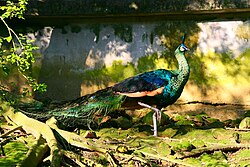
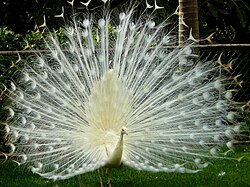
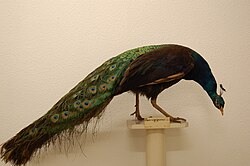
Not all peafowl follow the standard color pattern. The "black-shouldered" or Japanned mutation results in a melanistic adult male with black wings. While once thought to be a separate species, Charles Darwin provided evidence that this is a variety resulting from domestication and genetic variation rather than a distinct wild species.
Cultural and Historical Significance
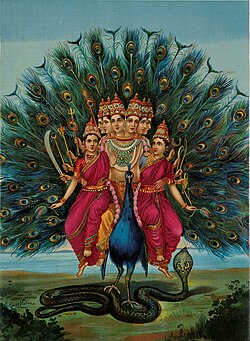
Peafowl have held deep symbolic meaning across diverse civilizations. In India, the bird is a national symbol and is associated with the god Kartikeya, who is often depicted with a peacock mount.
In the Middle East, the peacock appears in Yazidism (specifically the Peacock Angel, Malak-Tāwūs) and Mandaeism. In Western history, the peacock was a motif in Ancient Greece and later revived during the Renaissance in iconography linking the goddesses Hera and Juno.
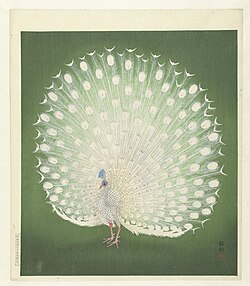
In the modern era, the peacock became a corporate icon. In 1956, NBC adopted a brightly colored 11-feathered peacock logo to promote the rise of color television broadcasting. This was later updated to a six-feathered version in 1986.
Gastronomy
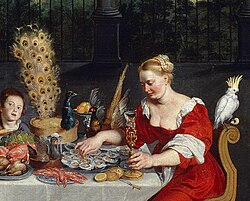
Historically, peafowl were considered a delicacy in Ancient Rome, introduced around 35 B.C. However, not everyone was impressed; the poet Horace famously ridiculed the practice, claiming that peafowl simply tasted like chicken. Similarly, Gaius Petronius mocked the snobbery associated with eating peafowl and their eggs in the Satyricon.
Summary of Peafowl Species
| Species | Native Region | Primary Display Feature | Female Coloration |
|---|---|---|---|
| Indian Peafowl | Indian Subcontinent | Long covert feather train with ocelli | Dull grey/brown |
| Green Peafowl | Southeast Asia | Long covert feather train with ocelli | Dull grey/brown |
| Congo Peafowl | Congo Basin | Short actual tail feathers | Dull grey/brown |
Frequently Asked Questions
Is the peacock's train actually its tail?
No. The extravagant "tail" seen in Indian and Green peafowl is actually composed of elongated covert feathers. The true tail feathers are shorter and located underneath the train.
Why are peahens not colorful?
Peahens are typically dull grey or brown to provide camouflage. This is a survival mechanism that protects them and their eggs from predators while nesting on the ground.
How do peacocks create their iridescent colors?
The colors are created through structural coloration. Microscopic structures in the feathers interfere with light, reflecting specific wavelengths to create a shimmering, iridescent effect that changes with the angle of light.
What did the Romans think of eating peacock?
While served as a luxury delicacy to show off wealth and status, some Roman writers like Horace and Petronius mocked the practice, suggesting the meat tasted like common chicken and the habit was merely an act of snobbery.
What is the "handicap principle" in peafowl evolution?
The handicap principle suggests that the peacock's train is an honest signal of fitness. Because the train is cumbersome and attracts predators, only the healthiest and strongest males can afford to maintain such a handicap and still survive.