Phasianidae: The Diverse World of Pheasants, Partridges, and Peafowl
The Phasianidae are a family of heavy-bodied, ground-dwelling birds known for their striking plumage and significant role in both nature and human agriculture. This expansive group includes some of the most recognizable birds on Earth, ranging from the iridescent peafowl and the elusive pheasant to the common domestic chicken. With 185 extant species across 54 genera, they represent the largest branch of the order Galliformes.
From a biological perspective, these birds are terrestrial specialists. While they possess wings, their anatomy is optimized for life on the ground, featuring powerful legs and a plump build. Their diversity in size is remarkable; the king quail measures a mere 12.5 cm in length, while the green peafowl can reach up to 300 cm when including its elongated train.
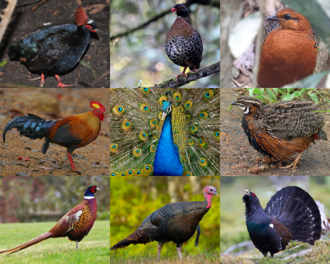
Key Facts
- Species Count: 185 extant species divided into 54 genera.
- Temporal Range: They have existed since the late Oligocene epoch, approximately 30 million years ago.
- Global Impact: Includes the domestic chicken, the world's most abundant bird subspecies with a population exceeding 26.5 billion as of 2023.
- Taxonomy: Divided into two primary subfamilies: Rollulinae and Phasianinae.
- Physical Range: Weights vary from 43 g (king quail) to over 17 kg (wild turkey).
Physical Characteristics and Anatomy
Phasianids are characterized by their terrestrial nature and robust builds. Most species exhibit sexual dimorphism, where males are typically larger and more colorful than females. This is particularly evident in larger species, where males often sport facial ornaments such as combs, wattles, or crests to attract mates.
A defining feature of many phasianids is the presence of spurs on their legs. While junglefowl, pheasants, turkeys, and peafowl have prominent spurs, others like grouse and quails have reduced or no spurs at all. Their bills are short and compact, an adaptation specifically useful for species that dig into the earth for food, such as the Mearns quail.
Distribution and Habitat
While primarily an Old World family, Phasianidae are found across a vast geographical range. They inhabit most of Europe, Asia, and Africa (excluding the driest deserts), and extend into eastern Australia. However, certain groups have specific distributions:
- Meleagridini (Turkeys): Native to the New World.
- Tetraonini (Grouse): Found in circumpolar regions.
- Rollulinae: Restricted to the tropics of East and Southeast Asia and the mountains of Tanzania.
Most species are sedentary, though some, such as Old World quail and ptarmigans, undertake long migrations. Human intervention has also expanded their range; pheasants, in particular, have been introduced to the Americas, Europe, and Australia for hunting purposes.
Behavior and Ecology
Breeding strategies within Phasianidae vary significantly and often deviate from the monogamy common in other bird families. While some African francolins are monogamous, many pheasants and junglefowl are polygamous. Peacocks are known for their elaborate breeding displays, which are similar to a lek (a communal area where males perform to attract females).
Nesting is almost exclusively a ground-based activity, with the exception of tragopans, which may nest in trees or bushes. A typical clutch consists of 7 to 12 eggs, though some species lay up to 20. Incubation usually lasts between 14 and 30 days and is primarily the responsibility of the hen, although males in species like the bobwhite quail may assist.
Relationship with Humans
The impact of Phasianidae on human civilization is profound. The red junglefowl of Southeast Asia is the wild ancestor of the domestic chicken, the most critical bird in global agriculture. Similarly, the wild turkey is the ancestor of the domestic turkey. Beyond food production, many species are managed as game birds for sport hunting, though human activity continues to threaten several wild species.
Systematics and Evolution
The classification of Phasianidae has evolved as molecular evidence has improved. Previously, the family was split into Phasianinae and Perdicinae. However, research revealed these groups were not monophyletic (descended from a single common ancestor). Current taxonomy recognizes two subfamilies: Rollulinae and Phasianinae.
The family name is derived from the genus Phasianus, which comes from the Greek phāsiānos, referring to the Phasis River (now the Rioni in Georgia), where the Argonauts encountered these birds.
| Subfamily | Key Groups/Tribes | Example Species |
|---|---|---|
| Rollulinae | Forest and Hill Partridges | Crested Partridge, Ferruginous Partridge |
| Phasianinae (Erectile clade) | Tetraonini, Phasianini, Lophophorini | Wild Turkey, Common Pheasant, Capercaillie |
| Phasianinae (Non-erectile clade) | Pavonini, Gallini, Coturnicini | Indian Peafowl, Red Junglefowl, Old World Quail |
Frequently Asked Questions
Which bird is the most abundant member of the Phasianidae family?
The domestic chicken (Gallus gallus domesticus) is the most abundant, with a global population exceeding 26.5 billion as of 2023.
How long has the Phasianidae family existed?
The earliest fossil records of phasianids date back to the late Oligocene epoch, approximately 30 million years ago.
What is the difference between the Rollulinae and Phasianinae subfamilies?
Rollulinae is a smaller group restricted mostly to the tropics of East/Southeast Asia and Tanzania, while Phasianinae is a much larger, more diverse group with a circumpolar range including the New World turkeys and grouse.
Do all Phasianidae birds have spurs on their legs?
No. While spurs are prominent in junglefowl, pheasants, and peafowl, they are reduced or entirely absent in quails, partridges, and grouse.
Are turkeys and grouse separate families?
While they were formerly treated as distinct families (Meleagrididae and Tetraonidae), they are now known to be deeply nested within the Phasianidae family.