Papiermark: The Story of Germany's Hyperinflation Currency
The Papiermark (literally "paper mark") serves as one of history's most stark reminders of economic instability. While formally the same German mark used since 1871, the term became a derisive label for the currency after it departed from the gold standard, eventually fueling one of the most extreme periods of hyperinflation in the early 20th century.
The descent began in August 1914, when Germany stopped issuing gold coins to cover the mounting debts of World War I. As precious metals vanished from circulation, the government relied on paper money, setting the stage for a currency collapse that would peak during the early years of the Weimar Republic.
Key Facts
- Peak Inflation: In October 1923, Germany experienced a monthly inflation rate of 29,500%.
- Extreme Denominations: Banknotes eventually reached face values as high as 100 trillion marks.
- Exchange Rate Collapse: The mark fell from 4.2ℳ︁ per US$1 in 1914 to 4.2 trillionℳ︁ per US$1 by late 1923.
- Replacement: The Papiermark was replaced by the Rentenmark in November 1923 at a rate of 1 trillion to 1.
- Issuing Authority: The primary central bank responsible for issuance was the Reichsbank.
The Path to Hyperinflation
Following the end of World War I, the value of the mark plummeted. The inflation rate accelerated rapidly, reaching its zenith in October 1923. To understand the scale of this collapse, one can look at the cost of a gold mark (containing 358 mg of pure gold). At the end of 1918, a gold mark cost 2ℳ︁; by November 30, 1923, it required 1 trillionℳ︁ to purchase a single gold mark.
This economic chaos was not limited to the mainland. In the Free City of Danzig, the Papiermark was issued from 1914 to 1923, with denominations eventually reaching 10 billion marks before being replaced by the Danzig gulden in October 1923.
Currency Denominations and Materials
As the currency lost value, the Reichsbank and other institutions, such as the Reichsbahn railway company, were forced to issue notes with ever-increasing face values. Before the war, the highest note was 1,000ℳ︁. By February 1923, 1-million-ℳ︁ notes appeared, and by October 1923, the 100-trillion-ℳ︁ note was introduced.
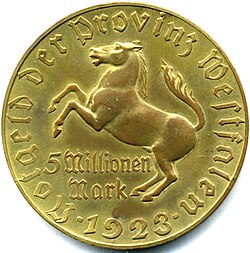
Coins also evolved to reflect the economic crisis. The government shifted from silver to cheaper metals, including aluminium, zinc, and iron. While silver 1/2ℳ︁ pieces were produced until 1919, later coins like the 200ℳ︁ and 500ℳ︁ pieces issued in 1923 were made of aluminium and varied significantly in quality.
Summary of Currency Evolution
| Period | Currency Name | Key Characteristic | Replacement/Successor |
|---|---|---|---|
| Pre-1914 | German Mark | Backed by Gold Standard | Papiermark |
| 1914–1923 | Papiermark | Hyperinflation / Paper-backed | Rentenmark |
| 1923–1924 | Rentenmark | Stabilization Currency | Reichsmark |
| Post-Aug 1924 | Reichsmark | Standardized National Currency | N/A |
The End of the Papiermark
Stability finally returned in November 1923 with the announcement of the Rentenmark. This new currency was introduced to halt the spiral of inflation. The exchange rate was set at 1 trillion Papiermark to 1 Rentenmark. By August 30, 1924, the Rentenmark was further succeeded by the Reichsmark, effectively closing the chapter on the Papiermark era.
Frequently Asked Questions
What was the Papiermark?
The Papiermark was the derisive name for the German mark after it left the gold standard in 1914, specifically during the hyperinflation period of 1922 and 1923.
How high did the banknote denominations go?
At the peak of hyperinflation in October 1923, the Reichsbank issued banknotes with face values as high as 100 trillion marks.
What caused the hyperinflation of 1923?
The inflation began when Germany stopped issuing gold-backed coins in 1914 to cover war debts with paper money, a process that accelerated uncontrollably during the early Weimar Republic.
What was the exchange rate between the Papiermark and the Rentenmark?
The Papiermark was replaced by the Rentenmark at a rate of 1 trillion Papiermark to 1 Rentenmark.
Which other countries have experienced worse monthly inflation than Germany in 1923?
Germany's October 1923 rate of 29,500% has been exceeded only by Yugoslavia (January 1994), Zimbabwe (November 2008), and Hungary (July 1946).