German Mark: The Gold Standard Currency of the Empire
The German mark (known retrospectively as the Goldmark) served as the official currency of the German Empire from 1871 to 1918. Established to unify a fragmented landscape of regional currencies, the mark provided the monetary stability necessary for a rising industrial power. It was divided into 100 pfennigs, a decimal system that simplified trade and accounting across the empire and its colonies.
From its inception in 1871 until the outbreak of World War I in 1914, the mark was anchored to the gold standard. This meant the currency was backed by physical gold, ensuring a stable exchange rate. However, in August 1914, the German Empire removed this gold backing to fund the war effort, leading to the cessation of gold coin circulation and setting the stage for future economic instability.
Key Facts
- Time Period: 1871 to 1918.
- Standard: Gold standard (1871–1914).
- Subunit: 100 pfennigs = 1 mark.
- Central Bank: The Reichsbank.
- Gold Value: 2,790 marks per 1 kilogram of pure gold.
- Successor: The Papiermark (Paper mark) of the Weimar Republic.
The Path to Monetary Unification
The creation of the mark was the result of decades of effort to harmonize the various currencies used by the German Confederation. Before the mark, the Zollverein (a customs union) had attempted to link Prussian and South German currencies. By 1857, the Vereinsthaler—a silver coin—became a primary bridge between different regional currencies, including the Austro-Hungarian florin and the South German gulden.
The formal transition began with a law on December 4, 1871, which defined the mark as one-tenth of a new imperial gold coin. By January 1, 1876, the mark and the Vereinsthaler became the only legal tender in Germany. This shift was funded in part by 5 billion gold francs secured from France following the Franco-Prussian War.
The adoption of the gold standard by Germany influenced the rest of Europe and North America, prompting the Latin Monetary Union to move from bimetallism (using both gold and silver) to a gold-only standard.
Coins and Denominations
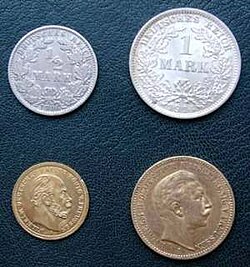
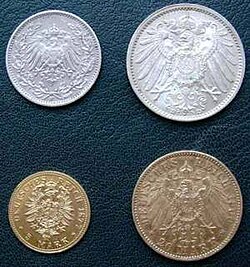
The German Empire employed a tiered system for its coinage. Small denominations (1 pfennig to 1 mark) featured standard designs used throughout the empire. In contrast, coins valued above 1 mark were issued by individual states. While the reverse of these coins always featured the Reichsadler (the imperial eagle), the obverse displayed the portrait of the local monarch or the coat of arms for free cities like Hamburg, Bremen, and Lübeck.
Base Metal and Silver Coins
Base metal coins were used for daily small transactions. The 1 and 2 pfennig coins were primarily copper, though the 1 pfennig shifted to aluminium during the latter stages of World War I. Silver coins, minted with .900 fineness, served as subsidiary currency. These included denominations from 20 pfennigs up to 5 marks, though they were only legal tender for payments up to 20 marks.
Gold Coinage
Gold coins were the prestige currency of the empire, minted in .900 fineness. The most common denominations were 10 and 20 marks. Because gold was so valuable, the government implemented a Passiergewicht (tolerance weight), allowing coins to be slightly underweight due to wear. If a coin fell below this threshold, it was withdrawn from circulation. This made weighing coins a routine part of business transactions.
Banknotes and the Shift to Paper
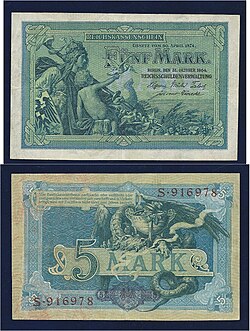
Banknotes were issued by three primary sources: the Imperial Treasury (as Reichskassenscheine), the Reichsbank, and various state banks. Treasury notes were available in 5, 10, 20, and 50 mark denominations, while the Reichsbank issued higher values, including 100 and 1,000 mark notes.
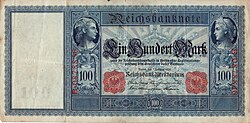
After 1914, as the gold backing vanished, these notes became known as Papiermark. Following the November Revolution of 1918 and the establishment of the Weimar Republic, the Papiermark suffered from catastrophic hyperinflation between 1918 and 1923, leading to a total loss of value.
Summary of German Mark Specifications
| Category | Details | Notes |
|---|---|---|
| Main Unit | Mark (ℳ) | Known as Goldmark retrospectively |
| Subunit | Pfennig (₰) | 100 Pfennig = 1 Mark |
| Gold Standard | 1 kg Gold = 2,790 Marks | Active 1871–1914 |
| Gold Coins | 5, 10, 20 Marks | Production ceased in 1915 |
| Silver Coins | 20pf, 1/2, 1, 2, 3, 5 Marks | Subsidiary currency |
| Banknotes | 5 to 1,000 Marks | Issued by Treasury and Reichsbank |
Frequently Asked Questions
What is the difference between the Goldmark and the Papiermark?
The Goldmark refers to the currency while it was backed by gold (1871–1914). The Papiermark refers to the currency after the gold backing was removed during World War I, which eventually led to hyperinflation during the Weimar Republic.
Who issued the coins in the German Empire?
Coins up to 1 mark were issued with standard imperial designs. Coins above 1 mark were issued by individual states, featuring the local monarch's portrait or a city's coat of arms on the front and the imperial eagle on the back.
How was the mark converted from older currencies?
The mark was equal to 1/3 of a Vereinsthaler. Other conversions included 1 South German gulden equaling 1.71 gold marks and 1 Bremen thaler equaling approximately 3.32 marks.
What happened to the WWI reparations denominated in gold marks?
Reparations were set in gold marks to prevent Germany from paying in depreciated paper currency. While the 1921 schedule cited 132 billion marks, the actual obligation was 50 billion. Germany paid 20 billion gold marks between 1920 and 1931 before payments were suspended. Debt principal was paid by 1980, and final interest was settled on October 3, 2010.