50 State Quarters: A Decade of American Numismatic History
Between 1999 and 2008, the United States Mint embarked on one of the most successful numismatic endeavors in history: the 50 State Quarters Program. This series of circulating commemorative coins transformed everyday pocket change into a traveling gallery of American heritage, celebrating the unique history and geography of each of the 50 states.
Authorized by Public Law 105-124 and enacted in late 1997, the program released five new designs every year. This systematic approach encouraged millions of Americans to engage in coin collecting, as citizens sought to complete their sets of the diverse designs released by the Mint.
The Origins of the Program
The concept for the 50 State Quarters was not an original American invention, but rather an adaptation of a successful Canadian model. In 1992, the Royal Canadian Mint released the "Canada 125" program to mark the 125th anniversary of the country's Confederation. This series, featuring 12 different designs for provinces and territories, sparked a massive revival of interest in coin collecting. Inspired by this success, American numismatists—people who study or collect currency—advocated for a similar series to honor the United States' own states.
Technical Specifications and Design
While the reverse designs changed annually, the fundamental physical properties of the quarters remained consistent for circulation. The standard composition for these coins is a cupronickel alloy consisting of 91.67% copper and 8.33% nickel. For collectors, the Mint also produced proof versions, which are higher-quality coins intended for collectors, featuring a composition of 90% silver and 10% copper.
Coin Dimensions and Characteristics
- Value: 0.25 US Dollar
- Mass: 5.67 g (Cu-Ni) or 6.25 g (Silver)
- Diameter: 24.26 mm (0.955 in)
- Thickness: 1.75 mm (0.069 in)
- Edge: 119 reeds
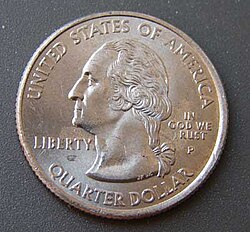
- Obverse Design: George Washington (based on the 1932 John Flanagan design)
The Evolution of the Series
The program followed a strict chronological release schedule based on the date of statehood. For example, Delaware, the first state to ratify the Constitution, was the first design released on January 1, 1999. The series concluded in 2008 with the release of the Hawaii and Alaska quarters.
Following the conclusion of the 50 State Quarters, the United States Mint expanded its commemorative efforts. In 2009, the District of Columbia and US Territories Program was launched under H.R. 2764. This program honored the District of Columbia and several territories, including Puerto Rico, American Samoa, Guam, the United States Virgin Islands, and the Northern Mariana Islands.
Summary of Program Data
| Program Phase | Years Active | Key Features |
|---|---|---|
| 50 State Quarters | 1999–2008 | 5 unique state designs released per year |
| DC & Territories | 2009–Present | Includes DC, Puerto Rico, Guam, and others |
| Mint Marks | Various | P (Philadelphia), D (Denver), S (San Francisco - Proof only) |
Key Facts
- The program was inspired by the 1992 "Canada 125" commemorative series.
- Each year, the Mint released five different designs.
- The obverse (front) of every quarter features George Washington.
- A rare "mule" error occurred in 2000, where a Sacagawea dollar reverse was paired with a state quarter obverse; only 19 specimens are known to exist.
- The series was authorized by Public Law 105-124.
Frequently Asked Questions
What is a "mule" in coin collecting?
A "mule" is a numismatic error that occurs when a coin is struck using two dies that were never intended to be used together. In 2000, a rare error produced a coin with the obverse of a state quarter and the reverse of a Sacagawea dollar.
How many states are represented in the series?
The series features unique designs for all 50 United States, released in groups of five per year from 1999 to 2008.
What is the difference between a standard quarter and a proof quarter?
Standard quarters are intended for general circulation and are made of a copper-nickel alloy. Proof quarters are specially struck for collectors, often featuring a higher silver content (90% silver) and a more polished finish.
Which territories were included after the 50 states?
The 2009 program included the District of Columbia, Puerto Rico, American Samoa, Guam, the United States Virgin Islands, and the Northern Mariana Islands.
Who designed the George Washington obverse?
The design is based on the 1932 version by John Flanagan, which was itself a modification of a 1786 bust by Houdon, with further modifications by William Cousin.