Panicles and Corymbs: Understanding Branched Inflorescences
In the study of botany, the arrangement of flowers on a plant is known as an inflorescence. These structures are not random; they follow specific geometric patterns that help botanists identify species and understand how plants reproduce. Among the most complex of these arrangements are branched inflorescences, specifically the panicle and the corymb.
What is a Panicle?
A panicle is defined as a much-branched inflorescence. While it may look similar to a compound spike, some botanical authors distinguish the two by requiring that the flowers and resulting fruit be pedicellate, meaning each flower is supported by its own single stem, or pedicel.
The architecture of a panicle is often composed of branches that are themselves racemes (unbranched clusters of flowers on a single stem). Depending on the species, a panicle may exhibit either determinate growth, where the tip stops growing once the flower forms, or indeterminate growth, where the main axis continues to grow.
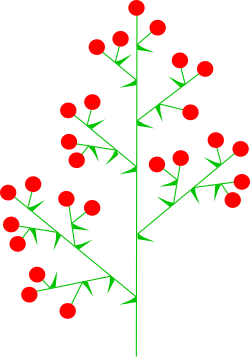
Common Examples of Panicles
This branching structure is a hallmark of many grasses, including oat and crabgrass. In these species, the basic unit is technically a spikelet, but the overall arrangement of these spikelets is described as a panicle. Beyond grasses, panicles are found in plants such as pistachio and mamoncillo.
The Term "Paniculate"
Botanists use the adjective paniculate in two distinct contexts. It can describe a plant that possesses a true panicle inflorescence, or it can be used more broadly to describe an inflorescence that has the general form of a panicle without necessarily sharing its exact internal structure.
The Corymb Structure
A corymb is another type of branched inflorescence that can exhibit a paniculate branching structure. The defining characteristic of a corymb is that the lower flowers have longer pedicels than the upper flowers. This variation in stem length pushes the flowers upward to create a flattish top, which superficially resembles an umbel (a cluster where all flower stalks spread from a single point).
Many species within the subfamily Amygdaloideae, including rowans and hawthorns, produce their flowers in corymbs.
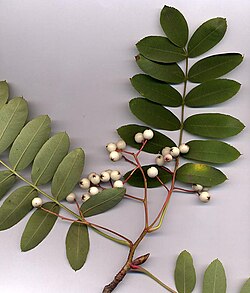
Key Facts
- Panicle: A highly branched inflorescence often consisting of racemes.
- Pedicellate: A requirement for some definitions of a panicle, meaning each flower has its own stem.
- Corymb: A flat-topped cluster where lower flower stalks are longer than upper ones.
- Grass Anatomy: While grasses have spikelets, their overall arrangement is often paniculate.
- Growth Patterns: Panicles can be either determinate or indeterminate.
Comparison of Inflorescence Types
| Type | Primary Characteristic | Growth Pattern | Example Plants |
|---|---|---|---|
| Panicle | Much-branched; often composed of racemes | Determinate or Indeterminate | Oat, Crabgrass, Pistachio |
| Corymb | Flat-topped; lower pedicels are longer | Paniculate branching | Hawthorns, Rowans |
| Thyrse | Branched; main axis is indeterminate | Branches are determinate | Various species |
Frequently Asked Questions
What is the difference between a panicle and a compound spike?
The primary distinction used by some authors is that a panicle must be pedicellate, meaning each flower or fruit is attached to the branch by its own individual stem.
How does a corymb differ from an umbel?
While both appear flat-topped, a corymb achieves this shape because the lower flower stalks are longer than the upper ones, whereas an umbel has stalks that all originate from a single point.
What does it mean for a plant to be "paniculate"?
A plant is paniculate if it has a true panicle inflorescence or if its inflorescence simply resembles the form of a panicle regardless of its specific structure.
Which plant families commonly feature these structures?
Panicles are characteristic of grasses (like oat) and certain fruit trees (like pistachio), while corymbs are common in the Amygdaloideae subfamily, including rowans and hawthorns.