Palistin: The Mysterious Neo-Hittite Kingdom of the Iron Age
In the wake of the Late Bronze Age collapse, the political landscape of the ancient Near East shifted dramatically. Among the successor states that emerged from the ruins of the Hittite Empire was Palistin (also referred to as Walistin), an early Neo-Hittite kingdom. Located in what is now northwestern Syria and the southeastern Turkish province of Hatay, this enigmatic state provides a crucial link in understanding the transition between the Bronze and Iron Ages.
Palistin existed roughly between the 11th and 9th centuries BC. While it remained a relatively obscure entity for years, the discovery of several inscriptions mentioning King Taita has confirmed its historical existence and territorial reach.
Key Facts
- Time Period: 11th century BC to 9th century BC (Iron Age).
- Location: Northwestern Syria and Hatay, Turkey.
- Capital: Likely Kinalua (identified with Tell Tayinat).
- Language: Luwian.
- Government: Absolute monarchy.
- Key Figure: King Taita and Queen Kupapiya.
The Rise and Reach of Palistin
Palistin emerged as a Neo-Hittite state—a group of kingdoms that maintained Hittite cultural and linguistic traditions after the central empire fell. The kingdom encompassed a significant territory, stretching from the Amouq Valley in the west to Aleppo in the east, and extending south to Mhardeh and Shaizar.
Historians, including Professor Itamar Singer, suggest that Palistin may have been a predecessor state. Upon its eventual disintegration, it likely gave rise to several smaller kingdoms, including Hamath, Bit Agusi, and Pattin (which is believed to be a shortened form of Palistin).
Archaeological Evidence and Discoveries
Much of what is known about Palistin comes from epigraphic evidence—inscriptions carved into stone. A pivotal site is Tell Tayinat in Turkey's Hatay province. Excavations here revealed an Iron Age Neo-Hittite city built atop an earlier Bronze Age Aegean farming community. An inscription found at this site in 1936 explicitly mentions the land as Walistin.
Other critical finds include the Sheizar Stele, a funerary monument for Queen Kupapiya, the wife of King Taita, and another stele in Meharde that may be Taita's own funerary monument. Both monuments invoke a "divine Queen of the Land," potentially the goddess Kubaba.
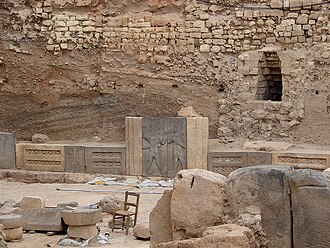
One of the most significant discoveries occurred in 2003, when German archaeologist Kay Kohlmeyer uncovered a statue of King Taita in the Citadel of Aleppo, featuring an inscription written in Luwian (an Indo-European language related to Hittite).
The Controversial Link to the Philistines
A subject of intense scholarly debate is whether Palistin is connected to the Philistines. The phonetic similarity between Palistin/Walastin and terms like the Egyptian Peleset and the Hebrew Plištim has led some researchers, such as Benjamin Sass and Kay Kohlmeyer, to hypothesize a connection. Some suggest that Kinalua may have been part of a Philistine urheimat (original homeland).
Gershon Galil has gone further, suggesting that King David's alliance with the southern Philistine kings and Toi, king of Hamath (identified as Taita II of Palistin), helped halt Aramean expansion into Israel. Galil points to eight inscriptions indicating a large kingdom that included Aleppo, Hamath, and Carchemish.
However, this theory remains controversial. Hittitologist Trevor Bryce argues that the link is merely a hypothesis requiring more evidence. Archaeological data from Tell Tayinat supports a typical Luwian state; the pottery used by the Neo-Hittite inhabitants (red slipped burnished ware) differs entirely from the Aegean-type pottery of the earlier settlers. While some Philistines may have settled in Kinalua, evidence suggests they were eventually assimilated into the indigenous Luwian population.
| Attribute | Details |
|---|---|
| Era | Iron Age (11th–9th Century BC) |
| Region | Northwestern Syria / Southeastern Turkey |
| Primary Language | Luwian |
| Key Ruler | King Taita |
| Successor States | Pattin, Hamath, Bit Agusi |
| Key Archaeological Site | Tell Tayinat (Kinalua) |
Frequently Asked Questions
What was Palistin?
Palistin was a Neo-Hittite kingdom that existed during the Iron Age in northwestern Syria and southeastern Turkey, emerging after the collapse of the Hittite Empire.
Who was King Taita?
King Taita was the most prominent ruler of Palistin, known through various inscriptions and a statue discovered in the Citadel of Aleppo.
Is Palistin the same as the land of the Philistines?
This is a subject of academic debate. While some scholars suggest a link based on the similarity of the names (Palistin vs. Peleset/Plištim), others argue that the material culture of Palistin is predominantly Luwian and Neo-Hittite.
What language did the people of Palistin speak?
The inscriptions found in the region, including those of King Taita, are written in Luwian, a language closely related to the Hittite language.
Where was the capital of Palistin located?
It is widely believed that the capital was Kinalua, which corresponds to the archaeological site of Tell Tayinat in the Hatay province of Turkey.