Paleolithic Age: The Dawn of Human Technology and Culture
The Paleolithic, commonly known as the Old Stone Age, represents the vast majority of human prehistoric history. Spanning from the earliest known use of stone tools by hominins approximately 3.3 million years ago to the end of the Pleistocene epoch around 11,650 cal BP, this era marks the fundamental development of human technology, social structures, and artistic expression.
During this immense stretch of time, early humans lived in small, nomadic societies known as bands. These groups subsisted through a combination of gathering plants, fishing, and hunting or scavenging wild animals. While stone tools—created through a process called knapping (striking stone to create sharp edges)—are the era's namesake, prehistoric people also utilized wood, bone, leather, and vegetable fibers to navigate their changing environments.
Key Facts
- Duration: From roughly 3.3 million years ago to 11,650 years ago.
- Core Technology: Development of knapped stone tools, including Oldowan and Acheulean industries.
- Human Evolution: Includes the eras of Homo erectus, Homo neanderthalensis, and the emergence of Homo sapiens.
- Social Structure: Small, nomadic bands of families that occasionally formed larger "macrobands."
- Global Expansion: Humans reached Australia by 50,000–40,000 BP and eventually crossed Beringia into the Americas.
Paleogeography and the Pleistocene Epoch
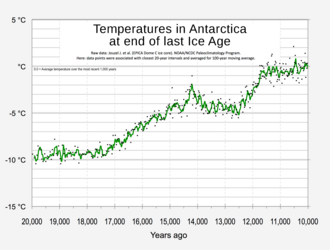
The Paleolithic overlaps significantly with the Pleistocene epoch, a geologic period characterized by major climatic shifts and geographic changes. The relationship between these two timelines is complex; while the Paleolithic began much earlier, both reached their conclusion roughly 12,000 years ago. These climatic fluctuations profoundly influenced human migration and survival strategies.
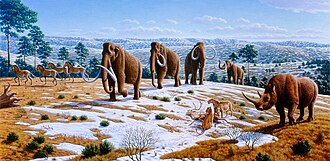
The landscape of the Pleistocene was often dominated by massive fauna. The mammoth steppe, for example, was inhabited by a variety of giant mammals, including woolly mammoths, woolly rhinoceroses, and cave lions.
| Time Period (Years Ago) | America | Atlantic Europe | Mediterranean Europe | Central Europe |
|---|---|---|---|---|
| 10,000 | Flandrian interglacial | Flandrian interglacial | Versiliense | Flandrian interglacial |
| 80,000 | Wisconsin | Devensiense | Regresión | Wisconsin Stage |
| 140,000 | Sangamoniense | Ipswichiense | Tirreniense II y III | Eemian Stage |
| 450,000 | Yarmouthiense | Hoxniense | Tirreniense I | Hoxnian Stage |
Human Evolution and Migration
The Paleolithic saw the rise and fall of several distinct hominin species. Homo erectus was among the early colonists of Eurasia. Around 500,000 years ago, a group often referred to as Homo heidelbergensis migrated from Africa to Europe, eventually evolving into Homo neanderthalensis (Neanderthals).

While Neanderthals occupied much of Europe, including regions like modern-day Poland, they eventually became extinct. They were succeeded by anatomically modern Homo sapiens sapiens, who emerged in eastern Africa around 300,000 years ago. As Homo sapiens expanded globally, they coexisted and interbred with other groups, such as Neanderthals and Homo sapiens denisova.
Human expansion was remarkable. By 50,000–40,000 BP, humans had reached Australia. By 30,000 BP, they had reached Japan, and by 27,000 BP, they were living in Siberia above the Arctic Circle. Eventually, these populations crossed Beringia to inhabit the Americas.

Technological Advancements and Craftsmanship
The Evolution of Stone Tools
Tool-making technology progressed from the simple Oldowan industry (starting c. 2.6 million years ago) to the more sophisticated Acheulean industry, which was pioneered by Homo ergaster. Later, Middle Paleolithic toolkits, such as the Mousterian and Aterian industries, offered even greater complexity.

Inventions and Domestication
As the Upper Paleolithic progressed, human ingenuity led to a surge in specialized tools. Innovations included the net, the bolas, the spear thrower, and the bow and arrow. There is also evidence suggesting that Homo erectus may have utilized rafts to cross large bodies of water, a hypothesis that points to advanced cognitive abilities.
![An artist's rendering of a temporary wood house, based on evidence found at Terra Amata (in Nice, France) and dated to the Lower Paleolithic (c. 400,000 BP)[20]](/images/e9/1d/e91ddd76548c54770bc4a879ff4bb2fc4df9faac119d08967d3966cacf027aeb.gif)
Domestication also began to take root. While some evidence suggests dogs may have been domesticated as early as 100,000 years ago, more definitive evidence places dog domestication between 30,000 and 14,000 BP. In the late Upper Paleolithic, some European cultures even practiced early animal husbandry, such as raising reindeer for meat and milk.
![People may have first fermented grapes in animal skin pouches to create wine during the Paleolithic age.[57]](/images/27/e2/27e29f6d7a7b4d8659d4d4928d957c7aced2123aaaf645f96b9cf34f162b3c71.jpg)
Social Life, Art, and Beliefs
Paleolithic societies were highly interconnected. As early as 120,000 years ago, Middle Paleolithic humans engaged in long-distance trade for rare commodities like ochre or raw materials for toolmaking. This trade likely served as a survival mechanism during times of scarcity.
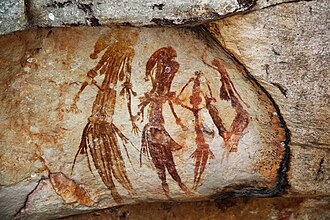
Artistic expression flourished, particularly in the Upper Paleolithic. Cave paintings, engravings, and figurines provide a window into their world. These works often depicted animals or symbolic figures, such as the famous Venus figurines or half-human, half-animal beings that some archaeologists believe represent early shamanic practices.



Frequently Asked Questions
What were the main types of tools used in the Paleolithic?
The primary tools were knapped stone implements. Early industries included the Oldowan (choppers and awls) and the Acheulean (more complex tools). Later, humans developed projectile points, engraving tools, and drilling tools made from stone, bone, and wood.
How did Paleolithic people organize their societies?
Most people lived in small, nomadic bands consisting of several families. These bands typically ranged from 20 to 100 members. Occasionally, they would form larger "macrobands" for social celebrations or to access abundant resources.
When did humans first begin to migrate globally?
Migration occurred in waves. Humans reached Australia between 50,000 and 40,000 years ago, moved into Europe and Japan by 45,000–30,000 years ago, and eventually expanded into the Americas after crossing Beringia.
Did Paleolithic humans engage in trade?
Yes. Evidence suggests that as early as 120,000 years ago during the Middle Paleolithic, humans participated in long-distance trade for raw materials and rare commodities like ochre to ensure survival during periods of scarcity.
What is the difference between the Paleolithic and the Pleistocene?
The Paleolithic refers to a period of human technological development (the Old Stone Age), while the Pleistocene refers to a geologic epoch characterized by specific climatic conditions and ice ages. The Paleolithic overlaps with the Pleistocene.