Organisation Consul: The Militant Shadow Network of the Weimar Republic
Between 1920 and 1922, the fragile democracy of the Weimar Republic was haunted by a secret, violent force known as the Organisation Consul (O.C.). This ultra-nationalist and antisemitic militant group operated as a shadow army, dedicated to the total destruction of the German Republic and its replacement with a right-wing dictatorship. Comprised largely of former soldiers and officers, the O.C. utilized terror and targeted assassinations to destabilize the state from within.
Key Facts
- Founded: 1920 by Hermann Ehrhardt.
- Ideology: Far-right ultranationalism and antisemitism.
- Personnel: Approximately 5,000 members.
- Primary Goal: Overthrow the Weimar Constitution and install a dictatorship.
- Notable Victims: Matthias Erzberger and Walther Rathenau.
- Dissolved: Banned by the German government on July 21, 1922.
Origins and the Legacy of the Freikorps
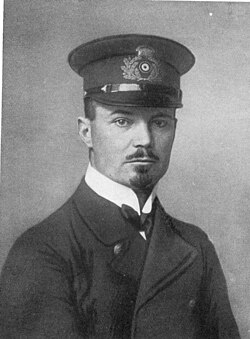
The Organisation Consul emerged from the remnants of the Freikorps—paramilitary units composed of World War I veterans. Specifically, it was formed by members of the Marine Brigade Ehrhardt after the government disbanded the brigade in 1920 due to its involvement in the Kapp Putsch, an attempted coup against the republic.
The group was named after a pseudonym, "Consul Eichmann," used by its leader, Hermann Ehrhardt. While it began partly as a way for former brigade members to maintain their professional and personal contacts, it quickly evolved into a militarily organized cadre. The O.C. recruited heavily from front-line officers of the Imperial German Army and Navy. Interestingly, the Reich government and military leadership initially tolerated the group, hoping these associations could help Germany bypass the arms restrictions imposed by the Treaty of Versailles.
Organizational Structure and Ideology
Operating out of Munich, the O.C. maintained a sophisticated network of liaison officers and seven main districts, including Berlin, Hamburg, and Frankfurt am Main. To mask its illegal activities, the group established a front company called the Bavarian Wood Products Company. This operation was managed by Alfred Hoffmann, Ehrhardt's chief of staff, and employed roughly 30 full-time staff.
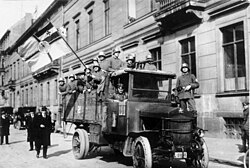
The membership was strictly limited to men of "German descent," typically aged between 20 and 30. Their ideology was rooted in a violent opposition to Marxism, social democracy, and Judaism. The O.C. also practiced Feme murders—extrajudicial killings of individuals, including their own members, who were suspected of betraying the cause.
Strategic Goals and Funding
The O.C.'s overarching strategy was to provoke the political left into an uprising. They believed that once a leftist revolt occurred, the Reichswehr (the national army) would step in to suppress it, creating a power vacuum that the O.C. could use to crush the Republic and install a dictatorship. To fund these operations, the group engaged in illegal arms trafficking, even dealing with the Irish Republican Army.
Financial support also flowed from wealthy industrialists, members of the nobility, and high-ranking military figures who shared Ehrhardt's desire for a violent political transformation.
A Campaign of Political Terror
The Organisation Consul is most infamous for its role in political assassinations. Their targets were typically figures associated with the Republic's legitimacy or those who had negotiated the end of World War I.
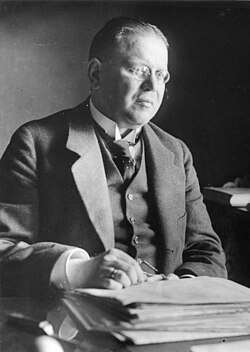
On August 26, 1921, the group murdered Matthias Erzberger, a former finance minister and signer of the WWI armistice. Although 34 members were arrested, most were released due to a lack of evidence proving the O.C. acted as a formal organization in the crime.
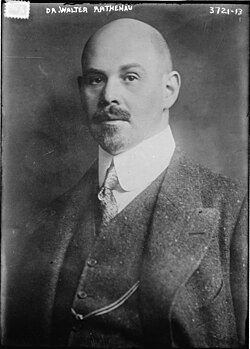
The violence escalated on June 24, 1922, with the assassination of Foreign Minister Walther Rathenau. This act, along with the attempted murder of Philipp Scheidemann using prussic acid, signaled the peak of the O.C.'s campaign of terror. Some historians suggest that the O.C. was involved in nearly every political murder occurring in Germany between 1918 and 1922.
The Ban and Aftermath
The assassination of Rathenau proved to be the breaking point. On July 21, 1922, the German government enacted the Law for the Protection of the Republic, which officially banned the Organisation Consul. Following the ban, the group's remnants formed the Viking League.
Despite the O.C.'s earlier rivalry with Adolf Hitler and the NSDAP, many of its members were later absorbed into the Nazi regime's security apparatus. Former O.C. members were assigned to the Schutzstaffel (SS) and celebrated as "heroes of the national resistance." Notable members like Julius Schreck and Joseph Berchtold became key figures in the early development of the SS and the Sturmabteilung (SA).
| Attribute | Details |
|---|---|
| Leader | Hermann Ehrhardt |
| Preceded by | Marine Brigade Ehrhardt |
| Succeeded by | Viking League |
| Headquarters | Munich, Germany |
| Key Targets | Matthias Erzberger, Walther Rathenau |
| Funding Sources | Industrialists, Nobility, Arms Trafficking |
Frequently Asked Questions
What was the primary goal of the Organisation Consul?
The primary goal was to destroy the Weimar Republic and replace its democratic constitution with a right-wing dictatorship through a combination of political assassinations and the provocation of civil unrest.
How did the Organisation Consul fund its activities?
The organization was funded through illegal arms trafficking (including deals with the Irish Republican Army) and financial contributions from wealthy industrialists, nobility, and military figures who opposed the Republic.
Who were the most prominent victims of the O.C.?
The most prominent victims were Matthias Erzberger, a former finance minister, and Walther Rathenau, the German Foreign Minister.
What happened to the members after the group was banned?
Many members joined the successor organization, the Viking League. Later, during the Nazi era, many were integrated into the SS and SA, where they were regarded as early pioneers of the national resistance.
What were 'Feme murders'?
Feme murders were extrajudicial killings carried out by the O.C. against individuals—including their own members—who were perceived as traitors to the nationalist cause.