Freikorps: The Right-Wing Paramilitaries of the Weimar Republic
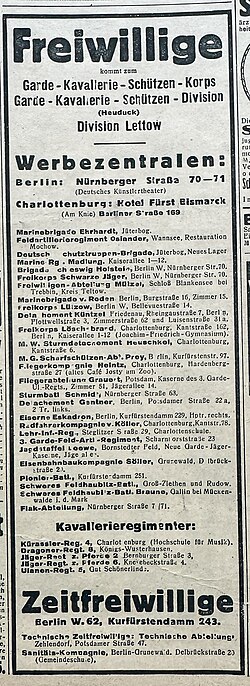
In the chaotic wake of World War I and the German Revolution of 1918–19, a series of right-wing paramilitary militias known as the Freikorps emerged. Composed primarily of demobilized soldiers, young men, and conservative nationalists, these units were driven by a fervent hatred of socialists and communists, whom they blamed for Germany's collapse and subsequent hardships.
While they were officially mustered to protect the fragile Weimar government, the Freikorps often harbored a deep contempt for the democratic Republic they served. This duality made them a volatile force, acting as both the government's sword against leftist uprisings and a breeding ground for the radical ideologies that would eventually fuel the rise of the Nazi Party.
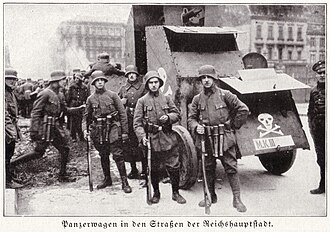
Key Facts
- Membership: Approximately 500,000 formal members and 1.5 million informal participants.
- Primary Role: Suppressing communist and socialist revolts during the early Weimar Republic.
- Key Figures: Used extensively by Minister of Defence Gustav Noske.
- Ideology: Conservative nationalism, anti-Marxism, and anti-Slavic racism.
- Legacy: Provided a training ground and personnel for future high-ranking Nazi leaders.
The Interwar Rise and Domestic Conflict
Following the defeat of 1918, the term Freikorps evolved to describe loosely affiliated paramilitary organizations. The tenuous government led by Friedrich Ebert of the Social Democratic Party (SPD) found itself unable to maintain order and turned to these militias to quell internal unrest.
Minister of Defence Gustav Noske relied heavily on the Freikorps to crush the Spartacist uprising, a Marxist revolt. This campaign culminated in the summary executions of revolutionary leaders Karl Liebknecht and Rosa Luxemburg on January 15, 1919.
The Bavarian Soviet Republic
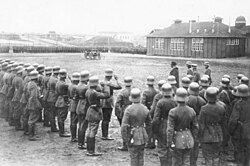
Between April 12 and May 3, 1919, a short-lived socialist-communist state known as the Bavarian Soviet Republic was established. In response, Noske dispatched roughly 30,000 Freikorps troops to Bavaria. This force included several notable brigades, such as Hermann Ehrhardt's second Marine Brigade and the large force commanded by Colonel Franz Ritter von Epp, to dismantle the unrecognized state.
Campaigns in Eastern Europe
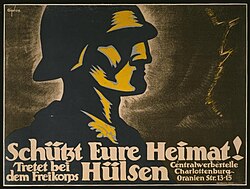
The Freikorps extended their operations beyond German borders, fighting Bolsheviks and communists in East Prussia, Latvia, Silesia, and Poland. In these regions, the militias operated with significant autonomy, often ignoring orders from the official German army, the Reichswehr.
Their campaigns in the East were characterized by extreme anti-Slavic racism. Viewing Slavs as "sub-human," the Freikorps engaged in widespread atrocities. Historian Nigel Jones notes that violence was unrestrained in foreign lands; for example, 500 Latvian civilians were massacred on suspicion of Bolshevik sympathies, and approximately 3,000 people were slaughtered during the capture of Riga.
Decline and the "Black Reichswehr"
The autonomy of the Freikorps eventually became a liability for the state. After the failed Kapp-Lütwitz Putsch in March 1920—an attempted coup in which the Freikorps participated—the government moved to curb their power. Hans von Seeckt, commander of the Reichswehr, purged Freikorps members from the army and restricted their funding.
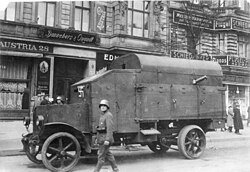
However, the Reichswehr continued to use the Freikorps clandestinely to bypass the manpower limits imposed by the Treaty of Versailles. In 1923, von Seeckt organized Arbeits-Kommandos (AKs), or "civilian work groups." Known as the Black Reichswehr, these units consisted largely of ex-Freikorps members and reached a peak strength of 20,000 men. This shadow army was disbanded after a failed putsch at Küstrin on October 1, 1923.
Connection to the Nazi Party
The Freikorps served as a critical precursor to the Third Reich. Many future Nazi leaders honed their skills and ideologies within these units. Notable examples include:
- Reinhard Heydrich: Served in Maercker's Freikorps as a teenager.
- Heinrich Himmler: Enlisted in the Freikorps and later carried a flag in the Beer Hall Putsch.
- Rudolf Höss: Joined the East Prussian Volunteer Freikorps before becoming the commander of Auschwitz.
- Martin Bormann: Served as a section leader and quartermaster in Roßbach's Freikorps.
While these high-ranking officials had Freikorps roots, research suggests that former members were not statistically more likely to join the Nazi Party than the average German male of the era.
Summary of Notable Freikorps Units
| Unit Name | Key Actions / Notable Members | Outcome/Fate |
|---|---|---|
| Volunteer Division of the Horse Guards | Executed Rosa Luxemburg and Karl Liebknecht | Disbanded July 1919 |
| Marinebrigade Ehrhardt | Participated in the Kapp Putsch | Members formed Organisation Consul |
| Freikorps Epp | Members included Rudolf Hess and Hans Frank | Active in Bavaria |
| Iron Division | Fought in the Baltics | Defeated at the Battle of Cēsis |
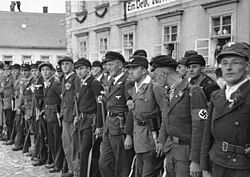
| Sudetendeutsches Freikorps | Operated 1938–1939 in Czechoslovakia | Aided Nazi absorption of territory |
Frequently Asked Questions
What were the Freikorps?
The Freikorps were right-wing paramilitary militias formed in Germany after World War I. They consisted of demobilized soldiers and nationalists who fought against communist and socialist uprisings during the early years of the Weimar Republic.
Did the German government support the Freikorps?
Yes, the Weimar government, specifically Minister of Defence Gustav Noske, used the Freikorps to suppress leftist revolts like the Spartacist uprising and the Bavarian Soviet Republic, despite the militias' own hatred for the democratic Republic.
How did the Freikorps relate to the Nazi Party?
Many future Nazi leaders, including Heinrich Himmler and Reinhard Heydrich, were former Freikorps members. The units provided a culture of political violence and anti-Marxism that aligned with later Nazi ideology.
What was the "Black Reichswehr"?
The Black Reichswehr consisted of Arbeits-Kommandos (civilian work groups) made up of ex-Freikorps members. They were used by the Reichswehr to secretly exceed the 100,000-man army limit set by the Treaty of Versailles.
Where did the Freikorps fight outside of Germany?
They were active in Eastern Europe, specifically in Latvia, Poland, and East Prussia, where they fought Bolsheviks and engaged in severe atrocities against civilian populations.